


The pressure's been building and I've got to vent . . ..


Thread Starter
1st Generation Admin
Joined: Jan 2005
Posts: 4,601
Likes: 118
From: Buies Creek, NC
The way I see it, most crankcase gases first come through the lifter-valley*, from there, they can be vented via the stock/OEM pipe out the side cover, and/or go up with the push-rods and out the fancy valve-covers.
* The 24v vent that mounts in place of our stock/OEM oil fill, those gases come by way of around the crankshaft's snout (I think).
- Considering the way the gases are vented, any entrained oil mist is gonna be most apparent with our stock/OEM vent. It has the simplest (least efficient at catching oil mist) baffling of all the methods. . . .
- Considering the way I currently have my two vent pipes connected. . ..
- Considering that checking the two hoses as they are finds the hose from the valve-covers is dry and the other isn't.
I can reroute the valve-cover vent hose to the engine's cold-air intake (pre-filter). It should at least have the engine consume those vapors presented there by default. Any make-up air required other than that provided by blow-by will be provided by the other hose. (See below sentence).
The other hose that connects the OEM and 24v vents will remain dumping under the cab, but will have one of those dinky K&N type filters there.
At idle, the stink'in "Diesel Sweat" smell should be pulled for the most part into the engine. With more throttle (and more blow-by), any gases not put to the engine's intake will go out under the cab.
Maybe?


366 Spring Chicken
Joined: May 2008
Posts: 2,105
Likes: 3
I would be worried about putting to much base pressure in the intake. That is a good way to run away. Marine engines have a special filter system so the oil does not get to the motor. I bet it would plug air filters pretty quick.

Adminstrator-ess

Joined: Mar 2003
Posts: 22,594
Likes: 19
From: New Holland, PA
It does not seem to be an issue on Mercedes and GM diesels. If it's a concern a CDR valve from a GM diesel could be installed to keep the crankcase from seeing too much vacuum.
I'm not really fond of venting the crankcase to the intake, but other than making an oily mess inside the intake system it does not seem to cause any trouble at all. If somebody wants to do it I would not argue against it.
I'm not really fond of venting the crankcase to the intake, but other than making an oily mess inside the intake system it does not seem to cause any trouble at all. If somebody wants to do it I would not argue against it.

Registered User
Joined: Mar 2008
Posts: 47
Likes: 0
From: Falcon, CO
originally I thought about going post-turbo but then the boost would reverse the flow...sending 40 psi into the crankcase and the dipstick through the radiator...so that ain't good. But I'm not sure I'd want to have the oil particles coating the inside of the plumbing either.....but I really dislike the fresh oil smell.....hmmmmm.....there's gotta be a way......hmmmm...
I don't suppose piping into the exhaust would be much better......
how do the pressurized gassers do it? hmmm.....
I don't suppose piping into the exhaust would be much better......
how do the pressurized gassers do it? hmmm.....

Registered User
Joined: May 2007
Posts: 349
Likes: 0
From: Kalispell Montana
I have done scavenger systems on both diesels and hopped up gassers. I just run a short piece of pipe into the exhaust far enough back that it doesnt melt the hose. The pipe is welded into the exhaust at a 45 as to scavenge any crank case pressure.


Registered User
Joined: Jun 2007
Posts: 126
Likes: 0
From: Sacramento, California
airsep
I'll be installing an airsep this week (weather permitting).
If goes inline between the turbo and the intake. There is a bunch of plumbing installed so that all the blow by goes into the airsep. Then airsep then seperates the oil from the other crap, returns the oil to the sump (more plumbing) and sticks the other crap into the intack tract between the filter and the turbo.
It is quite a nice kit. It has check valves and pressure regulators and is done up real well.
I'll report back with some pictures after I finish the installation.
Russ
If goes inline between the turbo and the intake. There is a bunch of plumbing installed so that all the blow by goes into the airsep. Then airsep then seperates the oil from the other crap, returns the oil to the sump (more plumbing) and sticks the other crap into the intack tract between the filter and the turbo.
It is quite a nice kit. It has check valves and pressure regulators and is done up real well.
I'll report back with some pictures after I finish the installation.
Russ

Registered User
Joined: Mar 2006
Posts: 1,176
Likes: 0
From: Port Crane (Binghamton) NY
The problem with plumbing the blowby into any part of the intake is the nice oily mess that follows with it, iirc, this is kind of how the powerjoke crowd is from the factory, and the result is after the engine is worn in, they acctually have to drain the intercooler like once a year!!
Think I will keep the blowby tube. Hey, walk around a truckstop sometime when the rigs are ideling, lots of blowby tubes hangin under those engines.
Think I will keep the blowby tube. Hey, walk around a truckstop sometime when the rigs are ideling, lots of blowby tubes hangin under those engines.
Adminstrator-ess
Joined: Mar 2003
Posts: 22,594
Likes: 19
From: New Holland, PA
I'll be installing an airsep this week (weather permitting).
If goes inline between the turbo and the intake. There is a bunch of plumbing installed so that all the blow by goes into the airsep. Then airsep then seperates the oil from the other crap, returns the oil to the sump (more plumbing) and sticks the other crap into the intack tract between the filter and the turbo.
It is quite a nice kit. It has check valves and pressure regulators and is done up real well.
I'll report back with some pictures after I finish the installation.
Russ
If goes inline between the turbo and the intake. There is a bunch of plumbing installed so that all the blow by goes into the airsep. Then airsep then seperates the oil from the other crap, returns the oil to the sump (more plumbing) and sticks the other crap into the intack tract between the filter and the turbo.
It is quite a nice kit. It has check valves and pressure regulators and is done up real well.
I'll report back with some pictures after I finish the installation.
Russ
Registered User
Joined: Jun 2007
Posts: 126
Likes: 0
From: Sacramento, California
sure will.
should be a good comparison too because I cleaned up the compressor wheel real good before I put the turbo back on the motor.
Maybe I'll do a proper write up with pics of the installation. It's about time I stop only leaching info from this site!
Russ
should be a good comparison too because I cleaned up the compressor wheel real good before I put the turbo back on the motor.
Maybe I'll do a proper write up with pics of the installation. It's about time I stop only leaching info from this site!
Russ
Thread Starter
1st Generation Admin
Joined: Jan 2005
Posts: 4,601
Likes: 118
From: Buies Creek, NC
OK, so the original point of this thread was to vent excess blow-by so as to reduce/stop oil being pushed out seals and the single OEM vent by being overwhelmed when running WOT. That goal has been met.
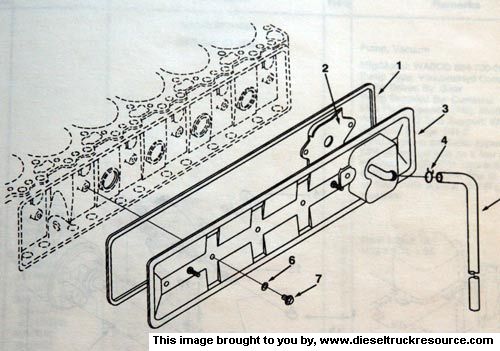
I added the 24v type crank-case vent (it goes where our OEM engine oil fill tube is on the gear case cover).
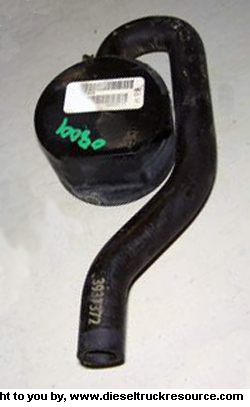 . . . .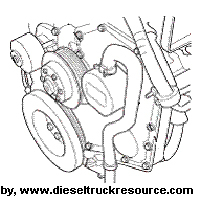
I also added two of the valve-cover vent assemblies. The OEM vent and the 24v vent are connected to one another and vent under the driver's side cab. I had the two valve-cover vents connected to one another with that hose paralleling the other to under the cab . . .
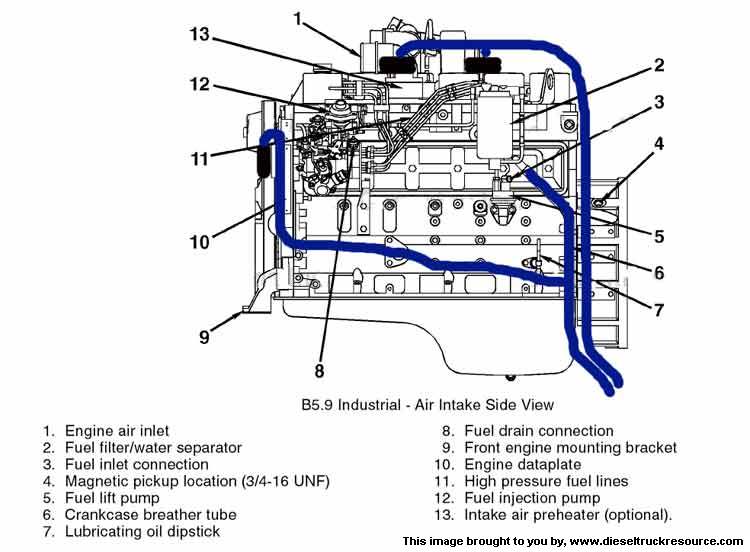
Again, at idle, my heap presents with, . . . on a cold day, . . . a visibly noticeable amount of vapors (steam) out the two vent hoses.
It "Stanks"!
The way I see things with my heap, the vast majority of vapors come from the OEM and 24v vents as they offer the least amount of resistance to flow. The OEM vent sees the flow at the lifter-valley and the 24v vent sees the flow through the gear-case. On the other hand, the two valve-cover vents see the same flow as that in the lifter-valley, but it has to flow past the push-rods to get to the valve-covers.
OK, fine . . .
At idle, the subtle low pressure area in the cold-air box should pull in a decent amount of the vapors. Not all of it, but enough to greatly reduce the "Dang! Who farted?" smell.
Anyhoot, I'm bored tonight and waiting on transmission valve-body stuff so . . . .
I re-oriented the two valve-cover vents so they'd point toward the engine's air filter box. I then whittled out a piece of pipe that connects the two valve-cover vents and have it terminating above the alternator's top bracket .. .

From there, I ran the hose over to the "Stock-Pot Cold-Air Box". I connected the hose with a nice 90* fitting into a standard PCV valve grommet . . .
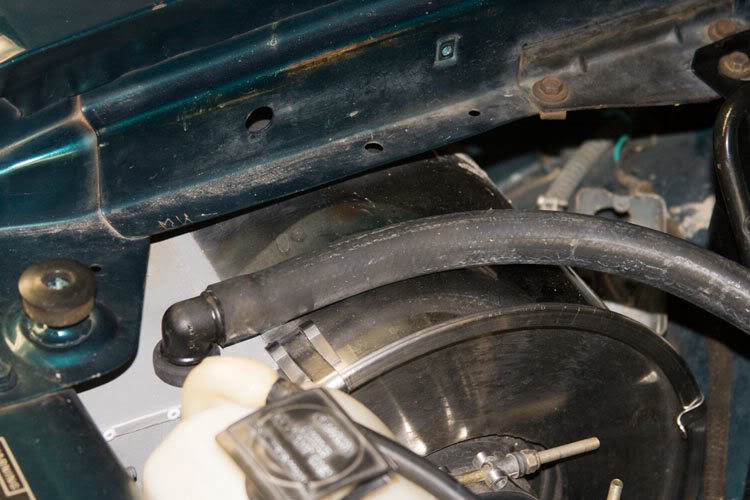
As I said earlier, the majority of the vapors go out the other vent hose. As such, it presents as being "Wet" with oil inside. The valve-cover vent tube does not. Even with a good number of full-throttle blasts. As such, I don't expect there to be an issue with an oily mess in the filter box.
With the way I have it plumbed now, there is still a small amount of vapors being emitted from the hose under the cab, but no where near the original amount.
Kewl.
I added the 24v type crank-case vent (it goes where our OEM engine oil fill tube is on the gear case cover).
. . . . I also added two of the valve-cover vent assemblies. The OEM vent and the 24v vent are connected to one another and vent under the driver's side cab. I had the two valve-cover vents connected to one another with that hose paralleling the other to under the cab . . .
Again, at idle, my heap presents with, . . . on a cold day, . . . a visibly noticeable amount of vapors (steam) out the two vent hoses.
It "Stanks"!
The way I see things with my heap, the vast majority of vapors come from the OEM and 24v vents as they offer the least amount of resistance to flow. The OEM vent sees the flow at the lifter-valley and the 24v vent sees the flow through the gear-case. On the other hand, the two valve-cover vents see the same flow as that in the lifter-valley, but it has to flow past the push-rods to get to the valve-covers.
OK, fine . . .
At idle, the subtle low pressure area in the cold-air box should pull in a decent amount of the vapors. Not all of it, but enough to greatly reduce the "Dang! Who farted?" smell.
Anyhoot, I'm bored tonight and waiting on transmission valve-body stuff so . . . .
I re-oriented the two valve-cover vents so they'd point toward the engine's air filter box. I then whittled out a piece of pipe that connects the two valve-cover vents and have it terminating above the alternator's top bracket .. .
From there, I ran the hose over to the "Stock-Pot Cold-Air Box". I connected the hose with a nice 90* fitting into a standard PCV valve grommet . . .
As I said earlier, the majority of the vapors go out the other vent hose. As such, it presents as being "Wet" with oil inside. The valve-cover vent tube does not. Even with a good number of full-throttle blasts. As such, I don't expect there to be an issue with an oily mess in the filter box.
With the way I have it plumbed now, there is still a small amount of vapors being emitted from the hose under the cab, but no where near the original amount.
Kewl.

Registered User
Joined: Sep 2008
Posts: 218
Likes: 1
From: Vancouver, BC
You also set up a catch-can style setup inline to give a place for the oil residue to collect. I like the idea of routing it into the exhaust though. Everything goes out the tailpipe and you also create minor vacuum in the crankcase which increases power. Although not as effective as a vacuum pump there would be minor benefits.

