


Downpipe Issues


Thread Starter
Banned
Joined: May 2006
Posts: 3,421
Likes: 1
From: Colorado
Well, there's my answer and Bill seconds it, so thanks guys! I wasn't sure what the turbine outlet sizes are on some of these turbos. I understand some of them may even require a custom or vendor-supplied downpipe?


Registered User
Joined: Mar 2006
Posts: 753
Likes: 1
From: Salina, Kansas
I plan on just modifying the end of my existing stan's downpipe when I get a 4" outlet turbo. I'll only have to change about 2 or 3 inches and weld on the vband. So you could go with a 4" d/pipe for now and just change the end of it later. Just a thought.
Very simple
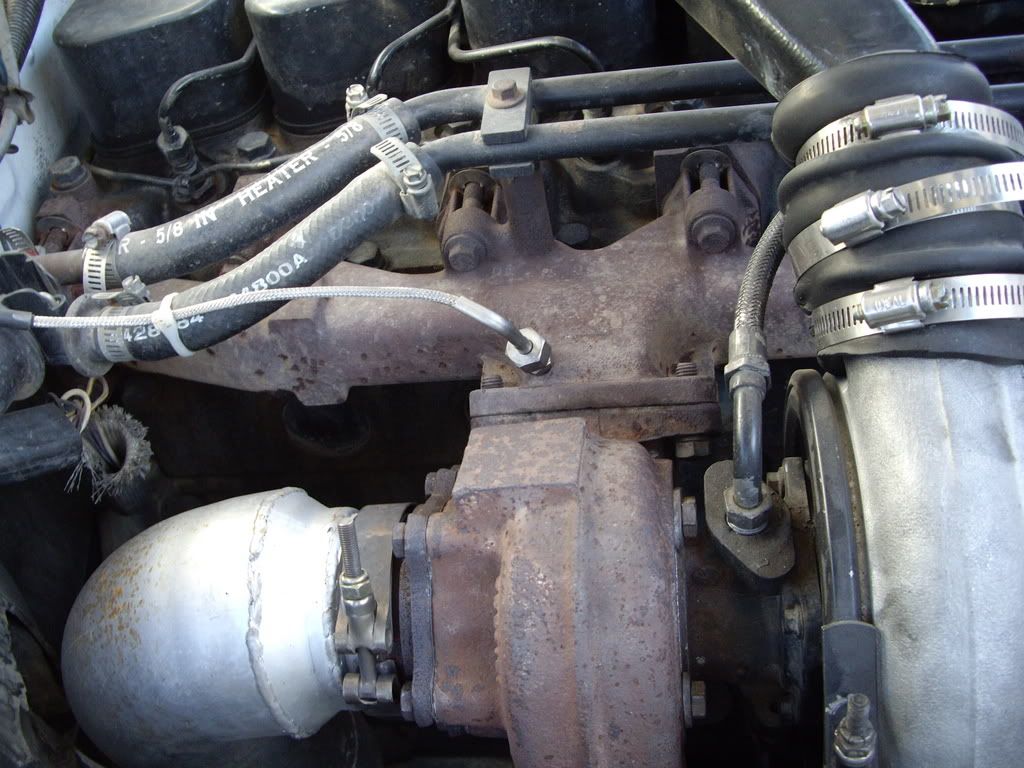
Very simple
Thread Starter
Banned
Joined: May 2006
Posts: 3,421
Likes: 1
From: Colorado
No downpipes for the Schwitzers, huh? Hmmm. Bummer. Why isn't this stuff ever EASY!! 
Oh well. Looks like 90firstgen has the right idea. Just gotta figure out what parts to put together and get ready to weld....
Oh well. Looks like 90firstgen has the right idea. Just gotta figure out what parts to put together and get ready to weld....


Registered User
Joined: Feb 2007
Posts: 48
Likes: 0
I got mine from sorce automotive.. very nice to deal with ..very nice prouduct... fit like a glove ... altho it does not come with the flange u have to weld it on yourself (wich i prefer) some pre welded pipes can be off quite a bit and not fit like they should .... as for going bigger it all depends on your backpressure ... just put a fitting in your down pipe and attatch a cheap pressure gauge from a farm store about 8 bucks... i have one on my down pipe and one on my turbo housing .. i routed them to the glove box with some extra hose so when i do a diffrent mod i can check the backpressure and boost ratio ... i have been told the maximum optmim ratio is 2:1 ...2 being the boost ...

Registered User
Joined: Dec 2006
Posts: 1,269
Likes: 0
From: Jonesboro, TEXAS
I could be wrong but I thank that is the drive pressure pre-turbo in the manifold, and its usualy 2psi of drive pressure to every 1psi of boost. The best is around 1:1 but is usualy closer to 2:1.
Thread Starter
Banned
Joined: May 2006
Posts: 3,421
Likes: 1
From: Colorado
I do kinda like the idea of welding my own flange, actually. Then I know I will make it fit right, like you said. I don't know how many times I've taken to cutting and welding new parts because they didn't fit like I thought they should. 

Registered User
Joined: May 2006
Posts: 697
Likes: 0
I believe it's incorrect to look at the turbo's exhaust exit wave/pressure or gas column as a continuous flow. Yes, the turbo reaches particular speeds as the exhaust exducer is spun, but you still have individual exhaust pulses into that system. It's somewhat like water flowing through a hose and quickly driving over the hose. Regardless of flow a change occurs.
If the flow is entirely constant you would hear a continuous whine like a turbine from the exhaust. Because it is not you hear individual exhaust pulses even thought the turbo is in the system. The turbo uses the exhaust pulses but it doesn't eliminate them. The inertial mass of the turbo impeller prevents instantaneous reaction and causes that despite a rising and falling pressure in system there are still inidvidual pulses which effect it.
The principles of tuned exhaust still apply. You have an exhaust wave exiting through the tube, and when it reaches the outlet at end the wave collapses. Then a negative waveforem travels back up the pipe at a lower pressure. This transition wave stops at the turbo outlet, but other than that it's quite similar to a gasser or non-turbo exhaust pulse. Tuned length can still have a dramatic effect if you correct for wave speed or even if you only correct for exhaust outlet at turbo instead of valve face. The next exhaust pulse meets a negative pressure in pipe, instead of atmospheric or hi pressure. Extraction effect still applies.
A mentioned, the sooner the exhaust opens up the sooner the exhaust's
'backpressure' is reduced. A venturi effect is created by restricting flow and then expanding it again after. Cut a venturi in half and look and you will see the profile of an airplane wing, with a high pressure section and a low pressure section. An exhaust adapter going from 3" to 4" doesn't give the venturi effect unless it is then restricted again, but it will allow the gases to expand and reduces pressure in pipe thereby increasing flow. It causes the higher pressure gases in 3" to dump into the lower pressure atmosphere of the 4" pipe. The sooner flow restriction is removed the sooner the gas can more easily move.
If the flow is entirely constant you would hear a continuous whine like a turbine from the exhaust. Because it is not you hear individual exhaust pulses even thought the turbo is in the system. The turbo uses the exhaust pulses but it doesn't eliminate them. The inertial mass of the turbo impeller prevents instantaneous reaction and causes that despite a rising and falling pressure in system there are still inidvidual pulses which effect it.
The principles of tuned exhaust still apply. You have an exhaust wave exiting through the tube, and when it reaches the outlet at end the wave collapses. Then a negative waveforem travels back up the pipe at a lower pressure. This transition wave stops at the turbo outlet, but other than that it's quite similar to a gasser or non-turbo exhaust pulse. Tuned length can still have a dramatic effect if you correct for wave speed or even if you only correct for exhaust outlet at turbo instead of valve face. The next exhaust pulse meets a negative pressure in pipe, instead of atmospheric or hi pressure. Extraction effect still applies.
A mentioned, the sooner the exhaust opens up the sooner the exhaust's
'backpressure' is reduced. A venturi effect is created by restricting flow and then expanding it again after. Cut a venturi in half and look and you will see the profile of an airplane wing, with a high pressure section and a low pressure section. An exhaust adapter going from 3" to 4" doesn't give the venturi effect unless it is then restricted again, but it will allow the gases to expand and reduces pressure in pipe thereby increasing flow. It causes the higher pressure gases in 3" to dump into the lower pressure atmosphere of the 4" pipe. The sooner flow restriction is removed the sooner the gas can more easily move.

Registered User
Joined: May 2006
Posts: 697
Likes: 0
I was saying that increasing pipe diameter helps exhaust flow, and that the sooner you do it, and also the more smooth the transition, the better.
It lowers EGT's because there's less time for the exhaust gases to hang around and also: pressure is heat. Less pressure, less heat.
Also for those so inclined, the tuning and extraction properties of a tuned exhaust sytsem still apply.
Problem with exhaust tuning on a turbo is the variables for turbo types, size etc. so it's much more trial and error than a normally aspirated engine.
JimmieD
It lowers EGT's because there's less time for the exhaust gases to hang around and also: pressure is heat. Less pressure, less heat.
Also for those so inclined, the tuning and extraction properties of a tuned exhaust sytsem still apply.
Problem with exhaust tuning on a turbo is the variables for turbo types, size etc. so it's much more trial and error than a normally aspirated engine.
JimmieD

Thread
Thread Starter
Forum
Replies
Last Post
PeytonMaterne
1st Gen. Ram - All Topics
5
Jun 12, 2012 09:57 AM
97catintenn
1st Gen. Ram - All Topics
2
Jul 12, 2009 05:33 PM
patriot pearl blue
Performance and Accessories 2nd gen only
3
Dec 15, 2002 12:10 AM