


DTR brain trust,,,wheel bearing


Thread Starter
Registered User
Joined: Aug 2006
Posts: 286
Likes: 0
From: outside of H-town, Tx, thankfully
 DTR brain trust,,,wheel bearing
Have to replace the seal in my right rear axle, going to do the bearing while I'm in there,,,, use to be old school thought was it was always the bearing that knocks out the seal,,,, don't know if that still hold true today, but I'll replace it while I'm there.
Question is,,,, I like Timken bearings, choices I have here are,,,
1/ O'Reilley's = BCA bearings
2/ NAPA = SKF bearings
3/ Auto Zone (gulp) = Timken, said their USA made also.
Problem is I don't buy anything from Auto Zone other than fluids, cleaners, stuff like that,,,,,,
What's ya'lls experience?
Question is,,,, I like Timken bearings, choices I have here are,,,
1/ O'Reilley's = BCA bearings
2/ NAPA = SKF bearings
3/ Auto Zone (gulp)
= Timken, said their USA made also.Problem is I don't buy anything from Auto Zone other than fluids, cleaners, stuff like that,,,,,,
What's ya'lls experience?

Registered User

Joined: Jul 2004
Posts: 1,252
Likes: 52
From: Whitehorse, cultural hub of the universe..
Timken is a good bearing, so is SKF. Either one could be considered industry standard.
Normally it isn't the bearing on these that knocks out the wheel seal, it is age, heat, or a plugged diff breather. Better than 90% of the failures I see on axle seals, relate DIRECTLY to a plugged diff breather line.
Just food for thought
Normally it isn't the bearing on these that knocks out the wheel seal, it is age, heat, or a plugged diff breather. Better than 90% of the failures I see on axle seals, relate DIRECTLY to a plugged diff breather line.
Just food for thought
Thread Starter
Registered User
Joined: Aug 2006
Posts: 286
Likes: 0
From: outside of H-town, Tx, thankfully
Timken is a good bearing, so is SKF. Either one could be considered industry standard.
Normally it isn't the bearing on these that knocks out the wheel seal, it is age, heat, or a plugged diff breather. Better than 90% of the failures I see on axle seals, relate DIRECTLY to a plugged diff breather line.
Just food for thought
Normally it isn't the bearing on these that knocks out the wheel seal, it is age, heat, or a plugged diff breather. Better than 90% of the failures I see on axle seals, relate DIRECTLY to a plugged diff breather line.
Just food for thought
Wonder how the vent tube becomes plugged
Would like to know your experience to this question to, if you don't mind.Off topic for this discussion,,, but I have my son's 4 wheeler front dif. off a Honda Rubicon, tore down as we speak waiting on parts because he knocked off the vent tube coming out at least 3 to 4 yrs ago
,, of course full of water and mud, set up like concrete.It has taken me about 2 weeks of soaking, heating, soaking, built a special puller to pull the axles out, bent the first puller I made,,,,,,,, welded up a bigger one,,,, but it finally came apart,,,, like to never got the "pumpking" to seperate into the 2 halves after pulling the axles out.
Ring and pinion are "kinda" rusty to say the least
 ,,, can you say wore out bearings,,, this will be interesting setting this back up.
Registered User
Joined: Jul 2004
Posts: 1,252
Likes: 52
From: Whitehorse, cultural hub of the universe..
Ah, it won't be that bad..... hah
Seriously enough, the breather on the rear axle goes up into the frame rail on the left side, and resides there where road spray can't seem to get at it, but mud and snow sure can. So, they tend to gum up, or freeze up, and that is when the axle seal goes south. Just from pressure built while the diff is warm.
That said, I have had good luck with cleaning the breather out, topping up the oil, and running it, and for some reason, the leak stops.
Also, better than 75% of the time, its the right seal that leaks. It is normally the left side where the brake pads delaminate from the backing plates, and lodge, creating heat and destroying the axle seal in the process.
While you have yours apart, do check the wheel bearings for "flat" spots on the cone, or inner race. I have seen a few outboard stock bearings do this. Never been totally sure on the cause, but it does happen.
I have to say, the diffs in the last two years of dana production for these trucks, are as bulletproof as a hastily assembled gumbo of parts can be. I swear from what I have seen, they were just using whatever they had laying around, and praying that it didn't blow. And most times, they last.
When you are setting the diff back up in the honda, get your required backlash, and check it by rolling a pattern, and you should be golden. If I thought they would get abused, I would set them up loose.
I also do quite a bit of work on top-drive setups for Mobile drills. Same thing, ring and pinion, helical cut. And man, when they grenade, they really come apart. Only thing worth saving is the case. So, when I rebuild them, I go by book spec til the pattern is right, then add another 5 thou in either direction to loosen it up a bit. some 85w140 oil, and I haven't had one fail yet. Other than a catastrophic " jammed the steel at too high torque load". When that happens, it is going to break. Something about the cascade effect of a failure. It starts at the operator's console, and has a domino effect from there.
Good luck with the Honda
Seriously enough, the breather on the rear axle goes up into the frame rail on the left side, and resides there where road spray can't seem to get at it, but mud and snow sure can. So, they tend to gum up, or freeze up, and that is when the axle seal goes south. Just from pressure built while the diff is warm.
That said, I have had good luck with cleaning the breather out, topping up the oil, and running it, and for some reason, the leak stops.
Also, better than 75% of the time, its the right seal that leaks. It is normally the left side where the brake pads delaminate from the backing plates, and lodge, creating heat and destroying the axle seal in the process.
While you have yours apart, do check the wheel bearings for "flat" spots on the cone, or inner race. I have seen a few outboard stock bearings do this. Never been totally sure on the cause, but it does happen.
I have to say, the diffs in the last two years of dana production for these trucks, are as bulletproof as a hastily assembled gumbo of parts can be. I swear from what I have seen, they were just using whatever they had laying around, and praying that it didn't blow. And most times, they last.
When you are setting the diff back up in the honda, get your required backlash, and check it by rolling a pattern, and you should be golden. If I thought they would get abused, I would set them up loose.
I also do quite a bit of work on top-drive setups for Mobile drills. Same thing, ring and pinion, helical cut. And man, when they grenade, they really come apart. Only thing worth saving is the case. So, when I rebuild them, I go by book spec til the pattern is right, then add another 5 thou in either direction to loosen it up a bit. some 85w140 oil, and I haven't had one fail yet. Other than a catastrophic " jammed the steel at too high torque load". When that happens, it is going to break. Something about the cascade effect of a failure. It starts at the operator's console, and has a domino effect from there.
Good luck with the Honda
Thread Starter
Registered User
Joined: Aug 2006
Posts: 286
Likes: 0
From: outside of H-town, Tx, thankfully
Ah, it won't be that bad..... hah
Seriously enough, the breather on the rear axle goes up into the frame rail on the left side, and resides there where road spray can't seem to get at it, but mud and snow sure can. So, they tend to gum up, or freeze up, and that is when the axle seal goes south. Just from pressure built while the diff is warm.
That said, I have had good luck with cleaning the breather out, topping up the oil, and running it, and for some reason, the leak stops.
Also, better than 75% of the time, its the right seal that leaks. It is normally the left side where the brake pads delaminate from the backing plates, and lodge, creating heat and destroying the axle seal in the process.
While you have yours apart, do check the wheel bearings for "flat" spots on the cone, or inner race. I have seen a few outboard stock bearings do this. Never been totally sure on the cause, but it does happen.
I have to say, the diffs in the last two years of dana production for these trucks, are as bulletproof as a hastily assembled gumbo of parts can be. I swear from what I have seen, they were just using whatever they had laying around, and praying that it didn't blow. And most times, they last.
When you are setting the diff back up in the honda, get your required backlash, and check it by rolling a pattern, and you should be golden. If I thought they would get abused, I would set them up loose.
I also do quite a bit of work on top-drive setups for Mobile drills. Same thing, ring and pinion, helical cut. And man, when they grenade, they really come apart. Only thing worth saving is the case. So, when I rebuild them, I go by book spec til the pattern is right, then add another 5 thou in either direction to loosen it up a bit. some 85w140 oil, and I haven't had one fail yet. Other than a catastrophic " jammed the steel at too high torque load". When that happens, it is going to break. Something about the cascade effect of a failure. It starts at the operator's console, and has a domino effect from there.
Good luck with the Honda
Seriously enough, the breather on the rear axle goes up into the frame rail on the left side, and resides there where road spray can't seem to get at it, but mud and snow sure can. So, they tend to gum up, or freeze up, and that is when the axle seal goes south. Just from pressure built while the diff is warm.
That said, I have had good luck with cleaning the breather out, topping up the oil, and running it, and for some reason, the leak stops.
Also, better than 75% of the time, its the right seal that leaks. It is normally the left side where the brake pads delaminate from the backing plates, and lodge, creating heat and destroying the axle seal in the process.
While you have yours apart, do check the wheel bearings for "flat" spots on the cone, or inner race. I have seen a few outboard stock bearings do this. Never been totally sure on the cause, but it does happen.
I have to say, the diffs in the last two years of dana production for these trucks, are as bulletproof as a hastily assembled gumbo of parts can be. I swear from what I have seen, they were just using whatever they had laying around, and praying that it didn't blow. And most times, they last.
When you are setting the diff back up in the honda, get your required backlash, and check it by rolling a pattern, and you should be golden. If I thought they would get abused, I would set them up loose.
I also do quite a bit of work on top-drive setups for Mobile drills. Same thing, ring and pinion, helical cut. And man, when they grenade, they really come apart. Only thing worth saving is the case. So, when I rebuild them, I go by book spec til the pattern is right, then add another 5 thou in either direction to loosen it up a bit. some 85w140 oil, and I haven't had one fail yet. Other than a catastrophic " jammed the steel at too high torque load". When that happens, it is going to break. Something about the cascade effect of a failure. It starts at the operator's console, and has a domino effect from there.
Good luck with the Honda
 , I know what you mean, I use to weld the furnance tubes for 11 years at the plant, and when the operators were told to bring up capacity to 110% of capacity,,,, things started, shall we say, dis-assembling.
Thanks again, if you don't mind, I might come back and ask for some "adult suprervision" when I start on the Honda, only piddle with it on weekends, have the FSM, plan on using it to, ha!
Checked out tools from the plant, "last word indicator" for the backlash, depth gauge for the clutch pack, need to pick up some prussian blue I guess.
Thanks Pind
Thread Starter
Registered User
Joined: Aug 2006
Posts: 286
Likes: 0
From: outside of H-town, Tx, thankfully
Timken is a good bearing, so is SKF. Either one could be considered industry standard.
Normally it isn't the bearing on these that knocks out the wheel seal, it is age, heat, or a plugged diff breather. Better than 90% of the failures I see on axle seals, relate DIRECTLY to a plugged diff breather line.
Just food for thought
Normally it isn't the bearing on these that knocks out the wheel seal, it is age, heat, or a plugged diff breather. Better than 90% of the failures I see on axle seals, relate DIRECTLY to a plugged diff breather line.
Just food for thought
Thanks for the info,,, I'd never thought of that one.

Registered User
Joined: Apr 2007
Posts: 2,435
Likes: 0
From: Edmonton Alberta
if your axel seal is leaking, double check your ball joints!! Just replacing the hub bearing because the seal is bad, does not apply in this case! if the bearing is tight and makes no noise, it will be fine and not cause an inner axel seal failure....BUT the ball joints (lower one causes this) can allow the spindal to move up and down as much as 1/4inch and NOT show up as lateral play. to test place a prybar inbetween the lower BJ and the axel U-joint and pry down, you will be surprized how much play can be in there (jack truck up via the front diff to do this test) if you have a dial indicator you can get a measurement of the movement less than 50thou is withing spec.
both my axel seal were leaking (had been for quite a long time) I replaced the right seal (PITA) and ball joints right side had 70thou play Left side had 100thou play, never replaced the left side seal and it stopped leaking. that axel shaft was moving so much it was pushing against the seal allowing oil to excape. yet I had no side (lateral) play in the BJ.
the upper BJ tapered shaft will move in and out upto 1/2 inch!! the lower one is the one that stops the up/down movement. I only fiqured it out AFTER I had replaced one upper in one side SO I left the other side used BJ in as it had no later play, I'll monitor it for play and see how it lasts, the used one has as a min 190,000kms on it, so we will see how it lasts
here are pics of both the NEW and old BJ extended and collapsed
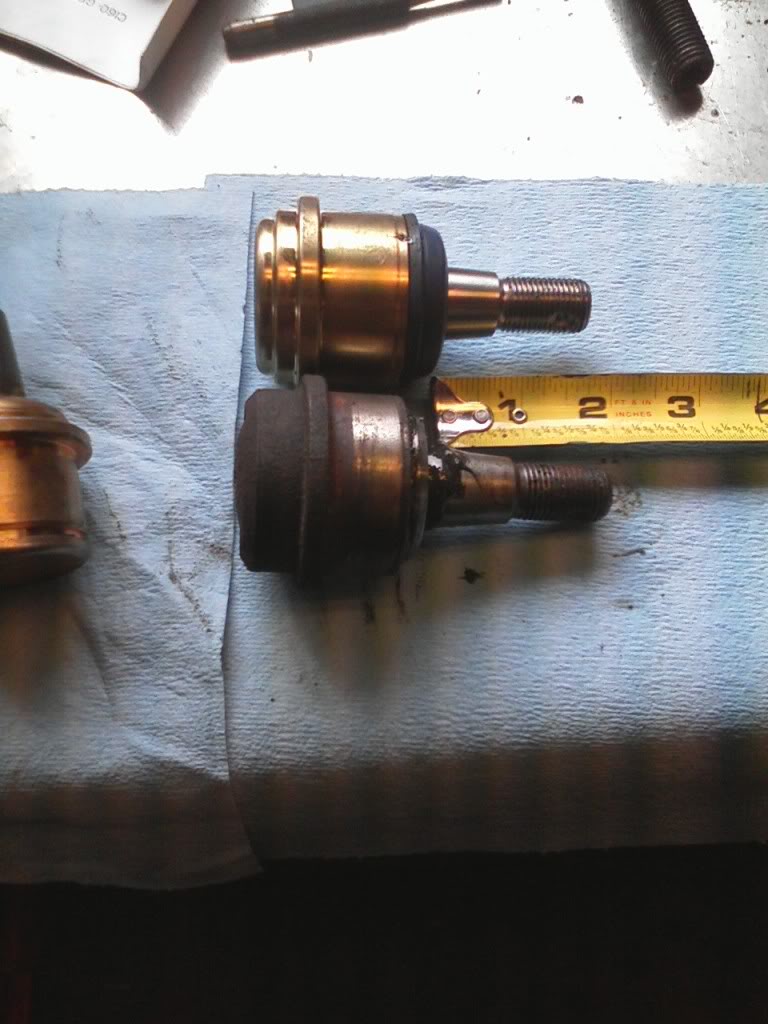
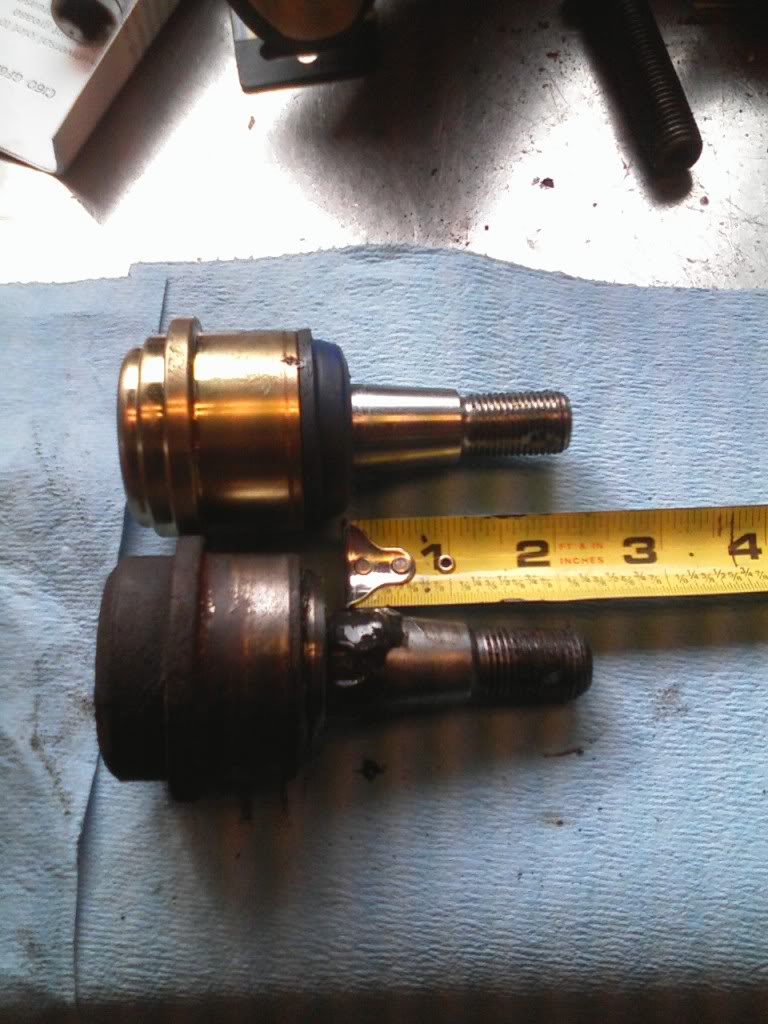
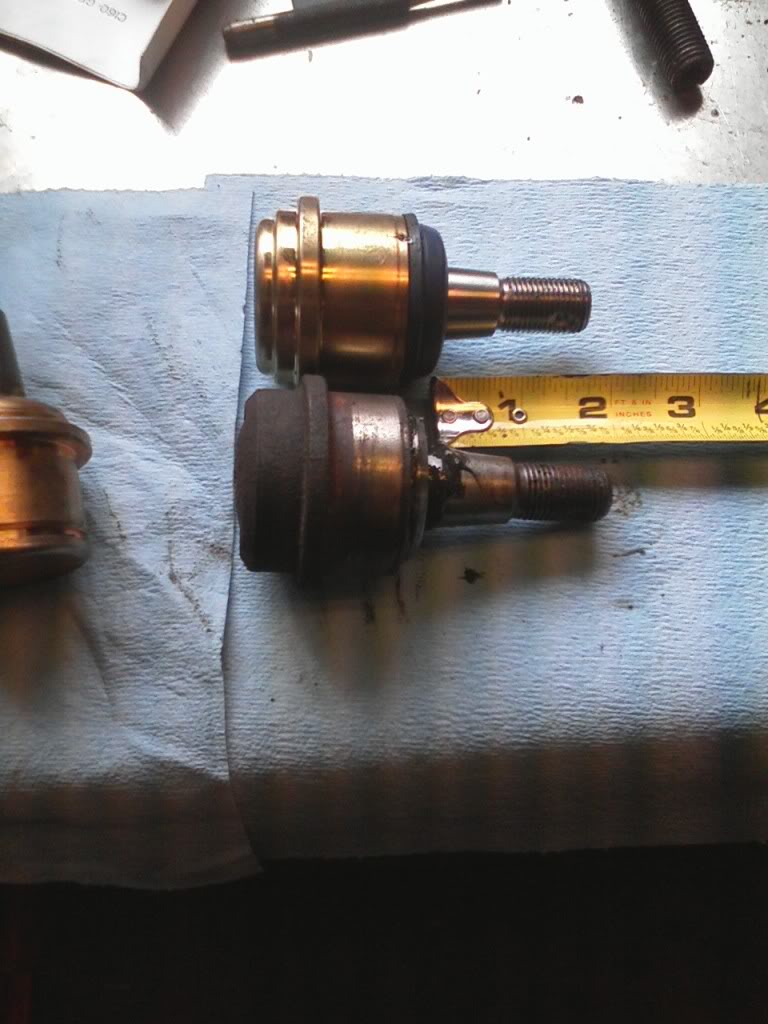
both my axel seal were leaking (had been for quite a long time) I replaced the right seal (PITA) and ball joints right side had 70thou play Left side had 100thou play, never replaced the left side seal and it stopped leaking. that axel shaft was moving so much it was pushing against the seal allowing oil to excape. yet I had no side (lateral) play in the BJ.
the upper BJ tapered shaft will move in and out upto 1/2 inch!! the lower one is the one that stops the up/down movement. I only fiqured it out AFTER I had replaced one upper in one side SO I left the other side used BJ in as it had no later play, I'll monitor it for play and see how it lasts, the used one has as a min 190,000kms on it, so we will see how it lasts
here are pics of both the NEW and old BJ extended and collapsed
Trending Topics
Thread Starter
Registered User
Joined: Aug 2006
Posts: 286
Likes: 0
From: outside of H-town, Tx, thankfully
if your axel seal is leaking, double check your ball joints!! Just replacing the hub bearing because the seal is bad, does not apply in this case! if the bearing is tight and makes no noise, it will be fine and not cause an inner axel seal failure....BUT the ball joints (lower one causes this) can allow the spindal to move up and down as much as 1/4inch and NOT show up as lateral play. to test place a prybar inbetween the lower BJ and the axel U-joint and pry down, you will be surprized how much play can be in there (jack truck up via the front diff to do this test) if you have a dial indicator you can get a measurement of the movement less than 50thou is withing spec.
both my axel seal were leaking (had been for quite a long time) I replaced the right seal (PITA) and ball joints right side had 70thou play Left side had 100thou play, never replaced the left side seal and it stopped leaking. that axel shaft was moving so much it was pushing against the seal allowing oil to excape. yet I had no side (lateral) play in the BJ.
the upper BJ tapered shaft will move in and out upto 1/2 inch!! the lower one is the one that stops the up/down movement. I only fiqured it out AFTER I had replaced one upper in one side SO I left the other side used BJ in as it had no later play, I'll monitor it for play and see how it lasts, the used one has as a min 190,000kms on it, so we will see how it lasts
here are pics of both the NEW and old BJ extended and collapsed


both my axel seal were leaking (had been for quite a long time) I replaced the right seal (PITA) and ball joints right side had 70thou play Left side had 100thou play, never replaced the left side seal and it stopped leaking. that axel shaft was moving so much it was pushing against the seal allowing oil to excape. yet I had no side (lateral) play in the BJ.
the upper BJ tapered shaft will move in and out upto 1/2 inch!! the lower one is the one that stops the up/down movement. I only fiqured it out AFTER I had replaced one upper in one side SO I left the other side used BJ in as it had no later play, I'll monitor it for play and see how it lasts, the used one has as a min 190,000kms on it, so we will see how it lasts
here are pics of both the NEW and old BJ extended and collapsed
But I'm working on the rear axle not the front.
Thanks,

Thread
Thread Starter
Forum
Replies
Last Post
pull-do
24 Valve Engine and Drivetrain
7
Oct 12, 2009 11:54 PM