


Fuel pressure checking and gauge questions


Thread Starter
Registered User
Joined: Feb 2011
Posts: 606
Likes: 0
From: Washington
Fuel pressure checking and gauge questions
I am going to check fuel pressure on my stock motor with 84k miles. The motor has a stock lift pump as well. After putting a few hundred miles on this new to me truck, I find that on some steep grades it will lose power. I don't believe it is the stock governor causing defueling as it has happened at 1750 to 1800 rpms at around 65 MPH on some grades. The truck has 3.55 gears. I just changed the fuel filter today and will be driving in some hilly areas in the next few days for another test run to see if there is any difference after filter change. If the fuel pressure is below spec I will pinch the return line and watch pressure to see if the OFV is bad.
I was going to buy the pre tapped snubber from Genos. I have read many posts from others checking fuel pressure. Does the pre tapped snubber have enough spike dampening for a stock lift pump when using a typical free loaner mechanical gauge you can find at most auto parts stores? If not, I could also buy a needle valve as well. Many report that the snubber by itself worked great with little to no needle bounce on a fuel pressure gauge. Others report their pre tapped snubber still had their gauge needle bouncing all over.
Does the snubber tend to work more consistently when using an electric vs an mechanical gauge or visa versa? Can you run the pre tapped snubber and if needed add a needle valve without any issue?
With a stock lift pump set up, any advantage to an in cab electric vs mechanical with the 12v motor? I also read that some run grease gun hose to the snubber or needle valve. Is that just for permanent install of a an electrical gauge sender to get it to another off engine mounting position? Any photos of gauge installs would be helpful.
I was going to buy the pre tapped snubber from Genos. I have read many posts from others checking fuel pressure. Does the pre tapped snubber have enough spike dampening for a stock lift pump when using a typical free loaner mechanical gauge you can find at most auto parts stores? If not, I could also buy a needle valve as well. Many report that the snubber by itself worked great with little to no needle bounce on a fuel pressure gauge. Others report their pre tapped snubber still had their gauge needle bouncing all over.
Does the snubber tend to work more consistently when using an electric vs an mechanical gauge or visa versa? Can you run the pre tapped snubber and if needed add a needle valve without any issue?
With a stock lift pump set up, any advantage to an in cab electric vs mechanical with the 12v motor? I also read that some run grease gun hose to the snubber or needle valve. Is that just for permanent install of a an electrical gauge sender to get it to another off engine mounting position? Any photos of gauge installs would be helpful.

Administrator
Joined: Jan 2007
Posts: 8,372
Likes: 172
From: Streator Illinois
I am going to check fuel pressure on my stock motor with 84k miles. The motor has a stock lift pump as well. After putting a few hundred miles on this new to me truck, I find that on some steep grades it will lose power. I don't believe it is the stock governor causing defueling as it has happened at 1750 to 1800 rpms at around 65 MPH on some grades. The truck has 3.55 gears. I just changed the fuel filter today and will be driving in some hilly areas in the next few days for another test run to see if there is any difference after filter change. If the fuel pressure is below spec I will pinch the return line and watch pressure to see if the OFV is bad.
I was going to buy the pre tapped snubber from Genos. I have read many posts from others checking fuel pressure. Does the pre tapped snubber have enough spike dampening for a stock lift pump when using a typical free loaner mechanical gauge you can find at most auto parts stores? If not, I could also buy a needle valve as well. Many report that the snubber by itself worked great with little to no needle bounce on a fuel pressure gauge. Others report their pre tapped snubber still had their gauge needle bouncing all over.
Does the snubber tend to work more consistently when using an electric vs an mechanical gauge or visa versa? Can you run the pre tapped snubber and if needed add a needle valve without any issue?
With a stock lift pump set up, any advantage to an in cab electric vs mechanical with the 12v motor? I also read that some run grease gun hose to the snubber or needle valve. Is that just for permanent install of a an electrical gauge sender to get it to another off engine mounting position? Any photos of gauge installs would be helpful.
I was going to buy the pre tapped snubber from Genos. I have read many posts from others checking fuel pressure. Does the pre tapped snubber have enough spike dampening for a stock lift pump when using a typical free loaner mechanical gauge you can find at most auto parts stores? If not, I could also buy a needle valve as well. Many report that the snubber by itself worked great with little to no needle bounce on a fuel pressure gauge. Others report their pre tapped snubber still had their gauge needle bouncing all over.
Does the snubber tend to work more consistently when using an electric vs an mechanical gauge or visa versa? Can you run the pre tapped snubber and if needed add a needle valve without any issue?
With a stock lift pump set up, any advantage to an in cab electric vs mechanical with the 12v motor? I also read that some run grease gun hose to the snubber or needle valve. Is that just for permanent install of a an electrical gauge sender to get it to another off engine mounting position? Any photos of gauge installs would be helpful.
I don't personally like the electric units, I would just run a mechanical glycerine filled gauge 0-60 or 0-100. I didn't find a back mounted 0-60 but here is a back mounted 0-100 from surplus center for 13 bucks.
http://www.surpluscenter.com/item.as...652-A&catname=
Look at Infidels gallery, I believe he has pictures.

Registered User
Joined: Dec 2003
Posts: 14,672
Likes: 9
From: Montana
Electric FP gauges lie to you in tricky ways that make you think your FP is ok when it isn't
Mechanical gauges tell the truth.
http://www.cumminsforum.com/forum/94...-12-valve.html
Mechanical gauges tell the truth.
http://www.cumminsforum.com/forum/94...-12-valve.html
Thread Starter
Registered User
Joined: Feb 2011
Posts: 606
Likes: 0
From: Washington
Ok, are most people running the mechanical gauge in the cab without an isolator? If the gauge or line started to leak and the needle valve is installed, that would provide an easy way to shut off fuel completely to the gauge an line, correct? Am I correct in that most if not all the mechanical fuel pressure gauges do not have lights for night viewing? Not a deal breaker, just have not seen any.
What opening have you guys routed the fuel tubing through at the firewall? I was planning on putting the tubing inside a conduit as long as it does not make it too big to get through an opening.
What opening have you guys routed the fuel tubing through at the firewall? I was planning on putting the tubing inside a conduit as long as it does not make it too big to get through an opening.

Registered User
Joined: Dec 2003
Posts: 14,672
Likes: 9
From: Montana
If the the needle valve is closed off enough that the gauge doesn't pulsate any leak will be a very, very slow drip.
Fuel doesn't really flow though the line to the gauge in the normal sense, it just changes pressure.
Even the slightest leak will cause the gauge to read zero, then you can close the needle valve to shut it down.
Going on 15 years with diesel in the cabs of both trucks without a single leak.
In fact when I upgraded to a better gauge that actually said fuel pressure on it I was all prepared for diesel in the cab.
Not a drop, the lines were still full of air from the initial installation 13 years before.
With an isolator any air in the lines will make the gauge read wrong, a real PITA.
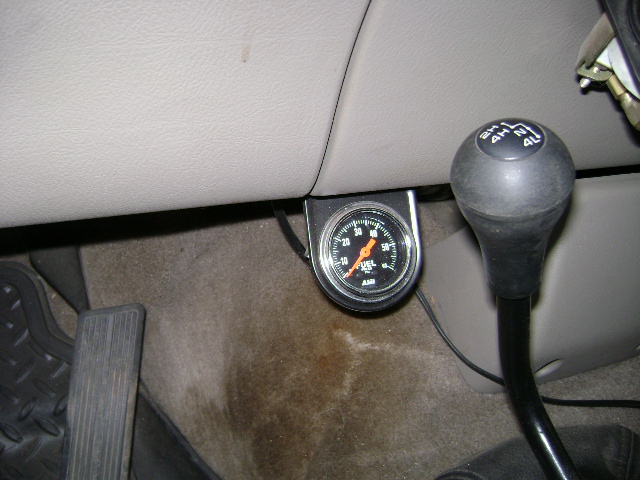
Even though my new gauges have lighting I didn't hook it up. FP isn't something you have to watch all the time. For that reason also I have my FP gauges mounted low on the dash just ahead of the 4wd shifter.
On an auto there is a big rubber grommet on the firewall where the clutch linkage of a manual would have passed.
Just cut a slit in it and you can pass though many wires and tubes.
I use the exact same nylon tubing for boost and FP, 1/8" passed through some 1/4" tubing for a protective sheath.
Truck air brake hose works great and is available at most auto parts by the foot.
Fuel doesn't really flow though the line to the gauge in the normal sense, it just changes pressure.
Even the slightest leak will cause the gauge to read zero, then you can close the needle valve to shut it down.
Going on 15 years with diesel in the cabs of both trucks without a single leak.
In fact when I upgraded to a better gauge that actually said fuel pressure on it I was all prepared for diesel in the cab.
Not a drop, the lines were still full of air from the initial installation 13 years before.
With an isolator any air in the lines will make the gauge read wrong, a real PITA.
Even though my new gauges have lighting I didn't hook it up. FP isn't something you have to watch all the time. For that reason also I have my FP gauges mounted low on the dash just ahead of the 4wd shifter.
On an auto there is a big rubber grommet on the firewall where the clutch linkage of a manual would have passed.
Just cut a slit in it and you can pass though many wires and tubes.
I use the exact same nylon tubing for boost and FP, 1/8" passed through some 1/4" tubing for a protective sheath.
Truck air brake hose works great and is available at most auto parts by the foot.
Thread Starter
Registered User
Joined: Feb 2011
Posts: 606
Likes: 0
From: Washington
If the the needle valve is closed off enough that the gauge doesn't pulsate any leak will be a very, very slow drip.
Fuel doesn't really flow though the line to the gauge in the normal sense, it just changes pressure.
Even the slightest leak will cause the gauge to read zero, then you can close the needle valve to shut it down.
Going on 15 years with diesel in the cabs of both trucks without a single leak.
In fact when I upgraded to a better gauge that actually said fuel pressure on it I was all prepared for diesel in the cab.
Not a drop, the lines were still full of air from the initial installation 13 years before.
With an isolator any air in the lines will make the gauge read wrong, a real PITA.
Even though my new gauges have lighting I didn't hook it up. FP isn't something you have to watch all the time. For that reason also I have my FP gauges mounted low on the dash just ahead of the 4wd shifter.
On an auto there is a big rubber grommet on the firewall where the clutch linkage of a manual would have passed.
Just cut a slit in it and you can pass though many wires and tubes.
I use the exact same nylon tubing for boost and FP, 1/8" passed through some 1/4" tubing for a protective sheath.
Truck air brake hose works great and is available at most auto parts by the foot.
Fuel doesn't really flow though the line to the gauge in the normal sense, it just changes pressure.
Even the slightest leak will cause the gauge to read zero, then you can close the needle valve to shut it down.
Going on 15 years with diesel in the cabs of both trucks without a single leak.
In fact when I upgraded to a better gauge that actually said fuel pressure on it I was all prepared for diesel in the cab.
Not a drop, the lines were still full of air from the initial installation 13 years before.
With an isolator any air in the lines will make the gauge read wrong, a real PITA.
Even though my new gauges have lighting I didn't hook it up. FP isn't something you have to watch all the time. For that reason also I have my FP gauges mounted low on the dash just ahead of the 4wd shifter.
On an auto there is a big rubber grommet on the firewall where the clutch linkage of a manual would have passed.
Just cut a slit in it and you can pass though many wires and tubes.
I use the exact same nylon tubing for boost and FP, 1/8" passed through some 1/4" tubing for a protective sheath.
Truck air brake hose works great and is available at most auto parts by the foot.
Infidel - Thanks for the clarification with additional details! That is the info I was looking for. The gauges I have been seeing online dont include the nylon tubing or compression fittings. I take it Napa will have the compression fittings I need for the connections at the 1/8 NPT fitting at the needle valve and the back of the gauge? I will be getting the Genos snubber and the needle valve you referred to at Graingers. I will be going the same route as your install right down to the gauge mount location by the 4x4 shifter. I was thinking that is the perfect place for it as well. I was hoping to get a couple photos of your gauge mounted there. I would appreciate it. If possible, I would like to use the couple of factory screws that secure the plastic panels. I am **** about clean installs and strive to minimize drilling when I can.
Trending Topics
Thread Starter
Registered User
Joined: Feb 2011
Posts: 606
Likes: 0
From: Washington
Thanks! Also wanted to ask if I decided to run an isolator with my mechanical gauge is there any downside regarding accuracy or anything else? Also, should I run grease gun hose from the needle valve to the isolator if I do that?
Registered User
Joined: Dec 2003
Posts: 14,672
Likes: 9
From: Montana
Grease gun hoses are a simple and cheap way for FP gauges.
Isolators are a lot of trouble, if you don't get every bit of air out of the hoses they don't read correctly. Lot's of folks start chasing low FP problems only to find out it was the isolator causing all their problems.
Without an isolator it doesn't matter if there's air in lines.
Isolators are a lot of trouble, if you don't get every bit of air out of the hoses they don't read correctly. Lot's of folks start chasing low FP problems only to find out it was the isolator causing all their problems.
Without an isolator it doesn't matter if there's air in lines.

Thread
Thread Starter
Forum
Replies
Last Post
dieselfan
24 Valve Engine and Drivetrain
2
Jul 25, 2006 11:53 PM
Greeds22
Performance and Accessories 2nd gen only
25
Sep 11, 2005 03:13 PM
engcogod
Performance and Accessories 2nd gen only
17
Feb 3, 2005 08:49 PM

