


WD Hitch Brackets Problem


Thread Starter
Registered User
Joined: Jan 2002
Posts: 2,730
Likes: 7
From: Powhatan, Virginia
WD Hitch Brackets Problem
I just bought a Reese 12,000 lb WD hitch for my trailer. When I went to install it I found that the trailer is built heavier than the hitch. The beams that form the tongue are 4" across, by 6" tall I-beams (12K GVW trailer). The Reese WD hitch bracket that are supposed to fasten to the trailer can only span 2.5" worth of metal.
I called Reese customer service and they told me they had nothing to help this situation and I would need to weld the brackets if I wanted to make them work.
Does anyone know where I can get bigger WD hitch brackets, or do I really need to weld mine?
And since I'm here, why on Earth would Reese manufacture a hitch for a 12K GVW trailer and only be able to accomodate 2.5" tongue bars? As I said, mine are 4"x6", and I sometimes feel like the trailer is flexing too much. If I had 2.5" bars for the tongue I doubt I'd still have a 12K GVW trailer.
Anyone got any ideas about this?
Thanks,
Chris
I called Reese customer service and they told me they had nothing to help this situation and I would need to weld the brackets if I wanted to make them work.
Does anyone know where I can get bigger WD hitch brackets, or do I really need to weld mine?
And since I'm here, why on Earth would Reese manufacture a hitch for a 12K GVW trailer and only be able to accomodate 2.5" tongue bars? As I said, mine are 4"x6", and I sometimes feel like the trailer is flexing too much. If I had 2.5" bars for the tongue I doubt I'd still have a 12K GVW trailer.
Anyone got any ideas about this?
Thanks,
Chris

Registered User
Joined: Aug 2002
Posts: 8,803
Likes: 0
From: Northern Virginia
I bought my trailer from Midlothian Trailer Sales not to far from you on the Midlothian Turnpike. There is a hitch shop right around the corner from him that sold me my 10,000lb drop hitch. They might be able to help you.
All the WD Hitch directions I've seen tell you that if the brackets can't be slipped over the frame then you will have to weld them on...
All the WD Hitch directions I've seen tell you that if the brackets can't be slipped over the frame then you will have to weld them on...
Thread Starter
Registered User
Joined: Jan 2002
Posts: 2,730
Likes: 7
From: Powhatan, Virginia
Originally posted by Dodgezilla
All the WD Hitch directions I've seen tell you that if the brackets can't be slipped over the frame then you will have to weld them on...
All the WD Hitch directions I've seen tell you that if the brackets can't be slipped over the frame then you will have to weld them on...
Thanks,
Chris

Chapter President
Joined: May 2004
Posts: 3,539
Likes: 7
From: Caistor Centre, ON, Canada
4"x6"!!! .....that is a big tongue!!......how much weight are you putting on the tongue that would make you think that it may be flexing?........
I have only seen the one size of bracket but as Dodgezilla said, they are the cheapest part of the WD hitch.........they are forged steel so it will be easy to successfully weld them....I never liked the set screw type mounting the used......
I use a 6 ton float from time to time that has a 2" x 6" x 1/4" wall tubes that make the tongue that doesn't flex for nothing!
.....that is a big tongue!!......how much weight are you putting on the tongue that would make you think that it may be flexing?........I have only seen the one size of bracket but as Dodgezilla said, they are the cheapest part of the WD hitch.........they are forged steel so it will be easy to successfully weld them....I never liked the set screw type mounting the used......
I use a 6 ton float from time to time that has a 2" x 6" x 1/4" wall tubes that make the tongue that doesn't flex for nothing!
Thread Starter
Registered User
Joined: Jan 2002
Posts: 2,730
Likes: 7
From: Powhatan, Virginia
It's a Hurst trailer, and I didn't think is was all that big. Only 20ft, and it's not even a deck-over (which I WISH I had). I think this is it: http://www.hursttrailers.com/10.htm
In the pic below you can see most of the tongue. Those 4x6" I-beams run the length of the trailer. My heaviest is with that tractor on there, and the grader box also. Tractor weighs in at 7800, like you see it; and the grader box is 4-500? The trailer weighs in at 2,720, although the registration says it weighs 2K. I didn't think the spare tire and chains wieghed 720 lbs.
My heaviest, I think is about 10,840. I sometimes feel the trailer flexing when I load equipment or tie stuff down. I figured it should be stiffer, especially with that size beams on it, but what do I know.
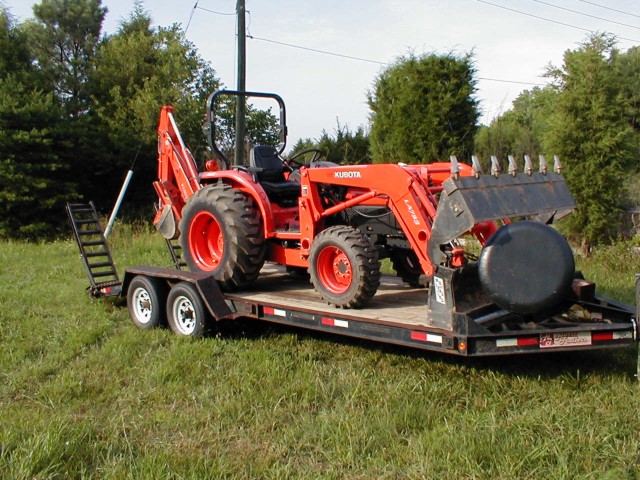
Thanks,
Chris
In the pic below you can see most of the tongue. Those 4x6" I-beams run the length of the trailer. My heaviest is with that tractor on there, and the grader box also. Tractor weighs in at 7800, like you see it; and the grader box is 4-500? The trailer weighs in at 2,720, although the registration says it weighs 2K. I didn't think the spare tire and chains wieghed 720 lbs.
My heaviest, I think is about 10,840. I sometimes feel the trailer flexing when I load equipment or tie stuff down. I figured it should be stiffer, especially with that size beams on it, but what do I know.
Thanks,
Chris
Chapter President
Joined: May 2004
Posts: 3,539
Likes: 7
From: Caistor Centre, ON, Canada
Why are the axles so far back?!?!........I would not have to get out the tape measure to see that you have WAY more than 10% tongue weight.........no wonder you think the tongue may be flexing..........was that float designed for a specific piece of equipment that is very heavy in the rear?..........Where the tractor is sitting in relation to the axles is way off...........If I were to guess I would say you have AT LEAST 2000 lbs of tongue weight - way too much.......I would suggest getting a different float or relocating the axles so they are only 10% rearward of the center of the deck..........it will tow beautifully and you won't be thinking the tongue is flexing.....IMO, that frame will be plenty stiff if the axles were located properly........somebody was definately in dream land to suggest that your 6 ton float only weighs 2000 lbs!........The 6 ton I use weighs 3000 lbs..........the typical 7000 lb GTW car hauler weighs 1700 - 2000 lbs......
Trending Topics
Thread Starter
Registered User
Joined: Jan 2002
Posts: 2,730
Likes: 7
From: Powhatan, Virginia
I thought the axles were too far back myself, but people I talked to said it needed to eb that way, otherwise it would tow badly, swaying all over the place. I try to put the tractor as far back as possible, but that's a lot of weight, and it's spread out so much there's only so far back I can get it.
The trailer tows fine at this point. Before I got the leveling kit, and with my Ford 4000D on the back, the tongue weight just broought the rear end to level with the rest of the truck. Now, since the leveling kit, it seems like anything back the rear end sag.
Chris
The trailer tows fine at this point. Before I got the leveling kit, and with my Ford 4000D on the back, the tongue weight just broought the rear end to level with the rest of the truck. Now, since the leveling kit, it seems like anything back the rear end sag.
Chris
Chapter President
Joined: May 2004
Posts: 3,539
Likes: 7
From: Caistor Centre, ON, Canada
Well, I fail to see how it will tow so nice with the axles that far back.........sure it will track as straight as an arrow but you have dangerously high tongue weight that seriously compromises the handling of your truck not to mention WD hitch or not, the receiver will not put up with being continuously over loaded to that extent..........the 6 ton float I use has the axles properly located 10% rearward of the center of the deck and it tracks straight with no sway and does not bully the truck around at all because of high tongue weights..........it just feels like a heavier version of my car hauler..............
Maybe you should drop the Kubota off at my place and we'll relocate the axles!

Maybe you should drop the Kubota off at my place and we'll relocate the axles!
Thread Starter
Registered User
Joined: Jan 2002
Posts: 2,730
Likes: 7
From: Powhatan, Virginia
Yeah, I'll be right up there....I have been looking for a tongue weight scale to check this sort of thing, but have not come across one, and am too lazy to do the bathroom scale formula.
This is my first trailer and figured it was fine since it was made by a professional manufacturer. If I go to measure mine, for possible relocation, do I count the dovetail in the measurements?
You ever dyno that CJ? I sounds like a HOSS, for a gasser.
Thanks,
Chris
Chapter President
Joined: May 2004
Posts: 3,539
Likes: 7
From: Caistor Centre, ON, Canada
If you are ever near a scale at a truck stop, I would roll in and get your axle weights........I think you will be surprised at what is on the rear.......I would still do the bathroom scale measurement - then you know exactly how much your receiver is carrying......
Yes, include the dove-tail in you measurements.....it is considered usable deck space and since you have the hoe on the Kubota, the rear will plenty heavy............
Ha ha........I would never put my CJ on a dyno - not unless I got some much smaller rubber!........40" Boggers aren't exactly a dyno roller friendly tire.........It's a honest 400 hp motor without the spray, built for mid-range torque....
Yes, include the dove-tail in you measurements.....it is considered usable deck space and since you have the hoe on the Kubota, the rear will plenty heavy............
Ha ha........I would never put my CJ on a dyno - not unless I got some much smaller rubber!........40" Boggers aren't exactly a dyno roller friendly tire.........It's a honest 400 hp motor without the spray, built for mid-range torque....
Thread Starter
Registered User
Joined: Jan 2002
Posts: 2,730
Likes: 7
From: Powhatan, Virginia
I measured the axle location this evening. 12' 8" (148") from the front of the deck to the center of the axles. 7' 8" (92") from the end of the deck to the center of the axles.
What's that, a 40% offset to the rear?
Thanks,
Chris
What's that, a 40% offset to the rear?
Thanks,
Chris
Thread Starter
Registered User
Joined: Jan 2002
Posts: 2,730
Likes: 7
From: Powhatan, Virginia
I was just looking at this site, and if I read it correctly, I should have my axle centerline at 140 inches from the front of the box. That's only 8 inches forward fo where they are now.
Is 8 inches going to make that much difference in tongue weight?
http://www.trailerplans.com/axle_placement_bumper.htm
Thanks,
Chris
Is 8 inches going to make that much difference in tongue weight?
http://www.trailerplans.com/axle_placement_bumper.htm
Thanks,
Chris
Chapter President
Joined: May 2004
Posts: 3,539
Likes: 7
From: Caistor Centre, ON, Canada
Originally posted by Stamey
I measured the axle location this evening. 12' 8" (148") from the front of the deck to the center of the axles. 7' 8" (92") from the end of the deck to the center of the axles.
What's that, a 40% offset to the rear?
Thanks,
Chris
I measured the axle location this evening. 12' 8" (148") from the front of the deck to the center of the axles. 7' 8" (92") from the end of the deck to the center of the axles.
What's that, a 40% offset to the rear?
Thanks,
Chris
By that formula it would have your center line at exactly 11' (132") from the front of the deck........
The formula on the website you were at would have the center line at 140" from the front of the deck.......that website even conceded that there was an allowable margin for variances in center lines and obviously how a given load is dispersed on the trailer deck is critical in achieving proper tongue weight.....
IMO, if you had a 6 ton float with the axle center line roughly 1' rearward of where it should be to get proper tongue loading, then that could cause a significant increase in the allowable tongue weight........Here is a rough idea of what I mean: lets just say for an example you have a GTW of 6 tons and the axle center line was 10% rearward, that would give 1200 lbs of tongue weight........now bump the center line up to 20% and tongue weight jumps up to 1800 lbs!.......According to you, your center line is at 148" - that is about 23% tongue weight!........In theory, you are over 2000 lbs in tongue weight!........this does assume an evenly loaded trailer, though.........