


Rust Proofing (repelling or resisting actually)


Thread Starter
Registered User


Joined: Dec 2010
Posts: 6,838
Likes: 1,683
From: Land of the Toxic Avenger
Rust Proofing (repelling or resisting actually)
What do you guys do for keeping rust at bay ?
Today, I did something I wasn't looking forwards to, but it went well otherwise.
Being I had a 93 with a rotted roof, I didn't want my 92 to follow suit.... or not that soon anyway. Since it's spent most of it's existence in a salt free environment, then it was sold to me, the least I could do was to help prevent some of the salt air I live in, and the road salt from getting to the old pig...
I removed the passenger side sunshade, and used it's hole as an access to "rust resist" from inside. Notice, I didn't say rust proof, as I don't believe it's possible.... but ....
So I put the truck on a slight incline, and sprayed away. One thing I never expected was the amount of spray to wind up on the floor of the truck. It found its way all the way down into the footwell as I guess there is a pathway for it to follow down the pillar on both sides. Since it was on a hill, the fluid rolled where I wanted it to.... down the inner roofline to the drivers side from the passenger side hole I accessed, and out onto the floor. I then turned the truck around and let it roll into the other side through the same access holes cover the entire perimeter of the roof. here's it in action..
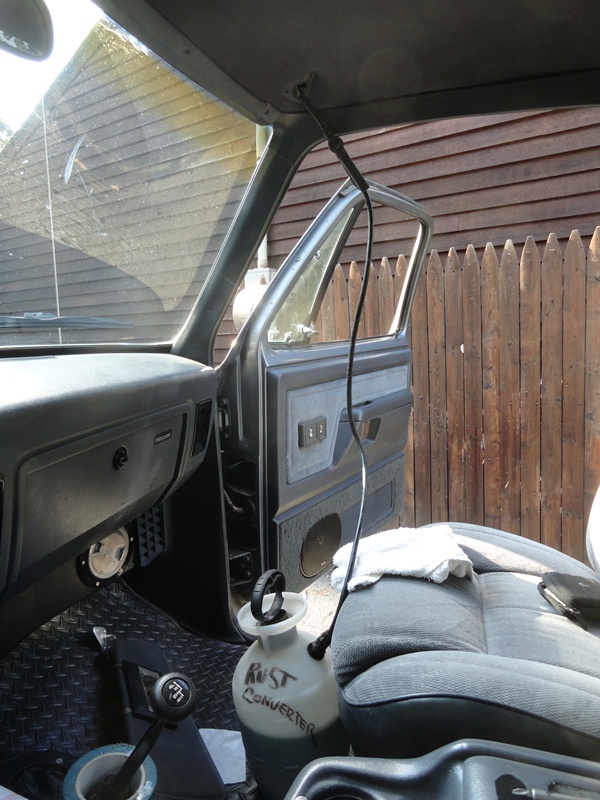
After about a quart or so of the fluid leaked out, I did the rear sector by removing the cab's cargo light and pumped it in as well. It too rolled out the drivers side (pitch of the truck) but I never expected it to come out just above my speaker in the rear of the cab. What a PITA that was. After sticking a bunch of rags into the gap above the speaker, I was eventually able to contain it.

Phosphoric Acid is STINKY and burns like hell. Don't do this without being prepared ....
After it sits overnight, it will be neutralized naturally by the moisture in the air. Anything it touched with rust on it's surface, will be now a black oxide.... and much more resistant to rusting..... for the next several years, anyway.
While I had the stuff out, I removed both taillamps and sprayed inside the body cavity above each rear tire, inside both front fenders, and behind the body in the bed in front of the rear tires.
Hoping this puts it to rest for a while...
So... what have you guys done to help resist rust ?
Today, I did something I wasn't looking forwards to, but it went well otherwise.
Being I had a 93 with a rotted roof, I didn't want my 92 to follow suit.... or not that soon anyway. Since it's spent most of it's existence in a salt free environment, then it was sold to me, the least I could do was to help prevent some of the salt air I live in, and the road salt from getting to the old pig...
I removed the passenger side sunshade, and used it's hole as an access to "rust resist" from inside. Notice, I didn't say rust proof, as I don't believe it's possible.... but ....
So I put the truck on a slight incline, and sprayed away. One thing I never expected was the amount of spray to wind up on the floor of the truck. It found its way all the way down into the footwell as I guess there is a pathway for it to follow down the pillar on both sides. Since it was on a hill, the fluid rolled where I wanted it to.... down the inner roofline to the drivers side from the passenger side hole I accessed, and out onto the floor. I then turned the truck around and let it roll into the other side through the same access holes cover the entire perimeter of the roof. here's it in action..
After about a quart or so of the fluid leaked out, I did the rear sector by removing the cab's cargo light and pumped it in as well. It too rolled out the drivers side (pitch of the truck) but I never expected it to come out just above my speaker in the rear of the cab. What a PITA that was. After sticking a bunch of rags into the gap above the speaker, I was eventually able to contain it.
Phosphoric Acid is STINKY and burns like hell. Don't do this without being prepared ....
After it sits overnight, it will be neutralized naturally by the moisture in the air. Anything it touched with rust on it's surface, will be now a black oxide.... and much more resistant to rusting..... for the next several years, anyway.
While I had the stuff out, I removed both taillamps and sprayed inside the body cavity above each rear tire, inside both front fenders, and behind the body in the bed in front of the rear tires.
Hoping this puts it to rest for a while...
So... what have you guys done to help resist rust ?

Registered User
Joined: Mar 2012
Posts: 160
Likes: 6
From: Indiana
Both my trucks are rust free Oregon trucks and I did the same as you. Bedside rust is 100% preventable by keeping the inner wheel arches clean of debris and oiled several times a year by removing the tail light lenses.Also I removed the plastic plugs located on the inside of the rockers and I spray WD 40 inside the rockers. Excess runs out the pinch welds on the bottom. There are also plastic plugs located at the rear left and right side of the cab behind the seat belt anchors that I remove and spray WD40 in. This covers the inside of the cab corners. It drains out the bottom of the cab corners. For flat surfaces under the truck like floorboards and bed floor I have found CRC Marine Heavy Duty Corrosion Inhibitor to be by far the best product in my 35 years of fighting rust in Northern Indiana. It was originally designed for salt water marine applications and it works great, doesnt make a mess, is transparent, doesnt flake or peel and stays put for years. I also spray oil inside my doors til it runs out the drains....it make rust unable to form in the crevice between the door and doorskin and rot your door inside out.
Thread Starter
Registered User
Joined: Dec 2010
Posts: 6,838
Likes: 1,683
From: Land of the Toxic Avenger
..... I have found CRC Marine Heavy Duty Corrosion Inhibitor to be by far the best product in my 35 years of fighting rust in Northern Indiana. It was originally designed for salt water marine applications and it works great, doesnt make a mess, is transparent, doesnt flake or peel and stays put for years......
I've read about a product called "Fluid-Film" and it appears that it works well for snow plow trucks, at keeping them rust free. Lanolin based, it acts as a shield against moisture. Haven't used it yet, but it looks promising.

Registered User
Joined: Aug 2004
Posts: 128
Likes: 0
From: Woodbridge Virginia
I do the same thing you do annually, but use WD40. Many have said that WD40 does not leave a residue but my research indicates it does. I use WD 40 Big Blast and spray the entire underside occasionally as well.
Thread Starter
Registered User
Joined: Dec 2010
Posts: 6,838
Likes: 1,683
From: Land of the Toxic Avenger
I read a few reviews of the CRC Corrosion inhibitor, and it appears it leaves a thick amber type residue, that's somewhat tacky. It was one of the favorites in this test...
+++++++++++++++++++++++++++++++++++++++++++++
A copy of the copy of april 07 "power boat magazine" test ..
Metal Maintenance: 12 Corrosion Inhibitors (Salt Water) Tested
What keeps corrosion at bay best in the marine environment? We found out by testing a dozen corrosion inhibitors, including products from well-known names such as CRC, WD-40, LPS, and Boeshield. One of mankind’s greatest early achievements was the extraction of pure metal from rock. The process takes ingenuity and consumes vast amounts of energy. So it is with considerable frustration that we watch nature so easily reclaim what we have wrought at such cost. Few are more familiar with corrosion than mariners, who fight a constant battle against it in the salty interface between sea and sky.
Each of the test products was applied to two mild steel strips—one to be suspended in salt water and the other to be sprayed with fresh water. The strips pictured here are post testing; the left strip of each pair is the freshwater panel.
A visit to the hardware store or a search on the Internet reveals no shortage of products to address, and even redress, corrosion—most are touted as being able to penetrate ("frees rusted parts"), lubricate, or protect electrical components. Here we examine the corrosion-inhibiting properties.
What We Tested
We chose the products based largely on their advertized claims and also on how easy they were to find. Several are available in hardware stores. West Marine carries its private-label product, CorrosionPro Lube, as well as CRC Heavy Duty Corrosion Inhibitor, Corrosion Block, Boeshield T-9, and WD-40. CorrosionX, Shark Hide, the LPS products, and TC-11 all popped up during Internet searches. We left out products that made no specific claims for use in the marine environment. Anything that had "rust" and any reference to "marine" or "boats" or "salt spray" was fair game.
Twelve made the roster: PMS Products’ Boeshield T-9; LPS Laboratories’ LPS 1, LPS 2, and LPS 3; Corrosion Technologies Corp.’s CorrosionX and CorrosionX HD; ICC Industries’ TC-11; Lear Chemical Research Corp.’s Corrosion Block; West Marine’s CorrosionPro Lube; CRC Heavy Duty; Shark Hide; and WD-40, because it was already in the workshop.
Each showed different degrees of viscosity, all went on wet, and most stayed wet, or at least tacky. Those that left a waxy coating performed the best in the saltwater test.
None is pleasant to use and all of their containers carry stern warnings about flammability, use in poorly ventilated areas, and against inhaling them. Most use heavier-than-air butane, pentane, or heptane, or a mixture thereof, as propellants, which means there’s a risk of an explosive mixture accumulating in confined spaces such as bilge compartments. Ventilate these areas throroughly before operating anything that might create a spark.
The LPS products use carbon dioxide as propellant, and Corrosion Block nitrogen, but the solvents are still flammable.
Boeshield T-9
According to its maker, Boeshield T-9 is designed for penetration, moisture displacement, lubrication, and rust and corrosion protection. Heavier than some of the other sprays in our test, it dries slightly tacky.
The T-9-coated strip sprayed with fresh water was rust-free after a week. The one submerged in salt water had rust around the screw and at the top after three days. The trend continued through eight days, with more corrosion on the cured side (see sidebar above) than on the uncured side.
Bottom Line: In terms of what our test covered, T-9 works as advertised, even in salt water. Slightly more corrosion at the screw and price edged it out of the top three.
Corrosion Block
Advertised as a corrosion preventor and inhibitor, Corrosion Block is a heavy, blue spray that dries thin, clear, and slightly tacky.
After seven days of freshwater dousing, the Corrosion Block-coated strip showed some rust spots at the top, where we’d expected a thicker coating. The saltwater strip, however, was very rusty after three days—except for an area toward the top. After eight days, it had rust all over it.
Bottom Line: Corrosion Block is OK for freshwater purposes, but not salt water. To be fair, the manufacturer makes no claim regarding rust.
CorrosionPro Lube
West Marine claims its product offers "...excellent water resistance and superior rust and corrosive preventative characteristics." And it does.
This fine spray leaves a visible, amber-colored, waxy coating. The coating remained intact through a week of freshwater dousing, and the metal strip showed no signs of rust. The saltwater strip saw similar success: The coating remained after three days, and there were no signs of rust. It was only after eight days of saltwater abuse that some rust appeared along the "uncured" edge.
Bottom Line: This product does what it claims. The waxy film isn’t pleasant to the touch, but for hard-to-reach parts, it’s on the money.
CorrosionX
This aerosol, which makers claim provides protection against rust and corrosion, initially forms a foamy, blue-green film. The bubbles eventually disappear.
CorrosionX’s freshwater performance was excellent: After seven days, there was no rust and the film was still tacky. (So sticky, in fact, that a few small flies met their end on the metal strip.) Unfortunately, its saltwater efficacy rated at the other end of the spectrum. After eight days, except for a band at the top, the metal strip was very rusty, and particularly corroded around screw.
Bottom Line: CorrosionX works fine in a freshwater environment, but it’s not ready for brine time, especially in a mixed-metal situation.
CorrosionX HD
Think of this as CorrosionX’s big brother: A "high-performance, thick film version of CorrosionX," according to Corrosion Technologies Corp. It comes out as a fine spray with some bubbles and a thick, amber color.
Like its sibling, we rated it Excellent in the freshwater test, but it wasn’t up to the challenge of salt water. The strip in saltwater had a rusty bottom half and a less-rusty top half, almost in proportion to the thickness of its coating. A clear halo appeared where the product accumulated around the nut, and curiously, less corrosion formed on the "uncured" side.
Bottom Line: The sticky film does resist freshwater penetration, but it isn’t immune to salt water, especially for the long term.
CRC Corrosion Inhibitor
CRC Heavy-Duty Corrosion Inhibitor, which is seemingly identical in appearance and performance to CorrosionPro Lube, is made for saltwater use. It claims to protect and preserve metal surfaces subject to salt spray and high humidity. It comes out as a fine spray with a thick coating.
The freshwater test strip still had a sufficient coating and no rust after seven days. It was equally impressive in the saltwater test: coating intact and no rust after eight days.
Bottom Line: Excellent performance. It lives up to its claims.
LPS 1
LPS Labs offers three products with three levels of rust protection. LPS 1 is marketed as a greaseless lubricant that displaces moisture. Colorless, it has a broad spray range.
In the freshwater test, the LPS 1 panel only had some rust on the uncured side after a week. After three days in salt water, the strip was very rusty, except at the top, and by Day 8, it had rusted all over. The brass screw also showed signs of rust, as though iron were being transported to its surface by galvanic action, there to repeat its demise (just a guess).
Bottom Line: LPS literature says the product displaces moisture on electronic components and that its light, greaseless film inhibits corrosion. It doesn’t claim to prevent rust, but it works for fresh water, if given time to cure. The broad spray pattern made it difficult to concentrate the product where it was wanted.
LPS 2
LPS 2 is touted as a multi-purpose lubricant and penetrant with added corrosion protection. It’s a colorless, fine spray with a strong almond odor and broad spray pattern.
The freshwater LPS 2 panel had no rust after three days, but some after seven days; more on the "uncured" side. After three days, the saltwater test strip exhibited extensive rusting, and after eight days, it was completely corroded.
Bottom Line: LPS 2 claims to provide protection indoors for a year, and its performance indicates that as its limit. It is not useful in salt water.
LPS 3
The strongest of the LPS series, LPS 3 claims to be a long-term, heavy-duty rust inhibitor, even in the harshest environment. Its bubbly, thick spray forms a waxy, pale brown coating.
The CRC spray (left) is the least expensive of the three products that showed no rust in saltwater. The CorrosionX HD saltwater panel (right), like several other test panels, had more rust on its bottom half than its top half, and oddly, it had less rust on its “uncured” side.
After a week of freshwater exposure, there was no sign of rust and the coating was still tacky. And even after eight days of saltwater torture, the LPS 3 panel showed no sign of rust and it was still very sticky.
Bottom Line: We tested it under "harsh conditions," and it does what it claims—but it’s not pretty.
Shark Hide
Shark Hide claims to be a protective coating against weathering and salt spray. Marketed mainly to owners of aluminum pontoon boats and similar craft, it lists steel among the surfaces it can be used on.
Unlike the other test products, Shark’s Hide is a thin, colorless liquid—not an aerosol—that wipes on with soft cloth. It’s a thin liquid, and has really nasty solvents (toluene and xylene)—so be sure to apply it in the open air and wear gloves.
The freshwater test strip showed rust spots on the "uncured" side after three days. But there was no rust on the cured side, even after a week.
The saltwater panel’s uncured side was rather rusty after three days, but the other side had only mottled rust. Even after eight days, the coupon wasn’t completely rusted.
Bottom Line: Shark’s Hide works well in fresh water when allowed to cure. And it performed better than expected (Fair) in salt water for having such an invisible coating. It’s easy to apply to large, smooth surfaces, less so to small parts like nuts and bolts.
TC-11
TC-11 is the "complete answer for rust control," according to its maker. The bubbly, blue-green spray forms a thick coating that was still sticky after a week of freshwater exposure. It kept the freshwater panel rust-free after seven days.
The saltwater panel did not fare as well: After three days, it had extensive rusting, and after eight days, only the very top was rust-free.
Bottom Line: This product isn’t the silver bullet—but it works in fresh water.
WD-40
Nearly as ubiquitous as duct tape, WD-40 claims to protect against rust and corrosion.
Although the fine, colorless spray’s coating was dry after a week of freshwater sprays, the panel had no rust.
However, after three days in salt water, the metal strip was completely rusted, except the top. After eight days, only the very top was showing resistance.
Bottom Line: This product works well in fresh water—and makes no greater claims.
Conclusions
Our salt water test is admittedly harsh, and quickly produced results. After three days, most of the steel coupons were significantly rusty. Only three saltwater test panels showed no corrosion: Those coated with CorrosionPro Lube, CRC Heavy Duty, and LPS-3.
Of the remainder, the Boeshield T-9 panel showed the least corrosion, followed by the cured Shark Hide. (The cured vs. non-cured results support the notion that it pays to follow instructions. Most non-cured sides mimicked the control panel.)
In the freshwater test, the Shark Hide remained rust free. It might be the answer for stainless steel rigging, stern rails, etc., because it leaves no sticky residue—however, it’s an expensive solution.
At 63¢ per ounce, CRC gets the Best Buy nod. For day-to-day use, loosening sticky mechanical parts, or softening greasy deposits, WD-40 works and is inexpensive.
In our opinion, the perfect solution still evades us. Where iron-based alloys are unavoidable and stainless steel isn’t suitable, the best protection against the ravages of salt water is a coat of paint.
Where paint isn’t an option, long-term protection against rust requires the use of sticky, dirt-attracting coatings, like the top performers in this test.
+++++++++++++++++++++++++++++++++++++++++++++
A copy of the copy of april 07 "power boat magazine" test ..
Metal Maintenance: 12 Corrosion Inhibitors (Salt Water) Tested
What keeps corrosion at bay best in the marine environment? We found out by testing a dozen corrosion inhibitors, including products from well-known names such as CRC, WD-40, LPS, and Boeshield. One of mankind’s greatest early achievements was the extraction of pure metal from rock. The process takes ingenuity and consumes vast amounts of energy. So it is with considerable frustration that we watch nature so easily reclaim what we have wrought at such cost. Few are more familiar with corrosion than mariners, who fight a constant battle against it in the salty interface between sea and sky.
Each of the test products was applied to two mild steel strips—one to be suspended in salt water and the other to be sprayed with fresh water. The strips pictured here are post testing; the left strip of each pair is the freshwater panel.
A visit to the hardware store or a search on the Internet reveals no shortage of products to address, and even redress, corrosion—most are touted as being able to penetrate ("frees rusted parts"), lubricate, or protect electrical components. Here we examine the corrosion-inhibiting properties.
What We Tested
We chose the products based largely on their advertized claims and also on how easy they were to find. Several are available in hardware stores. West Marine carries its private-label product, CorrosionPro Lube, as well as CRC Heavy Duty Corrosion Inhibitor, Corrosion Block, Boeshield T-9, and WD-40. CorrosionX, Shark Hide, the LPS products, and TC-11 all popped up during Internet searches. We left out products that made no specific claims for use in the marine environment. Anything that had "rust" and any reference to "marine" or "boats" or "salt spray" was fair game.
Twelve made the roster: PMS Products’ Boeshield T-9; LPS Laboratories’ LPS 1, LPS 2, and LPS 3; Corrosion Technologies Corp.’s CorrosionX and CorrosionX HD; ICC Industries’ TC-11; Lear Chemical Research Corp.’s Corrosion Block; West Marine’s CorrosionPro Lube; CRC Heavy Duty; Shark Hide; and WD-40, because it was already in the workshop.
Each showed different degrees of viscosity, all went on wet, and most stayed wet, or at least tacky. Those that left a waxy coating performed the best in the saltwater test.
None is pleasant to use and all of their containers carry stern warnings about flammability, use in poorly ventilated areas, and against inhaling them. Most use heavier-than-air butane, pentane, or heptane, or a mixture thereof, as propellants, which means there’s a risk of an explosive mixture accumulating in confined spaces such as bilge compartments. Ventilate these areas throroughly before operating anything that might create a spark.
The LPS products use carbon dioxide as propellant, and Corrosion Block nitrogen, but the solvents are still flammable.
Boeshield T-9
According to its maker, Boeshield T-9 is designed for penetration, moisture displacement, lubrication, and rust and corrosion protection. Heavier than some of the other sprays in our test, it dries slightly tacky.
The T-9-coated strip sprayed with fresh water was rust-free after a week. The one submerged in salt water had rust around the screw and at the top after three days. The trend continued through eight days, with more corrosion on the cured side (see sidebar above) than on the uncured side.
Bottom Line: In terms of what our test covered, T-9 works as advertised, even in salt water. Slightly more corrosion at the screw and price edged it out of the top three.
Corrosion Block
Advertised as a corrosion preventor and inhibitor, Corrosion Block is a heavy, blue spray that dries thin, clear, and slightly tacky.
After seven days of freshwater dousing, the Corrosion Block-coated strip showed some rust spots at the top, where we’d expected a thicker coating. The saltwater strip, however, was very rusty after three days—except for an area toward the top. After eight days, it had rust all over it.
Bottom Line: Corrosion Block is OK for freshwater purposes, but not salt water. To be fair, the manufacturer makes no claim regarding rust.
CorrosionPro Lube
West Marine claims its product offers "...excellent water resistance and superior rust and corrosive preventative characteristics." And it does.
This fine spray leaves a visible, amber-colored, waxy coating. The coating remained intact through a week of freshwater dousing, and the metal strip showed no signs of rust. The saltwater strip saw similar success: The coating remained after three days, and there were no signs of rust. It was only after eight days of saltwater abuse that some rust appeared along the "uncured" edge.
Bottom Line: This product does what it claims. The waxy film isn’t pleasant to the touch, but for hard-to-reach parts, it’s on the money.
CorrosionX
This aerosol, which makers claim provides protection against rust and corrosion, initially forms a foamy, blue-green film. The bubbles eventually disappear.
CorrosionX’s freshwater performance was excellent: After seven days, there was no rust and the film was still tacky. (So sticky, in fact, that a few small flies met their end on the metal strip.) Unfortunately, its saltwater efficacy rated at the other end of the spectrum. After eight days, except for a band at the top, the metal strip was very rusty, and particularly corroded around screw.
Bottom Line: CorrosionX works fine in a freshwater environment, but it’s not ready for brine time, especially in a mixed-metal situation.
CorrosionX HD
Think of this as CorrosionX’s big brother: A "high-performance, thick film version of CorrosionX," according to Corrosion Technologies Corp. It comes out as a fine spray with some bubbles and a thick, amber color.
Like its sibling, we rated it Excellent in the freshwater test, but it wasn’t up to the challenge of salt water. The strip in saltwater had a rusty bottom half and a less-rusty top half, almost in proportion to the thickness of its coating. A clear halo appeared where the product accumulated around the nut, and curiously, less corrosion formed on the "uncured" side.
Bottom Line: The sticky film does resist freshwater penetration, but it isn’t immune to salt water, especially for the long term.
CRC Corrosion Inhibitor
CRC Heavy-Duty Corrosion Inhibitor, which is seemingly identical in appearance and performance to CorrosionPro Lube, is made for saltwater use. It claims to protect and preserve metal surfaces subject to salt spray and high humidity. It comes out as a fine spray with a thick coating.
The freshwater test strip still had a sufficient coating and no rust after seven days. It was equally impressive in the saltwater test: coating intact and no rust after eight days.
Bottom Line: Excellent performance. It lives up to its claims.
LPS 1
LPS Labs offers three products with three levels of rust protection. LPS 1 is marketed as a greaseless lubricant that displaces moisture. Colorless, it has a broad spray range.
In the freshwater test, the LPS 1 panel only had some rust on the uncured side after a week. After three days in salt water, the strip was very rusty, except at the top, and by Day 8, it had rusted all over. The brass screw also showed signs of rust, as though iron were being transported to its surface by galvanic action, there to repeat its demise (just a guess).
Bottom Line: LPS literature says the product displaces moisture on electronic components and that its light, greaseless film inhibits corrosion. It doesn’t claim to prevent rust, but it works for fresh water, if given time to cure. The broad spray pattern made it difficult to concentrate the product where it was wanted.
LPS 2
LPS 2 is touted as a multi-purpose lubricant and penetrant with added corrosion protection. It’s a colorless, fine spray with a strong almond odor and broad spray pattern.
The freshwater LPS 2 panel had no rust after three days, but some after seven days; more on the "uncured" side. After three days, the saltwater test strip exhibited extensive rusting, and after eight days, it was completely corroded.
Bottom Line: LPS 2 claims to provide protection indoors for a year, and its performance indicates that as its limit. It is not useful in salt water.
LPS 3
The strongest of the LPS series, LPS 3 claims to be a long-term, heavy-duty rust inhibitor, even in the harshest environment. Its bubbly, thick spray forms a waxy, pale brown coating.
The CRC spray (left) is the least expensive of the three products that showed no rust in saltwater. The CorrosionX HD saltwater panel (right), like several other test panels, had more rust on its bottom half than its top half, and oddly, it had less rust on its “uncured” side.
After a week of freshwater exposure, there was no sign of rust and the coating was still tacky. And even after eight days of saltwater torture, the LPS 3 panel showed no sign of rust and it was still very sticky.
Bottom Line: We tested it under "harsh conditions," and it does what it claims—but it’s not pretty.
Shark Hide
Shark Hide claims to be a protective coating against weathering and salt spray. Marketed mainly to owners of aluminum pontoon boats and similar craft, it lists steel among the surfaces it can be used on.
Unlike the other test products, Shark’s Hide is a thin, colorless liquid—not an aerosol—that wipes on with soft cloth. It’s a thin liquid, and has really nasty solvents (toluene and xylene)—so be sure to apply it in the open air and wear gloves.
The freshwater test strip showed rust spots on the "uncured" side after three days. But there was no rust on the cured side, even after a week.
The saltwater panel’s uncured side was rather rusty after three days, but the other side had only mottled rust. Even after eight days, the coupon wasn’t completely rusted.
Bottom Line: Shark’s Hide works well in fresh water when allowed to cure. And it performed better than expected (Fair) in salt water for having such an invisible coating. It’s easy to apply to large, smooth surfaces, less so to small parts like nuts and bolts.
TC-11
TC-11 is the "complete answer for rust control," according to its maker. The bubbly, blue-green spray forms a thick coating that was still sticky after a week of freshwater exposure. It kept the freshwater panel rust-free after seven days.
The saltwater panel did not fare as well: After three days, it had extensive rusting, and after eight days, only the very top was rust-free.
Bottom Line: This product isn’t the silver bullet—but it works in fresh water.
WD-40
Nearly as ubiquitous as duct tape, WD-40 claims to protect against rust and corrosion.
Although the fine, colorless spray’s coating was dry after a week of freshwater sprays, the panel had no rust.
However, after three days in salt water, the metal strip was completely rusted, except the top. After eight days, only the very top was showing resistance.
Bottom Line: This product works well in fresh water—and makes no greater claims.
Conclusions
Our salt water test is admittedly harsh, and quickly produced results. After three days, most of the steel coupons were significantly rusty. Only three saltwater test panels showed no corrosion: Those coated with CorrosionPro Lube, CRC Heavy Duty, and LPS-3.
Of the remainder, the Boeshield T-9 panel showed the least corrosion, followed by the cured Shark Hide. (The cured vs. non-cured results support the notion that it pays to follow instructions. Most non-cured sides mimicked the control panel.)
In the freshwater test, the Shark Hide remained rust free. It might be the answer for stainless steel rigging, stern rails, etc., because it leaves no sticky residue—however, it’s an expensive solution.
At 63¢ per ounce, CRC gets the Best Buy nod. For day-to-day use, loosening sticky mechanical parts, or softening greasy deposits, WD-40 works and is inexpensive.
In our opinion, the perfect solution still evades us. Where iron-based alloys are unavoidable and stainless steel isn’t suitable, the best protection against the ravages of salt water is a coat of paint.
Where paint isn’t an option, long-term protection against rust requires the use of sticky, dirt-attracting coatings, like the top performers in this test.
Registered User
Joined: Mar 2012
Posts: 160
Likes: 6
From: Indiana
It will leave an amber residue in thicker applications that is still translucent (most notably on a light colored surface). It dries to the point where you can touch it and it doesnt come off on your fingers. And it stays on even if you wash the underside of your truck, which I wasnt sure fluid film would.

Registered User
Joined: Dec 2010
Posts: 273
Likes: 0
From: Waynesboro Georgia
We used to use the CRC on all the electrical connections on fire trucks when I worked at E-one. It is a light amber haze and kind of soft to the touch. It was called soft seal. Did a real good job.
Trending Topics

Registered User
Joined: Sep 2009
Posts: 196
Likes: 4
You are most likely not going to want to hear this, but there are three layers of sheetmetal. The outer roof, the roof support structure, and then the inner headliner panel. I think if you go through the visor holes, you do get the more critical section, so you are doing youself alot of good.
I was fortunate enough to find a good cab to replace my old rusted one. While it was only a bare cab, I was able to flip it, or roll it in any direction, so through the clearance light holes, visor holes, bed light holes, and a few added headliner holes, I poured in some por 15. I'm pretty confident the roof will outlast the rest of the truck. The inner roof has no paint or galvinizing, so any moisture will attack the bare sheetmetal.
Another thing that is very critical on these trucks, is the rockers. Most people dont realize that ALL the water that goes into the cowl drains(by design) into the rockers. The bottom seam on the rockers have three or four open spots for water to drain from. They must all be clean/open. There is an oval sheetmetal cleanout hole on the front of the cab/rockers. Two screws hold them on along with some sealer. These holes are behind the inner wheel houses behind the front tire. A blow gun to clean and dry the inner sections along with some sort of rust preventative in there is also a good idea. Just be sure that whatever you put in there doesn't plug the water drain holes.
I was fortunate enough to find a good cab to replace my old rusted one. While it was only a bare cab, I was able to flip it, or roll it in any direction, so through the clearance light holes, visor holes, bed light holes, and a few added headliner holes, I poured in some por 15. I'm pretty confident the roof will outlast the rest of the truck. The inner roof has no paint or galvinizing, so any moisture will attack the bare sheetmetal.
Another thing that is very critical on these trucks, is the rockers. Most people dont realize that ALL the water that goes into the cowl drains(by design) into the rockers. The bottom seam on the rockers have three or four open spots for water to drain from. They must all be clean/open. There is an oval sheetmetal cleanout hole on the front of the cab/rockers. Two screws hold them on along with some sealer. These holes are behind the inner wheel houses behind the front tire. A blow gun to clean and dry the inner sections along with some sort of rust preventative in there is also a good idea. Just be sure that whatever you put in there doesn't plug the water drain holes.
Thread Starter
Registered User
Joined: Dec 2010
Posts: 6,838
Likes: 1,683
From: Land of the Toxic Avenger
DID anyone here ever install a skylight in our trucks ? If so, that gaping hole would have allowed magnificent access. I've thought about drilling holes in the interior to the outer layer of steel, and shooting the other layer with the same RConv stuff. I'd match the holes to a set of plugs I could find to fit them afterwords, that way I could occasionally respray.
I did the best I could, so I have to just deal with whatever happens next. Hopefully, as you said, I got the worst of it.... so we'll see....
Good tip about the clogging the slots. Thanks for reminding me. Luckily our doors have really big holes in the bottom
I removed the plugs in the rockers a few months back and loaded them up with the Rconvtr spray. It has a 24" wand, and I could go from front to back. Did in the extra cab area as well both from inside and outside via the plugs, so for this year I guess I'm ok.

Registered User
Joined: May 2007
Posts: 1,437
Likes: 208
From: Saskatchewan
Do you guys have rust check in the states? It can be bought at Canadian tire here, used it extensively when putting my truck together. Found evidence recently that the stuff climbed a foot vertically, pretty impressive
Thread Starter
Registered User
Joined: Dec 2010
Posts: 6,838
Likes: 1,683
From: Land of the Toxic Avenger
http://www.rustcheck.com/index.php?o...121&Itemid=138
Did you have to re-apply, and if so, did you do it, or did a service center do it ? Nearest place to me is in Syracuse NY.... oh, about 300 miles

Registered User
Joined: Feb 2011
Posts: 207
Likes: 28
From: Maine
I drilled holes in the inside roof of mine to get above and below the middle sheetmetal. There's not much room so DO NOT use a normal step drill. They make special "shorty" drill bits just for things like this. I used Fluid film and the one problem I had was the first hot day, the stuff came running down the a pillar onto the floor or out the trim holes and dripped onto the floor mats. That CRC marine stuff sounds the perfect stuff. I contemplated eastwood internal frame coating but envisioned it trapping moisture for some reason.
This is the panel between the inner and outer
http://ramchargercentral.com/vehicle...44/#msg1726744
This is the panel between the inner and outer
http://ramchargercentral.com/vehicle...44/#msg1726744

Registered User
Joined: Nov 2007
Posts: 2,081
Likes: 3
From: Wisconsin
I started using Fluid Film last year, so not long enough to say how well it works. There was a guy on here who removed his headliner, and cut the inner roof open above it. He replaced it with a panel from a junk yard that he cut slightly larger, and fastened it with pop rivets. Not as good as a sun roof, but something.

Registered User
Joined: Mar 2010
Posts: 7,265
Likes: 1,346
From: Prince George, BC
I use old motor oil....squirt it up, in and around the truck in all the nooks and crannies. I just did mine last week...only end up using 1/2 quart or so. And other then regular spray downs under the truck when washing...to get salt, sand and dirt out of the critical areas..this is all I ever do.