


more fuel for the VE?


Adminstrator-ess

Joined: Mar 2003
Posts: 22,594
Likes: 19
From: New Holland, PA
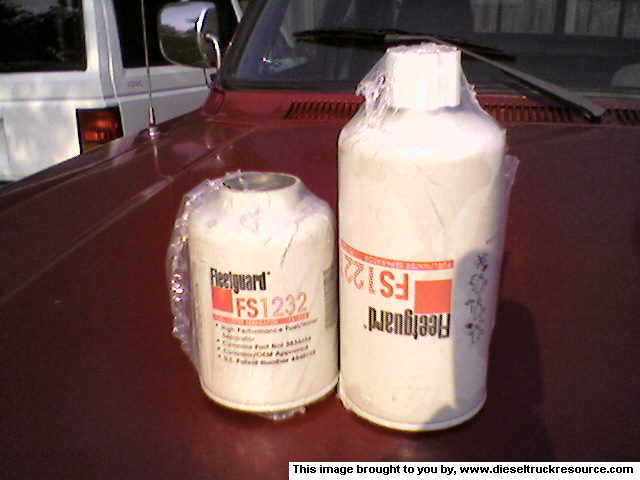
Been doing some poking around and found longer fuel filters. Fleetguard FS1221 is 7 inches long, the stocker is only 4 7/16". The Donaldson cross is P550688, but it's only 6.75" long. Hastings/Baldwin cross is about the same. Wix is only 5.5".
Only drawback is you lose the WIF sensor. I know what my next fuel filter will be.
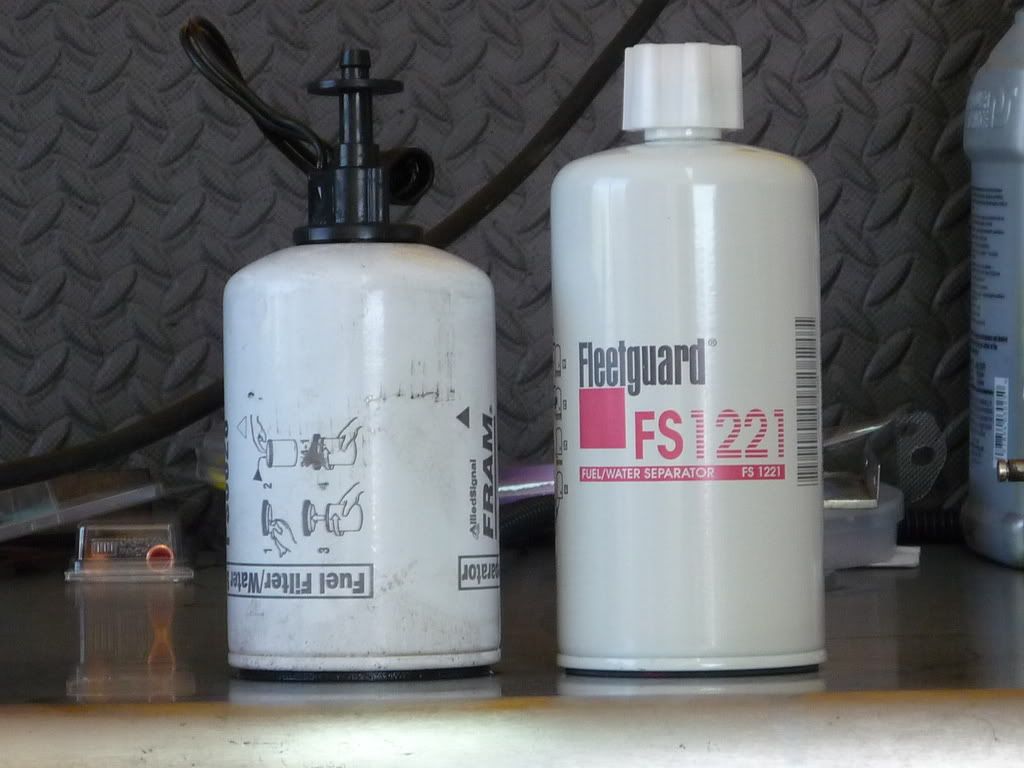
Photo courtesy of Hot Dawg
Only drawback is you lose the WIF sensor. I know what my next fuel filter will be.
Photo courtesy of Hot Dawg

Adminstrator-ess
Joined: Mar 2003
Posts: 22,594
Likes: 19
From: New Holland, PA
It is a filter/separator with a drain valve built in.
Even if you figure the drain valve adds about 3/4" to the length, that's still almost 50% more filter area. That can't help but reduce the pressure drop across the filter.
Stock:

FS1221:

Even if you figure the drain valve adds about 3/4" to the length, that's still almost 50% more filter area. That can't help but reduce the pressure drop across the filter.
Stock:
FS1221:

Registered User
Joined: Apr 2005
Posts: 3,253
Likes: 0
From: Terre Haute,IN
FS1221 should be about a buck cheaper than FS1232. It's what I use on two of the three B's I have. Baldwin cross reference is easy, it's BF1221. 22 micron vs 25 micron on the stock fs1232.

Registered User
Joined: May 2003
Posts: 758
Likes: 0
From: Colorado
Ok so back to the original question. If there is a check valve in the system. Then the extra fuel system would not come into affect unless fuel pressure to the head dropped. I think we have a whole big can of worms opened. This can go many directions.
Lets see some trial and error or trial and success!
Lets see some trial and error or trial and success!


Thread Starter
Registered User
Joined: Aug 2005
Posts: 319
Likes: 0
From: Nebraska
Dave that filter seems like a real good upgrade for everyone. I must admit your idea seems like a more ecomical approach to the problem. I am working on a slightly different approach now. I'm going to run a Davco filter assembly capable of about 100 GPH flow. The filter unit will have a heater, drain, water in fuel sensor and dual inlets/outlets. A 15 psi gerotor fuel pump will deliver the fuel to the one inlet under demand and the other will be fed by the piston pump under normal conditions. Both inlets will have check valves to prevent air entry and backflow. The electric pump will have its own fuel feed line. I also am going to utilize sort of a valet feature on the secondary pump. The operator must "ARM" the system by turning on a keyed switch in the dash marked "ENGINE POWER" like the ZR-1 corvette, a hobbs switch and possibly a throttle position switch will then be supplied power and when all is right they will activate the relay for the fuel pump.
Adminstrator-ess
Joined: Mar 2003
Posts: 22,594
Likes: 19
From: New Holland, PA
With only 15 psi to the filter you will find that you can't maintain 15 psi after the filter even with both pumps working. The filter is a false load in the system. This is why I'm going with a high volume/pressure pump with the regulator after the filter. Even if the pressure drop through the filter is 20 psi, this system will be able to maintain 15 psi at the VE easily.
Aren't those Davcos for the suction side only? That's what's on my truck at work, a Davco 384. They are really cool, I like how they fill up as they get dirty. I'd like to put one of them in the bed of my truck on the suction side of the new system, then go to a straight fuel filter on the engine instead of a fuel/water seperator.
P.S. No parts yet.
Aren't those Davcos for the suction side only? That's what's on my truck at work, a Davco 384. They are really cool, I like how they fill up as they get dirty. I'd like to put one of them in the bed of my truck on the suction side of the new system, then go to a straight fuel filter on the engine instead of a fuel/water seperator.
P.S. No parts yet.
Thread Starter
Registered User
Joined: Aug 2005
Posts: 319
Likes: 0
From: Nebraska
Well I'm on the fence between the davco and the new luberfiner spin on that is very similar in design to our current filter as it has a drain and water in fuel sensor. I am unsure if the davco I end up selecting is going to be for the suction side or not there are just a bunch of options. The luberfiner is for the pressure side for sure, but I haven't got a hold of the flow rate yet.
As for the concern about low vs high pressure pumps one must be sure that they have enough volume as well. We run slightly more than double the fuel pressure with the piston pump. 15-18 psi has been proven to work well with the fuel system, but greater pressure has been known to cause pump seals to fail. The solution is to provide a greater volume of fuel at the same pressure to the ve under load. This will keep the timing advance functional and give us the extra coals under the fire were all looking for.
Supposedly, it takes something like 0.06 gallons per hour to maintain one horsepower in a diesel engine (excluding acceleration). The isn't a mention of pressure in the equation. So figure for 300 HP figure, say 20 GPH. But, then theres load, so to be safe take it up a few notches. I figure 95-100 GPH @15 psi should let the little ve throw the smack down and allow room for future upgrades. I also have selected a gerotor pump as there are no vanes to break and contaminate the fuel, I also believe the chance of fuel aeration is greatly reduced.
As for the concern about low vs high pressure pumps one must be sure that they have enough volume as well. We run slightly more than double the fuel pressure with the piston pump. 15-18 psi has been proven to work well with the fuel system, but greater pressure has been known to cause pump seals to fail. The solution is to provide a greater volume of fuel at the same pressure to the ve under load. This will keep the timing advance functional and give us the extra coals under the fire were all looking for.
Supposedly, it takes something like 0.06 gallons per hour to maintain one horsepower in a diesel engine (excluding acceleration). The isn't a mention of pressure in the equation. So figure for 300 HP figure, say 20 GPH. But, then theres load, so to be safe take it up a few notches. I figure 95-100 GPH @15 psi should let the little ve throw the smack down and allow room for future upgrades. I also have selected a gerotor pump as there are no vanes to break and contaminate the fuel, I also believe the chance of fuel aeration is greatly reduced.
Adminstrator-ess
Joined: Mar 2003
Posts: 22,594
Likes: 19
From: New Holland, PA
The system I'm building will not exceed 15 psi at the VE. The regulator is after the filter, so full pump pressure is available (if needed) to force enough fuel through the filter to maintain 15 psi at all times. If pressure drop through the filter is around 10 psi, I will have 65 GPH available at the VE.
We do have to oversize the feed pump by a good margin because of the overflow valve on the VE as well as the return from the injectors. Not all the fuel that goes into the VE winds up in the cylinders, at least half of it goes right back in the tank.
We do have to oversize the feed pump by a good margin because of the overflow valve on the VE as well as the return from the injectors. Not all the fuel that goes into the VE winds up in the cylinders, at least half of it goes right back in the tank.

Registered User
Joined: Jul 2008
Posts: 1,054
Likes: 6
From: all over see below
Been doing some poking around and found longer fuel filters. Fleetguard FS1221 is 7 inches long, the stocker is only 4 7/16". The Donaldson cross is P550688, but it's only 6.75" long. Hastings/Baldwin cross is about the same. Wix is only 5.5".
Only drawback is you lose the WIF sensor. I know what my next fuel filter will be.
Photo courtesy of Hot Dawg
Only drawback is you lose the WIF sensor. I know what my next fuel filter will be.
Photo courtesy of Hot Dawg

Thread
Thread Starter
Forum
Replies
Last Post
Skidoo01
Performance and Accessories 2nd gen only
5
Jan 29, 2010 10:22 PM
Commatoze
Other
8
Nov 20, 2003 06:06 PM