


Twins Wastegate Question...


Registered User
Joined: Apr 2004
Posts: 8,234
Likes: 1
From: Texas/Oklahoma Border
I had a Tial 38mm and it works well! Ignore the PSI ratings on the springs. I had their stiffest spring...blue, I think, at 21 psi.
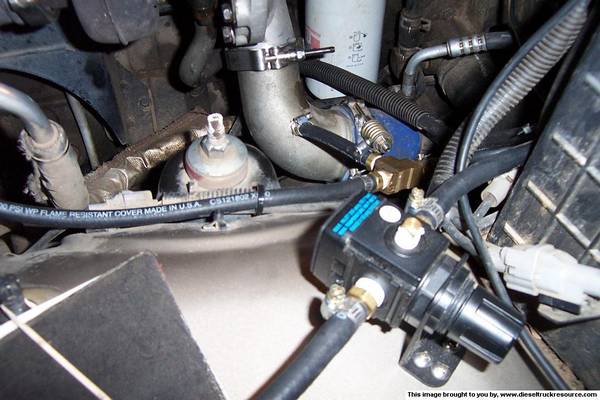
You plumb it with full boost into the bottom (fighting the spring) and with regulated boost into the top (helping the spring). You determine the boost at which it opens, by setting the difference between the two. I used a Wilkerson #RO8-02-F000 regulator ($19.95)...see second pic.

RJ
You plumb it with full boost into the bottom (fighting the spring) and with regulated boost into the top (helping the spring). You determine the boost at which it opens, by setting the difference between the two. I used a Wilkerson #RO8-02-F000 regulator ($19.95)...see second pic.
RJ

The Guru
Joined: Jan 2004
Posts: 6,589
Likes: 0
From: Airdrie Canada
Rj, why did you use an external wastegate? No internal wastegate? Looking at your brass tee. You have one fitting on the turbo discharge nozzle and one to the external wastegate. Where the other one at? Is the other one attached at the adjustable valve on the fender? You using that valve as a vent. A nice easy way of adjusting your wastegate based upon turbo boost. How repeatable is the set-up for regulating you final boost number? I never thought of doing it that way.
Registered User
Joined: Apr 2004
Posts: 8,234
Likes: 1
From: Texas/Oklahoma Border
Rj, why did you use an external wastegate? No internal wastegate? Looking at your brass tee. You have one fitting on the turbo discharge nozzle and one to the external wastegate. Where the other one at? Is the other one attached at the adjustable valve on the fender? .
Boost comes off turbo outlet to the 'T'. One line goes from 'T' directly to bottom of Ext WG (full boost pressure). Other line off back of 'T' goes to Wilkerson Regulator... then to top of Tial WG. Regulator controls how much boost you allow to assist the internal 21 psi spring in closing off the waste gate.
I guess that is your answer...there are two air lines going to the Tial wastegate... maybe you missed to top one?
I installed the External WG when I had a KSB-1 with no wastegate. Allowed me to stay with that turbo and add additional 75 HP. with good success, and was a fun winter project. Did not use the Ext WG with this HX-55 but at the time was the only exhaust manifold I had.
RJ

Registered User
Joined: Jul 2006
Posts: 511
Likes: 0
Question (cause I don't know) - Does the max boost of the primary change when you alter the WG setting on the secondary? I can make an argument for Yes or No.
I'm no expert but got very interested in this topic two yrs ago and have read three books and lots of articles on the subject.... as well as playing with my own twins. Think I have a fair working knowledge of 'twin theory' but admittedly I sometimes get bogged down when trying to explain it.
MY original point was lowering WG setting on top turbo, from where it would normally be on a single, will increase EGT's.... and therefore TIP (drive pressures). Anyone agree ... disagree??
RJ
I'm no expert but got very interested in this topic two yrs ago and have read three books and lots of articles on the subject.... as well as playing with my own twins. Think I have a fair working knowledge of 'twin theory' but admittedly I sometimes get bogged down when trying to explain it.
MY original point was lowering WG setting on top turbo, from where it would normally be on a single, will increase EGT's.... and therefore TIP (drive pressures). Anyone agree ... disagree??
RJ
I noticed that as I relaxed my primary WG more and more my EGT got warmer and was slower / needed more fuel to recover EGT after a fuel surge. At that time I had removed my boost elbow completely, and just used a brass elbow. I had set as low as 1 turn of pre-load on my WG. I could make 50+ psi boost and still my EGT was stuck above 1400F. My thinking in doing that was to let that big bottom turbo do its thing. This I found to be wrong.
I put the boost elbow back in and cranked it down good, like 3/4 open. I also set my WG spring pre-load to about 5 turns. This is about where I ran it as a single and made about 32 psi of boost with it. So I knew the tuning to do that. The difference was very noticeable. For less boost, like the high 40's, EGT's on a fuel surge would go only to 1250F or so. Of course, smoke and responsiveness were down and up. Cruising EGT was also down close to 150F.
I was concerned, so I hooked the drive pressure back up. It is hard for me to see a stable number, but it looked pretty good with a 1:1 ratio until around 40 psi boost. Which was as high as I got the boost for testing. I did not test drive pressure before this so I don't know how it was.
I can't tell you much about my primary pressures. Because later, after it had been disconnected for a while, I found out that the sensing line had a crack in it at a connection. I thought at the time that a max of 15 psi out of the primary, no matter what I tried, was a little odd. While earlier testing I had been getting closer to 50% of total boost out of the primary up to about 40 psi boost. I am green at this and it never dawned on me to check that. I just kept dinking and dinking with it trying to get it higher by relaxing the WG more and more.

Jim
Registered User
Joined: Apr 2004
Posts: 8,234
Likes: 1
From: Texas/Oklahoma Border
Jim, Great report! Confirms the theory, as described in books, and what the turbo engineer I have spoken with says.
Basically, keep the secondary at a boost level equal to when operating as an efficient single... and let it compress air from the primary as it receives it. This produces lowest EGT's & drive pressures.
RJ
Basically, keep the secondary at a boost level equal to when operating as an efficient single... and let it compress air from the primary as it receives it. This produces lowest EGT's & drive pressures.
RJ
The Guru
Joined: Jan 2004
Posts: 6,589
Likes: 0
From: Airdrie Canada
I talked to mark at PDR, he said pretty much the same thing. You need to balance them out. Depends on where you want the extra power at and how high your egt's at. Mark also mentioned that the top sled pullers are using computer-controlled wastegates to balance out the turbo(s) properly. He told me that you can do the same but just with the seat of your pants. I guess a guage on your primary and measuring your drive pressure is important. I'm just to lazy to go hook everything up. I just bought a new PDR HX35 that wastegate is getting hogged out so you can increase the exhaust flow thru it. I'll lose some top end power but I'll get some sweet spool-ups
Registered User
Joined: Jul 2006
Posts: 511
Likes: 0
During the period I was dinking with the twins allot a thread over on TDR got going. Topic was pointed at competition comparing of a big single vs twins. Deep in the discussion I asked this question.
I got this reply, at which point the light bulb finally went on in my head. (I hope he does not mind too much that I used his quote again)
Most importantly this line, made me do more re-thinking than about anything else I had read up to that point.
.
It's best if you think of it like this: Twins amplify the power capacity of the smallest turbo....
The other part about compressor Hp requirements and drive pressures effect on total engine Hp output, as you know from another thread, is a work in progress for me. But that is what got me to thinking about it.
Jim
Is it typically exhaust or intake restriction that limits most twins?
It seems to me that with properly sized compressors, multi stage compression would almost always be more efficient than single stage.
It seems to me that with properly sized compressors, multi stage compression would almost always be more efficient than single stage.
It's best if you think of it like this: Twins amplify the power capacity of the smallest turbo while keeping close to the same drivabilty/spool up as the small turbo.
Bypassing the turbine side is probably the most critical part to making big power with twins. Non wastegated primaries and undersized wastegates on the secondaries severely limit the power output of a twin system because turbo are needlessly over driven which costs hp. Two turbos take more hp to turn then one turbo so it's not always more efficient. They do have a more efficient powerband, meaning they have a broader range of usable power.
If you look at the new trucks there are basically two approaches to quick spool up and a broad powerband. The VGT's/VVT's which make a larger turbo spool quicker and then open up to relieve back pressure or a compounded set up like the new Ford. Cat has been doing it for a few years with the semi's too. But the manufacturers do it for emissions.
Idaho CTD
Bypassing the turbine side is probably the most critical part to making big power with twins. Non wastegated primaries and undersized wastegates on the secondaries severely limit the power output of a twin system because turbo are needlessly over driven which costs hp. Two turbos take more hp to turn then one turbo so it's not always more efficient. They do have a more efficient powerband, meaning they have a broader range of usable power.
If you look at the new trucks there are basically two approaches to quick spool up and a broad powerband. The VGT's/VVT's which make a larger turbo spool quicker and then open up to relieve back pressure or a compounded set up like the new Ford. Cat has been doing it for a few years with the semi's too. But the manufacturers do it for emissions.
Idaho CTD
.
It's best if you think of it like this: Twins amplify the power capacity of the smallest turbo....
The other part about compressor Hp requirements and drive pressures effect on total engine Hp output, as you know from another thread, is a work in progress for me. But that is what got me to thinking about it.
Jim
The Guru
Joined: Jan 2004
Posts: 6,589
Likes: 0
From: Airdrie Canada
Buddy, you forgot about friction. It takes more horsepower to drive two turbo's. Turbines only harness some of the energy, but 50% goes by wasted. A matched big single will make the most boost or pull in the mass flow. Twins just help to reduce turbo lag, and help to keep the boost line linear as much as possible. More streetable engine. If two is better why not three or four? Sled pullers would be three or four turbo's.

Registered User
Joined: Apr 2003
Posts: 820
Likes: 0
hey, how does the hx40 work with the ht3b? I ve thought about stepping my 35/14 up to a 40 but I tow alot, ussually around 18k lbs trailer only.
I dnt think you could measure the hp it takes to run the turbo or esspecially two. Its waisted energy anyways, not hp you could otherwise use. The reason they dont use three or four is simply strenght. Have you seen the picture of the block literally split in two? I agree that twins definately provide a more linear power curve and drivability.
I dnt think you could measure the hp it takes to run the turbo or esspecially two. Its waisted energy anyways, not hp you could otherwise use. The reason they dont use three or four is simply strenght. Have you seen the picture of the block literally split in two? I agree that twins definately provide a more linear power curve and drivability.
Registered User
Joined: Jul 2006
Posts: 511
Likes: 0
Buddy, you forgot about friction. It takes more horsepower to drive two turbo's. Turbines only harness some of the energy, but 50% goes by wasted. A matched big single will make the most boost or pull in the mass flow. Twins just help to reduce turbo lag, and help to keep the boost line linear as much as possible. More streetable engine. If two is better why not three or four? Sled pullers would be three or four turbo's.
I have no clue what you mean by "you forgot about friction". Please explain.
Too catch you up, I was referring to a previous meandering by myself in this DTR thread (page 3).
But Yeah... Twins take more Hp, because they move more air. My calculation shows 300 Hp at around 55 psi boost 1100 CFM (2500 RPM). This Hp requirement does not change wether the compressor(s) is driven by the engine (supercharger), has a seperate power supply or runs off the engines wasted exhuast energy. To move 1100 CFM raising the pressure to 55 psi requires about 300 Hp. So throw away what is going on on the turbine side, two properly sized compressors running sequencially at a higher efficientcy will require less Hp to move the same amount of air than one compressor moving the same amount of air at a lower efficientcy. Make the efficientcies equal, then all bets are off.
This is precisely why, in the world of gas turbine engines, the compressors are almost always multi-stage. For example, the one I am most familiar with has 16 stages of compression (and 4 stages of turbine). The maximum shaft Hp is around 240k Hp. From what I understand, the compressor uses 65% of the turbines available Hp. Working the numbers backwards mean that compressor requires about 370k Hp at full load. The turbine is actually producing in the neighborhood of 600k Hp to get 240k Hp at the shaft. So 600k plus Hp worth of fuel has to be burned to get 240k of shaft Hp. Not nearly as efficient as a turbo charged diesel.
My main focus on this subject is this:
All the Hp needed to drive the turbo(s), be it 1, 2, 3, or 8 comes from the engines exhaust (waste heat). From the engines perspective, if the drive to boost ratio is 1 or lower this Hp comes for free. If the ratio is greater than 1 there is a Hp deficit to the engine in the form of increased back pressure.
To tell you the truth, I don't know why more turbo's are not used other than cost and / or complexity. I am going to guess that it has to do with that amount of the energy that can be utilized by the current turbine technology. Each turbine extracts its share of energy, dropping the pressure and enthalpy (temperature) of the exhaust gas to the point where "the next" turbine can not extract anything usable and only acts as a restriction. When that happens there is no point in adding that "next" turbine.
Jim
Registered User
Joined: Jul 2006
Posts: 511
Likes: 0
hey, how does the hx40 work with the ht3b? I ve thought about stepping my 35/14 up to a 40 but I tow alot, ussually around 18k lbs trailer only.
I dnt think you could measure the hp it takes to run the turbo or esspecially two. Its waisted energy anyways, not hp you could otherwise use. The reason they dont use three or four is simply strenght. Have you seen the picture of the block literally split in two? I agree that twins definately provide a more linear power curve and drivability.
I dnt think you could measure the hp it takes to run the turbo or esspecially two. Its waisted energy anyways, not hp you could otherwise use. The reason they dont use three or four is simply strenght. Have you seen the picture of the block literally split in two? I agree that twins definately provide a more linear power curve and drivability.
But....
Compressor Hp consumption = Turbine HP production
I am using:
Fan Hp = P = ( Q * p ) / ( 229 * u )
P = Power in Hp
Q = Flow Rate in CFM
p = Pressure in psi
u= Efficiency coefficient (from the compressor map)
Jim

Registered User
Joined: Aug 2005
Posts: 7,780
Likes: 0
From: Airdrie, Alberta
So throw away what is going on on the turbine side, two compressors running sequencially at a higher efficientcy will require less Hp to move the same amount of air than one compressor moving the same amount of air at a lower efficientcy. Make the efficientcies equal, then all bets are off.
Most turbocharger compressors run somwhere between 65-80%, no? So if you have two compressors running at 80% effeciency sequentially, wouldn't that be roughly 64% effecient? Lose 20% per stage. Compare that to a single that only looses it through one stage (even if its running at 65%), its still ahead. Problem is most singles aren't run in its peak range, and run off the map. Wasn't it somebody on here (the name Fulmer comes to mind) that was making 700hp on #2 only with a silver bullet running 40 psi on a 3rd gen?
Gas turbines use axial compressors. Great at moving high volumes of air, but not that good at compressing them. Don't most run around 100 psi once its into the diffuser? 16 stages to compress the air to an eighth of it original volume.

Registered User
Joined: Jul 2006
Posts: 511
Likes: 0
I am not trying to dispute singles over twins. 
Well hmm, not quite....
The idea is that you run the compressors higher in the efficeintcy range, most likely the bottom turbo. It is not really a lose percentage deal at all, like you explain. It is more of a temperature rise deal. For better efficientcy the air density will be higher for a given temperature rise, so therefore the CFM (lbs/min) will also be higher for the same amount of Hp consumed. The compressor is more efficiently converting its Hp imput (from the turbine) to pressure and CFM. As well as more efficiently compressing the air.
I am not admitting to be in the same class of turbo knowledge as Jim (nor about anyone else). I am trying to learn though and I enjoy the discussion. It is my opinion that running off the map is also creating excess drive pressure which is where I am trying get to.
In my case, this is wrong. The one I refered to earlier makes 210 psia (about 800F @ 16.6:1). The shape is different for sure. But functionally in all, not so much different from the compressors in my truck (Which are closer to radial compressors?). It is the CFM as well as the pressure rise you have to consider. 1000 CFM at 20 psi and 2000 CFM at 10 psi would require about the same Hp.
For reference:
Fan Hp = P = ( Q * p ) / ( 229 * u )
P = Power in Hp = 370,000
Q = Flow Rate in CFM
p = Pressure in psi = 195
u = Efficiency coefficient (from the compressor map) = 75% (guesstimating)
-OR-
Q = P * ( 229 * u) / p
Q = ( 370,000 * 229 * (75 / 100) ) / 195
Q = 325,885 CFM
Jim
Most turbocharger compressors run somwhere between 65-80%, no? So if you have two compressors running at 80% effeciency sequentially, wouldn't that be roughly 64% effecient? Lose 20% per stage. Compare that to a single that only looses it through one stage (even if its running at 65%), its still ahead.
The idea is that you run the compressors higher in the efficeintcy range, most likely the bottom turbo. It is not really a lose percentage deal at all, like you explain. It is more of a temperature rise deal. For better efficientcy the air density will be higher for a given temperature rise, so therefore the CFM (lbs/min) will also be higher for the same amount of Hp consumed. The compressor is more efficiently converting its Hp imput (from the turbine) to pressure and CFM. As well as more efficiently compressing the air.
Problem is most singles aren't run in its peak range, and run off the map. Wasn't it somebody on here (the name Fulmer comes to mind) that was making 700hp on #2 only with a silver bullet running 40 psi on a 3rd gen?
Gas turbines use axial compressors. Great at moving high volumes of air, but not that good at compressing them. Don't most run around 100 psi once its into the diffuser? 16 stages to compress the air to an eighth of it original volume.
For reference:
Fan Hp = P = ( Q * p ) / ( 229 * u )
P = Power in Hp = 370,000
Q = Flow Rate in CFM
p = Pressure in psi = 195
u = Efficiency coefficient (from the compressor map) = 75% (guesstimating)
-OR-
Q = P * ( 229 * u) / p
Q = ( 370,000 * 229 * (75 / 100) ) / 195
Q = 325,885 CFM
Jim

Thread
Thread Starter
Forum
Replies
Last Post
dodgediesel
3rd Gen High Performance and Accessories (5.9L Only)
17
Apr 5, 2011 11:21 AM
MillerTime
3rd Gen High Performance and Accessories (5.9L Only)
5
Feb 2, 2008 11:46 AM
Stock 02
Performance and Accessories 2nd gen only
28
Sep 24, 2006 11:09 AM