


Crossdrilling my exhaust housing, a report for the curious..


Thread Starter
Registered User
Joined: Dec 2004
Posts: 3,411
Likes: 2
From: Laredo
Crossdrilling my exhaust housing, a report for the curious..
Guys
i was bored on sunday morning, so i woke up and decided to cross drill my exhaust housing on the truck. I did this due to many suggestions that my top turbo was choking out, and after reviewing Wide Open Throttles Pics (thanks for putting those up man) i better understood the major oops done by DC for not cross drilling the manifold. Well here is how it went for those of you that want to do it, there really aint much to it (my instructions are with twins)
First for safety i disconnect the negative battery post to eliminate a ground, after that i loosened all of my clamps and removed the cold pipe from the HX35 to the S400 in one piece, next i pulled off the hose that connects the cold pipe to the HX 35
While i was cleaning out the pipe, i sprayed the bolts with PB blaster and let them soak, all the while i removed the air filter from the pipe that connects to the front of the S400, and shoved some rags in the snail of the 400 that shoots air to the 35.
I removed the oil line connection from the top turbo alone with a 5/8 wrench. Next i went on and removed the 2 10mm bolts that hold the drain to the HX 35. Being that I had a fleixble oil drain, i went ahead and removed it from the rubber hose that now connects my factory drainport to my flexible drain. Next, i proceeded to remove the four 15mm bolts that hold the turbo to the manifold, A word of advice, a box end wrench cut in half or some stubby wrenches will really help alot here since the area is tight, But with the PB blaster after the first twist they come off easy.
Finally after i removed and set aside the bolts, i removed the five 13 mm bolts that hold the back of the turbo to the hotpipe to the S400, I was careful loosening them a little bit at a time till i got them all out, once the last bolt was on, i held the turbo and pulled off the bolt and gently let the turbo down (wasnt much but it still had play in it). now the turbo was ready to come out..
Removal took less than an hour and thats taking my time.
Next came the part that i had to drill through, While i was at it i took apart the wastegate assembly and turned the little head of the gate 180 degrees to face to the left towards my AFC, I did this by removing two of the three bolts that hold the Gate to the exhaust housing, I held the gate open in the process and saw where i needed to drill and what i needed to do. I went and got a good dewalt drill and a titanium step drill bit, then a 3/4 drill bit. The drilling took a bit longer than i thought, Being that the turbo was harder to hold, and i was in no hurry i just wanted to do it right. After 20 minutes or so, i was able to drill a 3/4 hole thru the divider. All the while i had a magnet, a shop vac, and some compressed air to blow the shavings out of the turbo after everytime id stop. I made extra sure that i had everything out being that i didnt disassemble the turbo.
Once the hole was drilled, i widened it out more to about a 7/8 diameter (both holes actually) and again cleaned out the area to the best of my abilities.
The install was simply the inverse of the removal, and took me just under an hour and a half to do so, (some of the bolts were a bit tougher goin back in than coming out) and i made sure everything was aligned right, and replaced my gaskets as well with new ones.
Results of this with twins were much better, My truck now sees a higher top speed of over 100 mph, again its slower but it was cause i had my plumber valves cranked to the minimum. I was loosing boost rapidly at WOT so i checked for boost leaks and found a pair of them. I fixed those up, and again ran the truck, low and behold i lost about 8 lbs of boost, so i go crank the plumber valves again to about 60 psi. WOAH NELLY!!!! now that the leaks were fixed, and the valves a little tighter up, the truck still maxes out at 1200or so degrees on egts but it slowly picks up speed over 105, and 60 lbs of boost really snuck up on me quickly.. (stock headgasket look out) My guess is its slow cause its runnin out of fuel and timing is fairly moderate at 16.5 degrees, but the truck does not choke on the top end anymore..
Around town driving my EGTS are about 100-150 degrees cooler on average, and it kinda feels like that bigger turbo gets a bit more of a boost with the other exhaust gasses allowed to escape and gate all six cylinders...
Truly i feel this is a mod now that should be done to any truck running twins (possibly the single turbo ones as well) Im no longer worried about driveline pressure as much and i know that the truck is a bit more efficient now at expelling unwanted gases and puttin them to good use...
Well just thought id share this with ya guys.. My kids are doin their work and while I teach i can be on DTR, they come ask me for help.. i love cooperative learnin activities...
Have a good one guys
Rick
i was bored on sunday morning, so i woke up and decided to cross drill my exhaust housing on the truck. I did this due to many suggestions that my top turbo was choking out, and after reviewing Wide Open Throttles Pics (thanks for putting those up man) i better understood the major oops done by DC for not cross drilling the manifold. Well here is how it went for those of you that want to do it, there really aint much to it (my instructions are with twins)
First for safety i disconnect the negative battery post to eliminate a ground, after that i loosened all of my clamps and removed the cold pipe from the HX35 to the S400 in one piece, next i pulled off the hose that connects the cold pipe to the HX 35
While i was cleaning out the pipe, i sprayed the bolts with PB blaster and let them soak, all the while i removed the air filter from the pipe that connects to the front of the S400, and shoved some rags in the snail of the 400 that shoots air to the 35.
I removed the oil line connection from the top turbo alone with a 5/8 wrench. Next i went on and removed the 2 10mm bolts that hold the drain to the HX 35. Being that I had a fleixble oil drain, i went ahead and removed it from the rubber hose that now connects my factory drainport to my flexible drain. Next, i proceeded to remove the four 15mm bolts that hold the turbo to the manifold, A word of advice, a box end wrench cut in half or some stubby wrenches will really help alot here since the area is tight, But with the PB blaster after the first twist they come off easy.
Finally after i removed and set aside the bolts, i removed the five 13 mm bolts that hold the back of the turbo to the hotpipe to the S400, I was careful loosening them a little bit at a time till i got them all out, once the last bolt was on, i held the turbo and pulled off the bolt and gently let the turbo down (wasnt much but it still had play in it). now the turbo was ready to come out..
Removal took less than an hour and thats taking my time.
Next came the part that i had to drill through, While i was at it i took apart the wastegate assembly and turned the little head of the gate 180 degrees to face to the left towards my AFC, I did this by removing two of the three bolts that hold the Gate to the exhaust housing, I held the gate open in the process and saw where i needed to drill and what i needed to do. I went and got a good dewalt drill and a titanium step drill bit, then a 3/4 drill bit. The drilling took a bit longer than i thought, Being that the turbo was harder to hold, and i was in no hurry i just wanted to do it right. After 20 minutes or so, i was able to drill a 3/4 hole thru the divider. All the while i had a magnet, a shop vac, and some compressed air to blow the shavings out of the turbo after everytime id stop. I made extra sure that i had everything out being that i didnt disassemble the turbo.
Once the hole was drilled, i widened it out more to about a 7/8 diameter (both holes actually) and again cleaned out the area to the best of my abilities.
The install was simply the inverse of the removal, and took me just under an hour and a half to do so, (some of the bolts were a bit tougher goin back in than coming out) and i made sure everything was aligned right, and replaced my gaskets as well with new ones.
Results of this with twins were much better, My truck now sees a higher top speed of over 100 mph, again its slower but it was cause i had my plumber valves cranked to the minimum. I was loosing boost rapidly at WOT so i checked for boost leaks and found a pair of them. I fixed those up, and again ran the truck, low and behold i lost about 8 lbs of boost, so i go crank the plumber valves again to about 60 psi. WOAH NELLY!!!! now that the leaks were fixed, and the valves a little tighter up, the truck still maxes out at 1200or so degrees on egts but it slowly picks up speed over 105, and 60 lbs of boost really snuck up on me quickly.. (stock headgasket look out) My guess is its slow cause its runnin out of fuel and timing is fairly moderate at 16.5 degrees, but the truck does not choke on the top end anymore..
Around town driving my EGTS are about 100-150 degrees cooler on average, and it kinda feels like that bigger turbo gets a bit more of a boost with the other exhaust gasses allowed to escape and gate all six cylinders...
Truly i feel this is a mod now that should be done to any truck running twins (possibly the single turbo ones as well) Im no longer worried about driveline pressure as much and i know that the truck is a bit more efficient now at expelling unwanted gases and puttin them to good use...
Well just thought id share this with ya guys.. My kids are doin their work and while I teach i can be on DTR, they come ask me for help.. i love cooperative learnin activities...
Have a good one guys
Rick


Thread Starter
Registered User
Joined: Dec 2004
Posts: 3,411
Likes: 2
From: Laredo


Thread Starter
Registered User
Joined: Dec 2004
Posts: 3,411
Likes: 2
From: Laredo
but this is the idea of what it looks like...
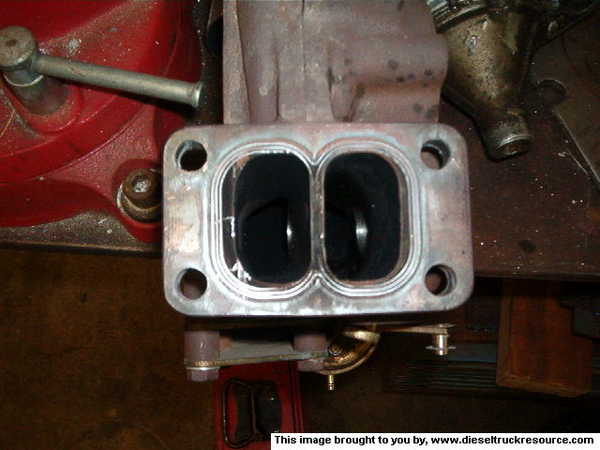
This photo was taken from Wide Open Throttles photo gallery, i found it by typing in Porting on the search on the photos and it came up, It was the pic that made this the most clear to me, u can now see that both sides of the divider are drilled thru, this makes for easier evacuation of exhaust gases... which reaps benefits in the sence that you have lower driveline pressures, and better efficiency...
Rick

Trending Topics
Thread Starter
Registered User
Joined: Dec 2004
Posts: 3,411
Likes: 2
From: Laredo
Plenty of good reading on this thread..
I never would have made this attempt at my freeby mod if it werent for this thread, and my top turbo choking out..
https://www.dieseltruckresource.com/...highlight=HX35
Rick
I never would have made this attempt at my freeby mod if it werent for this thread, and my top turbo choking out..
https://www.dieseltruckresource.com/...highlight=HX35
Rick


Registered User
Joined: Oct 2003
Posts: 1,292
Likes: 0
From: Albuquerque, NM
did you do this to the turbo, or the manifold? does it matter which one? also with the stock turbo, I would have less EGTs right? but will it spool as fast?
would this lessen the chance of a blown headgasket running meth on a stock turbo?
would this lessen the chance of a blown headgasket running meth on a stock turbo?

Registered User
Joined: Aug 2002
Posts: 385
Likes: 0
From: Enid, OK
 Cross-drill or notch divider?
Ok, I've seen much discussion about the cross-drilled divider possibly cracking. I want to install my Banks 14cm housing soon. Too bad they evidently don't drill them any more (?). I can't look at it since I'm stuck at work, but when previously examining it, I don't remember noticing a transfer hole.
It seems to me that the suggestion of just making a notch in the divider at the flange similar to notching the divider in a 2-plane intake makes quite a bit of sense. Nothing too big, maybe ~1/4 inch back and 1/2 inch long, with radiused edges.
I sure would like to hear more from the guys that have done these mods. I don't want to screw up my $450.00 exhaust housing. I would also hate to loose much low end spooling, but wouldn't mind a little more exhaust turbulance on the top end when the WG is open and the turbo producing all the boost I want anyway. I'm thinking the more even EGTs and exhaust pressure between cylinders would be a good thing.
It seems to me that the suggestion of just making a notch in the divider at the flange similar to notching the divider in a 2-plane intake makes quite a bit of sense. Nothing too big, maybe ~1/4 inch back and 1/2 inch long, with radiused edges.
I sure would like to hear more from the guys that have done these mods. I don't want to screw up my $450.00 exhaust housing. I would also hate to loose much low end spooling, but wouldn't mind a little more exhaust turbulance on the top end when the WG is open and the turbo producing all the boost I want anyway. I'm thinking the more even EGTs and exhaust pressure between cylinders would be a good thing.

Registered User
Joined: Jul 2006
Posts: 511
Likes: 0
The end result by cross drilling is that you lose exhaust gas energy that can be delivered to the turbine and maybe gain some EGT relief at higher power levels.
Just to post an opposing (some what) view here and just for the point of discussion. Keep in mind I have no direct experience, just spewning out some general knowledge I have picked up. Don't flame me too hard, just point out which discussion that I have gotten wrong.
There is definate purposes for the divider. The divider functions to most efficienctly carry an exhaust pressure pulse from one cylinder to the turbine. Taking a look at the Cummins firing order, you get alternating pressure pulses from cylinders 123 and 456. The divider minimizes the piping volume involved for an individual exhaust pulse of one end of the engine and basically doesn't pressure up the entire manifold wasting potential energy that could go toward spinning the turbine. Additionally, a pressure pulse from a pre-ceeding cylinder does not back up the entire exhaust manifold with a pressure pulse for the next cylinder in the firing order. This functions to help the engine breath better while delivering the maximum pressure to the turbine inlet.
Typically, I hear of cross drilling being done to trucks that are overfueled to the point that some EGT relief is desired. The idea is that once you start overdriving the turbo with the waste gate open some benefit may be realised by cross drilling or some such. I have heard this is called "Blowing past the waste gate" in most cases. And the idea for doing it is to allow all six cylinders access to the waste gate vice just three of them. IMO if doing it is deemed necessary the turbo is likely under sized and consideration for a larger turbine housing at the minimum should be on the bombing list.
One advantage that was explained to me for leaving the divider intact is that cylinder 6 likely runs the highest EGT on the engine. With the waste gate directly relieving drive pressure from cylinders 456, the number 6 cylinder gets the most beneficial pressure relief when it needs it the most.
FWIW I have recently added twins to my truck. The kit I used came with a 1/2 inch spacer that is used between the exhaust manifold and the secondary turbo. With the HX35 (or hybrids) the plate accomplishes the same function as cross drilling. My guess is that the efficientcy loss to the secondary turbo is made up by the gained efficientcy of the system as a whole. AFAIK the purpose of the spacer is simply to allow using a HX40 vice the HX35. That way the same hot pipe can be used for both installations.
One of the things I noticed, when I had my exhaust manifold off to flip it over, was that cylinders 1,2,5,6 had deflectors with slots installed. Cylinders 3 & 4 were straight shots. Anyone know the purpose for these deflectors?
Jim
Just to post an opposing (some what) view here and just for the point of discussion. Keep in mind I have no direct experience, just spewning out some general knowledge I have picked up. Don't flame me too hard, just point out which discussion that I have gotten wrong.
There is definate purposes for the divider. The divider functions to most efficienctly carry an exhaust pressure pulse from one cylinder to the turbine. Taking a look at the Cummins firing order, you get alternating pressure pulses from cylinders 123 and 456. The divider minimizes the piping volume involved for an individual exhaust pulse of one end of the engine and basically doesn't pressure up the entire manifold wasting potential energy that could go toward spinning the turbine. Additionally, a pressure pulse from a pre-ceeding cylinder does not back up the entire exhaust manifold with a pressure pulse for the next cylinder in the firing order. This functions to help the engine breath better while delivering the maximum pressure to the turbine inlet.
Typically, I hear of cross drilling being done to trucks that are overfueled to the point that some EGT relief is desired. The idea is that once you start overdriving the turbo with the waste gate open some benefit may be realised by cross drilling or some such. I have heard this is called "Blowing past the waste gate" in most cases. And the idea for doing it is to allow all six cylinders access to the waste gate vice just three of them. IMO if doing it is deemed necessary the turbo is likely under sized and consideration for a larger turbine housing at the minimum should be on the bombing list.
One advantage that was explained to me for leaving the divider intact is that cylinder 6 likely runs the highest EGT on the engine. With the waste gate directly relieving drive pressure from cylinders 456, the number 6 cylinder gets the most beneficial pressure relief when it needs it the most.
FWIW I have recently added twins to my truck. The kit I used came with a 1/2 inch spacer that is used between the exhaust manifold and the secondary turbo. With the HX35 (or hybrids) the plate accomplishes the same function as cross drilling. My guess is that the efficientcy loss to the secondary turbo is made up by the gained efficientcy of the system as a whole. AFAIK the purpose of the spacer is simply to allow using a HX40 vice the HX35. That way the same hot pipe can be used for both installations.
One of the things I noticed, when I had my exhaust manifold off to flip it over, was that cylinders 1,2,5,6 had deflectors with slots installed. Cylinders 3 & 4 were straight shots. Anyone know the purpose for these deflectors?
Jim

Registered User
Joined: Jul 2006
Posts: 511
Likes: 0
If I were you I would not worry about it, nor consider it a benefit or a detriment. The whole divider issue has to do with engine exhaust gas to turbine efficientcy at lower engine power levels compared to higher (bombed) engine power levels. For any efficientcy loss that might occur by cross drilling, (at any engine power level) the gain in efficientcy by the twins surpasses that loss by a big margin.
One thing that I did noticed when I was pushing my HX35 for all that it was worth and still had my drive pressure gauge hooked up is that right about the time that the waste gate opened the drive pressure would skyrocket. I have never really found a reason for this to happen, but it sure seemed to. There was no doubt in my mind that I was sometimes blowing past the waste gate pretty hard. My drive pressure gauge was connected to the 123 exhaust tube.
My only explanation was that my exhaust brake housing was a bit restrictive. The thing tapers from the HX35 outlet flange diameter to three inch diameter before it dumps into the 4 inch exhaust pipe. When the waste gate opened it dumped high enthalpy exhaust gas into the pipe, because the turbine had not removed a significant amount of the exhaust gas energy. This high energy gas had trouble expanding into the space allowed and backed up the turbine exhaust which backed up the drive pressure for exhaust tube that was not waste gated.
Anyone else have a clue?
Jim