


Water in a diesel storage tank


Thread Starter
I think I can... I think...
Joined: Aug 2004
Posts: 2,264
Likes: 0
From: Texas (DFW area)
 Water in a diesel storage tank
My brother has a storage tank with farm diesel in it.
Some how we ended up with quite a bit of water in there.
My thought was to siphon right off of the bottom slowly to get most of the water out. I think using the hand pump pulls it too fast and pulls more diesel with it. He drained off a couple of 5 gal buckets and after it settled out there was about 1" of water in the bottom of each.
Any ideas from you guys?
Some how we ended up with quite a bit of water in there.
My thought was to siphon right off of the bottom slowly to get most of the water out. I think using the hand pump pulls it too fast and pulls more diesel with it. He drained off a couple of 5 gal buckets and after it settled out there was about 1" of water in the bottom of each.
Any ideas from you guys?


Registered User
Joined: Apr 2010
Posts: 138
Likes: 0
From: Tennessee
Best way would be to drain each tank and put in a low point bleed on each tank. Then in the future, when water is there, let the tank rest for a bit, slowly drain until water is gone.
I have a 50 gallon tank, (yea, not a big tank, but fits my needs), and this was the first thing put on before the first fill. I don't have a site glass or level indicator on it, but it's easy to maintain. Isn't expensive, easy to do and less headaches.
I have a 50 gallon tank, (yea, not a big tank, but fits my needs), and this was the first thing put on before the first fill. I don't have a site glass or level indicator on it, but it's easy to maintain. Isn't expensive, easy to do and less headaches.

DTR's Volcano Monitor, Toilet Smuggler, Taser tester, Meteorite enumerator, Quill counter, Match hoarder, Panic Dance Choreographer, Bet losing shrew murderer
Joined: May 2007
Posts: 965
Likes: 0
From: Kenai Alaska
Dad has a 500 gal tank and only fills it every few years. After it gets halfway empty it starts accumilating water pretty quickly. He has always used a big old metal funnel that has a screen in the bottom of it. He gets his chamois leather cloth damp with a little gasoline (I dont know why) and covers the inside of the funnel with it. Than he starts pumping fuel. It goes slowly but it seems to do a really good job of filtering water (and dirt). I think he has been using the same cloth for 50 years. Im not sure i would use it as a filtering system for my CTD but for his older equipment it works great.

Registered User


Joined: May 2006
Posts: 5,613
Likes: 167
From: Pacific NW, B'ham, Kalispell MT
You should be able to drain it out of the low point on the tank. See if there is a bleeder screw underneath.
Trying to pump it out just agitates it and mixes the water and fuel.
If you don't have a low point bleeder I would drain the tank and put one in.
Trying to pump it out just agitates it and mixes the water and fuel.
If you don't have a low point bleeder I would drain the tank and put one in.
Thread Starter
I think I can... I think...
Joined: Aug 2004
Posts: 2,264
Likes: 0
From: Texas (DFW area)
I've got a 3/8" dia piece of clear tubing.
I'm going to weight one end and drop it to the lowest corner and siphon it out.
This should reduce the amount of stirring. I figure pull 5 galls at a time from each chamber into buckets, let it settle and drain the diesel off of the buckets. I would think it shouldn't take too long to clear up the problem.

Trending Topics
Thread Starter
I think I can... I think...
Joined: Aug 2004
Posts: 2,264
Likes: 0
From: Texas (DFW area)

Thread Starter
I think I can... I think...
Joined: Aug 2004
Posts: 2,264
Likes: 0
From: Texas (DFW area)
My thought was to slowly siphon the water off of the bottom with the small 3/8" clear tubing. My hope in doing this is to not disturb the separation much and not have to pull all of the diesel out. Using the clear tubing and siphoning into a white bucket should allow me to be able to tell when it changes from water to diesel.
The tank is full!! I think it's 250 gals in there.
I would already be doing this but I wrenched the heck out of my back trying to stand up a compressor that fell over in the back of my truck.

See this thread for details.
Thread Starter
I think I can... I think...
Joined: Aug 2004
Posts: 2,264
Likes: 0
From: Texas (DFW area)
Hard to tell. The tank is steel with no site glass. Now what has been pumped out into buckets appears to be about 1% or so. Don't know how accurate that measurement can be though.
Hard to tell how much that hand pump stirs up the bottom of the tank.
Hard to tell how much that hand pump stirs up the bottom of the tank.

Administrator / Scooter Bum
Joined: Sep 2002
Posts: 9,086
Likes: 49
From: Central VA
Why not add a diesel/water separator to the output path?
http://www.maesco.com/products/racor...spn_intro.html
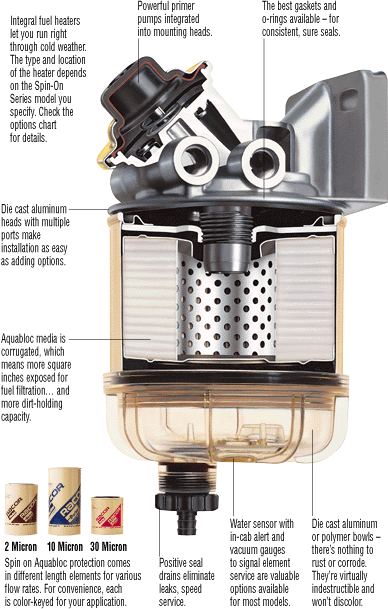
http://www.maesco.com/products/racor...spn_intro.html

I wish I was as fine, as those who work the pipeline!
Joined: Dec 2008
Posts: 1,639
Likes: 0
From: Wyoming
Ok gotcha, I was just wondering if there was something like 4" of water in the bottom. I would circulate it through a water separator with a fairly low volume pump ( something like 5 to 10 GPH) drawing off the bottom.
You could also rig up a couple or three 5 gallon buckets (in series) with weir hoses at the top to get most of it out. Just let it circulate for 8 - 10 hours, then settle over night and repeat.
If you can actually get your hands on a real water separator, you could just rig up a continuous loop and run a hose off the bottom of the separator to a 5 gallon bucket to collect the water. The biggest problem you are going to have is the ambient temps. As the 'liquid' temp increases, separation becomes less efficient.
You could also rig up a johnny appleseed biodiesel water heater and dry the fuel that way. It would be best to use an old electric water heater, but NG is ok too. That is guaranteed to work.
Only other thing I can think of is talking with your fuel delivery company to see if they can circulate it through the auxiliary tank in their delivery truck. They all have separators inline (at least the ones who deliver to me do).
After that just treat the conditioned fuel to dry it up, and try to figure out how the water got in there in the first place.
You could also rig up a couple or three 5 gallon buckets (in series) with weir hoses at the top to get most of it out. Just let it circulate for 8 - 10 hours, then settle over night and repeat.
If you can actually get your hands on a real water separator, you could just rig up a continuous loop and run a hose off the bottom of the separator to a 5 gallon bucket to collect the water. The biggest problem you are going to have is the ambient temps. As the 'liquid' temp increases, separation becomes less efficient.
You could also rig up a johnny appleseed biodiesel water heater and dry the fuel that way. It would be best to use an old electric water heater, but NG is ok too. That is guaranteed to work.
Only other thing I can think of is talking with your fuel delivery company to see if they can circulate it through the auxiliary tank in their delivery truck. They all have separators inline (at least the ones who deliver to me do).
After that just treat the conditioned fuel to dry it up, and try to figure out how the water got in there in the first place.
Thread Starter
I think I can... I think...
Joined: Aug 2004
Posts: 2,264
Likes: 0
From: Texas (DFW area)
Ok gotcha, I was just wondering if there was something like 4" of water in the bottom. I would circulate it through a water separator with a fairly low volume pump ( something like 5 to 10 GPH) drawing off the bottom.
You could also rig up a couple or three 5 gallon buckets (in series) with weir hoses at the top to get most of it out. Just let it circulate for 8 - 10 hours, then settle over night and repeat.
If you can actually get your hands on a real water separator, you could just rig up a continuous loop and run a hose off the bottom of the separator to a 5 gallon bucket to collect the water. The biggest problem you are going to have is the ambient temps. As the 'liquid' temp increases, separation becomes less efficient.
You could also rig up a johnny appleseed biodiesel water heater and dry the fuel that way. It would be best to use an old electric water heater, but NG is ok too. That is guaranteed to work.
Only other thing I can think of is talking with your fuel delivery company to see if they can circulate it through the auxiliary tank in their delivery truck. They all have separators inline (at least the ones who deliver to me do).
After that just treat the conditioned fuel to dry it up, and try to figure out how the water got in there in the first place.
You could also rig up a couple or three 5 gallon buckets (in series) with weir hoses at the top to get most of it out. Just let it circulate for 8 - 10 hours, then settle over night and repeat.
If you can actually get your hands on a real water separator, you could just rig up a continuous loop and run a hose off the bottom of the separator to a 5 gallon bucket to collect the water. The biggest problem you are going to have is the ambient temps. As the 'liquid' temp increases, separation becomes less efficient.
You could also rig up a johnny appleseed biodiesel water heater and dry the fuel that way. It would be best to use an old electric water heater, but NG is ok too. That is guaranteed to work.
Only other thing I can think of is talking with your fuel delivery company to see if they can circulate it through the auxiliary tank in their delivery truck. They all have separators inline (at least the ones who deliver to me do).
After that just treat the conditioned fuel to dry it up, and try to figure out how the water got in there in the first place.