


Diesel Connecting Rod Pics (New).




Trending Topics


Registered User
Joined: Apr 2002
Posts: 1,749
Likes: 4
From: Cypress, TX
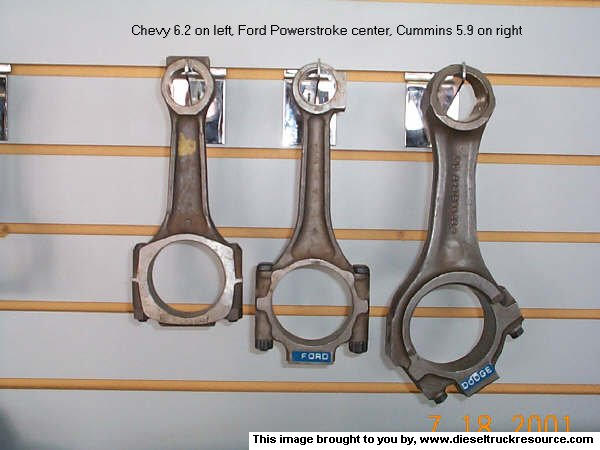
The angle cut on the rod cap enables a connecting rod that uses a large (relatively speaking) bearing journal to be removed through a smaller bore. In other words, it lets one remove the piston and rod as an assembly through the cylinder. It really isn't cut that way to gain additional strength.
Rusty
Rusty
Registered User
Joined: Apr 2002
Posts: 1,749
Likes: 4
From: Cypress, TX
They cut them that way so they can get them out of the engine. The angle cut gets the bosses required for the rod cap fasteners out of the way. If they didn't angle cut them, the engine designer would have to specify smaller crank journals - from that aspect, the angle cut allows them to build a stronger bottom end.
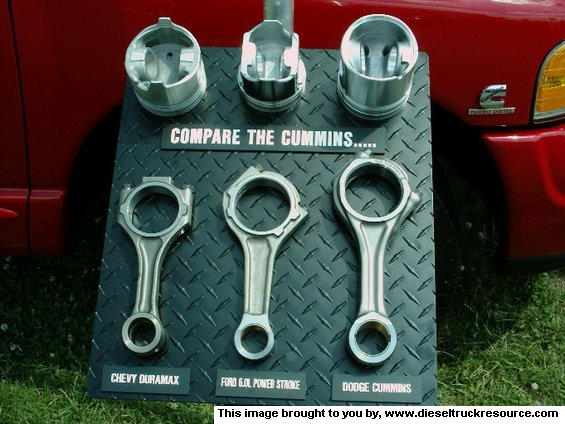
Compare the measurement across the rods with the caps removed to the piston diameters in the first picture. The big end of the connecting rod (less the rod cap) has to come through a hole that's the nominal diameter of each respective piston. Just eyeballing it (recognizing that I'm an old man and half blind), the Ford 6.0 appears to have a smaller cylinder bore than the Duramax, but the angle cut connecting rod allows the 6.0 to have larger crankshaft rod journal diameters than the Duramax.
Rusty
Compare the measurement across the rods with the caps removed to the piston diameters in the first picture. The big end of the connecting rod (less the rod cap) has to come through a hole that's the nominal diameter of each respective piston. Just eyeballing it (recognizing that I'm an old man and half blind), the Ford 6.0 appears to have a smaller cylinder bore than the Duramax, but the angle cut connecting rod allows the 6.0 to have larger crankshaft rod journal diameters than the Duramax.
Rusty

Chapter President
Joined: May 2004
Posts: 3,539
Likes: 7
From: Caistor Centre, ON, Canada
I like how the wrist pin bores are huge on the CTD compared to the others and even with the larger stroke of the CTD that extra rod length STILL gives a better rod ratio. The ONLY downside is that you can tell that the piston and rod combo on the CTD are much heavier than than the others - not good for high rpm longevity - but who cares?
 I don't have to rev my CTD to the moon to spank a durascrap or slowerjoke
and even with the larger stroke of the CTD that extra rod length STILL gives a better rod ratio. The ONLY downside is that you can tell that the piston and rod combo on the CTD are much heavier than than the others - not good for high rpm longevity - but who cares? I don't have to rev my CTD to the moon to spank a durascrap or slowerjoke

DTR Advertiser

Joined: Jun 2002
Posts: 3,347
Likes: 1
From: In the Shop
The new rods are forged, but not from the traditional steel we are used to.
They weigh slightly less. 62 grams lighter. They are thicker than the older rods, but are not as wide. They are also stiffer. The cracked cap is nice. The fastener on the new rod is weaker, but does not need to be as stout as the older bolt because of the cracked cap design.
The caps are angled for camshaft clearance and to facilitate the ease of removal during "in-frame" rebuilds in heavier trucks.
Don~
They weigh slightly less. 62 grams lighter. They are thicker than the older rods, but are not as wide. They are also stiffer. The cracked cap is nice. The fastener on the new rod is weaker, but does not need to be as stout as the older bolt because of the cracked cap design.
The caps are angled for camshaft clearance and to facilitate the ease of removal during "in-frame" rebuilds in heavier trucks.
Don~