


What's special about the Dodge 7-pin trailer jack?


Thread Starter
Registered User
Joined: Jan 2006
Posts: 291
Likes: 0
From: Spokane WA
What's special about the Dodge 7-pin trailer jack?
When I picked up my new 2006 3500 at the first of the year, one of the countless things they made me sign was a single sheet from DC that warned about the "different wiring" of the Dodge 7-pin trailer connector (my 3500 came stock with the towing kit as part of the Big Horn package). Lots of cautions about how you could have a fire, destroy your vehicle, void your warranty, cause Ford and Chevy drivers to laugh at you, etc. if you used one of the "other" 7-pin wiring styles.
I've been scanning the web but can't find anything definitive on this. I've always used the 4-flat connectors in the past - which seem well-standardized - but now I'm looking at towing some trailers with electric brakes so the 7-pin becomes an issue. What are they talking about, how big of a problem is it, how can you test it in the field, etc.?
Thanks for any guidance!
I've been scanning the web but can't find anything definitive on this. I've always used the 4-flat connectors in the past - which seem well-standardized - but now I'm looking at towing some trailers with electric brakes so the 7-pin becomes an issue. What are they talking about, how big of a problem is it, how can you test it in the field, etc.?
Thanks for any guidance!

Thread Starter
Registered User
Joined: Jan 2006
Posts: 291
Likes: 0
From: Spokane WA
If the plug and jack are physically different, I can understand an adapter being required. But the impression I got from the sheet they made me sign (which is not in front of me at the moment) was that the issue came from a WIRING difference on physically identical plugs/jacks.

Thread Starter
Registered User
Joined: Jan 2006
Posts: 291
Likes: 0
From: Spokane WA
That's what I'd expect.
So I wonder what the big panic is on DC's part? They went out of their way to print up a special piece of paper and require the customer to sign off on it.
Maybe I'll call the dealer and ask them for clarification.
So I wonder what the big panic is on DC's part? They went out of their way to print up a special piece of paper and require the customer to sign off on it.
Maybe I'll call the dealer and ask them for clarification.


Registered User
Joined: Mar 2004
Posts: 1,110
Likes: 0
From: Iowa
I have an '05, so this doesn't apply to me. But I do remember reading something over at TDR about the trailer wiring no longer being fuse protected on the 06 models. Someone seems to have fried the ECM due to a short in the trailer brakes or something. Talk about a nightmare situation. You might want to check your fuse box to see if that's the case.
Just a heads up.
mishkaya
Just a heads up.
mishkaya
Trending Topics


Registered User
Joined: Dec 2002
Posts: 684
Likes: 0
From: Southeastern,OH.
Originally Posted by mishkaya
I have an '05, so this doesn't apply to me. But I do remember reading something over at TDR about the trailer wiring no longer being fuse protected on the 06 models. Someone seems to have fried the ECM due to a short in the trailer brakes or something. Talk about a nightmare situation. You might want to check your fuse box to see if that's the case.
Just a heads up.
mishkaya
Just a heads up.
mishkaya
Registered User
Joined: Dec 2002
Posts: 1,055
Likes: 0
From: East Montpelier, VT.
I have the 7 pin also (2005 model). I bought a adapter for a typical small trailer (4 pin). Then one day while under the truck, I noticed that it also came with a plain jane 4-pin plug tucked way up by the spare tire. So you may have both and you just need to look for it.


Registered User
Joined: Oct 2004
Posts: 934
Likes: 4
From: Alabama
My '06 2500 (for which I did not have to sign any papers about the trailer socket) is exactly the same as my '98. I pull identical fema trailers with both trucks, and there's never any electrical issue. The only issue is that the '98 will run rings around the '06, but that's not the fault of the '06...

Registered User
Joined: Jan 2006
Posts: 36
Likes: 0
From: Kokomo,IN
First off if you have an '06 pop the cover on your fuse block(now known as the TIPM totally integrated power module) and notice it now has about half the amount of fuses and no relays as compared to the '05 and older trucks. The only fuses for trailers are the brakes and park/running lights. Turn signal, brake lights and B/U lights now run through self resetting circuit breakers on the circuit board under your fuses. I had a Fema trailer cord that had excess tie wrapped, those broke and I dragged the cord. This short was more than the TIPM ($309+ labor and dealer is only place to get it)could handle. It didn't totally fry, the truck lights still all functioned just didn't have any trailer brake lights or turn signals. It took 2 weeks to get the part and a big fight to get them to warranty it. I would suggest anyone using an '06 to tow with protect their truck. There is not any thing aftermarket specifically out there yet to fix this. So I built my own fuse box to protect my truck 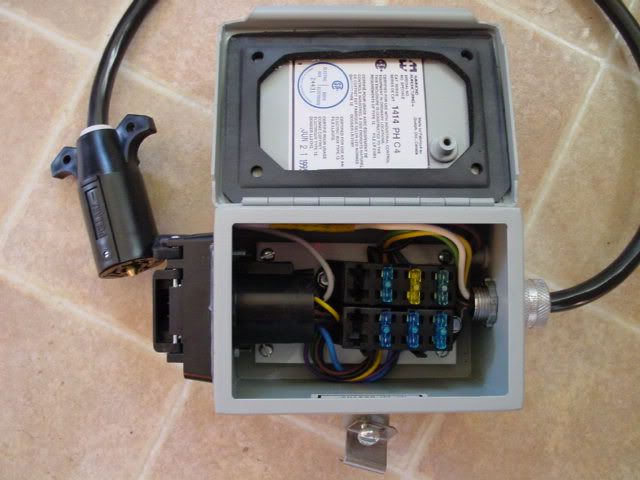 .
.
For the guy pulling FEMA's I would definitely do something soon, I've heard of several of the trailers with bad wiring. It cost me about $70 to build that box but that is cheap insurance considering the money I lost on that pull and being down for 2 weeks
. For the guy pulling FEMA's I would definitely do something soon, I've heard of several of the trailers with bad wiring. It cost me about $70 to build that box but that is cheap insurance considering the money I lost on that pull and being down for 2 weeks
Thread Starter
Registered User
Joined: Jan 2006
Posts: 291
Likes: 0
From: Spokane WA
Wow - great info. Some clarification, please?
You said the only fuses for trailers are the brakes and running lights. Then you said turn signals, brakes, and backup lights run through self-resetting circuit breakers. Can you be more specific? Is it:
1) Trailer is fused, truck's lights are breakered;
2) Truck is fused, trailer is breakered; or
3) Something else?
In either case, if the trailer wiring has either fuses or CB's it should have handled a dragged/shorted cord. Why didn't it? What happened to the protection from the fuses/CB's?
I like the idea of having dedicated fuses/CB's for the trailer, but you'd need to know what the upstream protection is doing. Otherwise you could use smaller/larger rated fuses/CB's and either degrade your capabilities or offer no additional protection beyond that which is already in place.
It looks like you've done the research - could you provide a bit more detail? Thanks!
You said the only fuses for trailers are the brakes and running lights. Then you said turn signals, brakes, and backup lights run through self-resetting circuit breakers. Can you be more specific? Is it:
1) Trailer is fused, truck's lights are breakered;
2) Truck is fused, trailer is breakered; or
3) Something else?
In either case, if the trailer wiring has either fuses or CB's it should have handled a dragged/shorted cord. Why didn't it? What happened to the protection from the fuses/CB's?
I like the idea of having dedicated fuses/CB's for the trailer, but you'd need to know what the upstream protection is doing. Otherwise you could use smaller/larger rated fuses/CB's and either degrade your capabilities or offer no additional protection beyond that which is already in place.
It looks like you've done the research - could you provide a bit more detail? Thanks!