


Smarty UDC Initial Impressions


Registered User
Joined: Feb 2005
Posts: 1,714
Likes: 1
From: Pueblo West
Edge only makes 150/350 and it's so expensive. What a crock - having to pay extra to unlock level 6 and still have less than the others! I'm sure you would have to buy sensors for everything you want to read, on top of it all. Neat technology is all they have to offer, IMO. I'll just sit back and read and wait for more UDC info or EFI live. Craig

Thread Starter
Registered User
Joined: Nov 2007
Posts: 4,737
Likes: 4
From: Kuna, Idaho
Okay, so this is going to be a quick lesson on checking your peak timing. The purpose in this is to make sure you don't have too much timing for your fuel. It's possible to have a low timing number, say 16° but not have enough fuel for that to be optimal. A 50:50 split (BTDC/ATDC) seems to work good for heavier fueling. A little more if you are really trying to squeeze every hp out, maybe 51-52 BTDC or a little less if you don't want quite as much piston heat, 45-48. Those are rough numbers I have played with, but motor mods will have effects as well.
With the way the stock maps are laid out it's pretty easy to check 100% load timing, a lot more difficult to check lower loads. But with some common sense you can do a lot just knowing what peak timing should be.
So lets look at a stock 04.5-07 tune. For this lesson we will leave duration and pressure stock, just messing with timing.
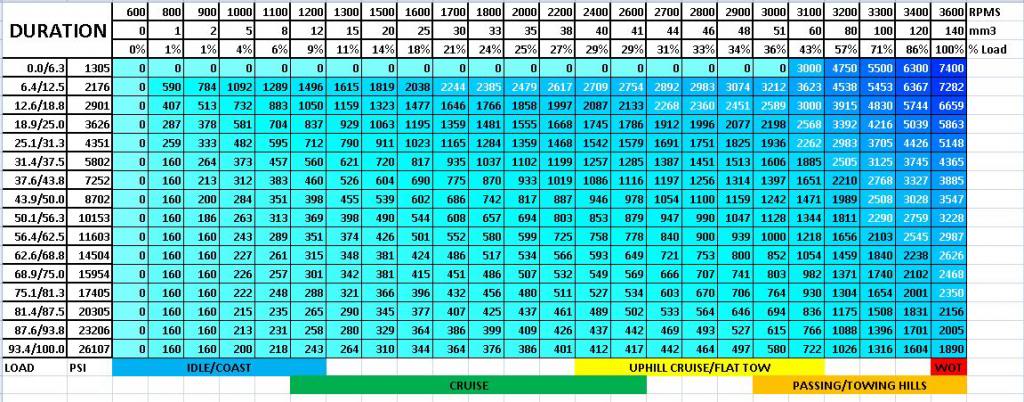
This is a stock duration map with additional labels. What's important to note is that rpms is really load and load is pressure. 100% load is the only one that isn't appox, it's really 100% load. The rest are for reference to an OBDII reader and not necessarily to match the load on the side of the timing/pressure table (which is why anything but 100% is harder to calculate).
When the ECM goes to calculate the desired pulse width (injector open time) it looks at 2 tables. Pressure and duration, with pressure being first. Lets calculate the desired peak timing at 4 rpms, 2000, 2400, 3000, 3200.
So we first reference the pressure table. At 2000 rpms and 100% load the pressure is 20,885 psi. We then go to the duration table (one below with labels). You will notice that 20,885 is not listed on the left column, so now we have to do some math. There is a 23,206 row and a 20,305 row, with 2,901 psi between them. 20,885 is 550 psi above 20,305 and 550/2901 is 19%.
The next thing we look at is duration at 100% load. At 20,305 the duration is 2156us and at 23,206 it's 2005us, with a 151us difference. You will notice that as pressure increases the duration decreases for a given load, this is because the pressure forces the desired fuel out faster.
So we now take our 19% difference from the pressure and multiply it by 151 for 29us difference. We subtract that 29us from 2156us. This gives us a pulse width of 2127us.
So know we know how long the injector is going to be open for we can figure out when to start the injection event. A crankshaft has 360° of rotation, and by using rpm's we can calculate how long it takes to go 1° at any given rpm. Lets start with 2000 rpms. 2000 rpms is 33.33 rotations per second, multiplied by 360° gives us 12,000 deg/sec. A microseconds (us) is 1,000,000th of a second, so 1,000,000 divided by 12,000 gives us 83us per 1° of rotation.
Next you take the total injector open time, 2127us, and divide it by 83. That gives us 25.6° of total injector open time.
Let's say we want a 50:50 split of BTDC/ATDC. Multiply 25.6 by 0.5 and you get 12.8°. Thus we would set our timing at 100% load, 2000 rpms at 12.8°.
Now lets look at 2400 rpms on the stock tables. Commanded pressure is 22,336. Since 22,336 falls between row's on the duration chart we have to do the math again. 22,336-20,305= 2031. 2031/2901=70% . At 20,305 the duration is 2156us and at 23,206 it's 2005us, with a 151us difference. .70*151= 105us. 2156-105=2051us.
At 2,400 rpms it takes 69us per 1° of rotation. 2051/69=29.7° of injector open time. Same thing 29.7*0.5=14.9° of timing.
Now lets look at 3,000 rpms. Commanded pressure is 23,207 (same as 23,206), which happens to be one of the columns on the chart so no math is needed. 23,206 and 100% load is 2005us. At 3,000 rpms it takes 56us for 1° of rotation. 2005/56=35.8°. 35.8°*.5= 17.9°.
Now lets look at 3,200 rpms. Commanded pressure is 23,207, which happens to be one of the columns on the chart so no math is needed. 23,206 and 100% load is 2005us. At 3,200 rpms it takes 52us for 1° of rotation. 2005/52=38.5°. 38.5°*.5= 19.3°.
Pay close attention to the 3,000 and 3,200.. the pulse width is the same, but the injector open time is just under 3° longer at 3,200 due to the increased speed of the crankshaft.
So now you are able to calculate what your peak timing should be based on pressure/duration tables and a given rpm. When the load is less than 100% you need to have less timing than 100% load, or you will be injecting all the fuel much sooner and that can lead to increased piston heat and cylinder pressure.
A calculator is simply a starting point, not an ending point. You may or may not have to adjust your timing values from what calc gives you. It's a reference and a guide, not a rule.
With the way the stock maps are laid out it's pretty easy to check 100% load timing, a lot more difficult to check lower loads. But with some common sense you can do a lot just knowing what peak timing should be.
So lets look at a stock 04.5-07 tune. For this lesson we will leave duration and pressure stock, just messing with timing.
This is a stock duration map with additional labels. What's important to note is that rpms is really load and load is pressure. 100% load is the only one that isn't appox, it's really 100% load. The rest are for reference to an OBDII reader and not necessarily to match the load on the side of the timing/pressure table (which is why anything but 100% is harder to calculate).
When the ECM goes to calculate the desired pulse width (injector open time) it looks at 2 tables. Pressure and duration, with pressure being first. Lets calculate the desired peak timing at 4 rpms, 2000, 2400, 3000, 3200.
So we first reference the pressure table. At 2000 rpms and 100% load the pressure is 20,885 psi. We then go to the duration table (one below with labels). You will notice that 20,885 is not listed on the left column, so now we have to do some math. There is a 23,206 row and a 20,305 row, with 2,901 psi between them. 20,885 is 550 psi above 20,305 and 550/2901 is 19%.
The next thing we look at is duration at 100% load. At 20,305 the duration is 2156us and at 23,206 it's 2005us, with a 151us difference. You will notice that as pressure increases the duration decreases for a given load, this is because the pressure forces the desired fuel out faster.
So we now take our 19% difference from the pressure and multiply it by 151 for 29us difference. We subtract that 29us from 2156us. This gives us a pulse width of 2127us.
So know we know how long the injector is going to be open for we can figure out when to start the injection event. A crankshaft has 360° of rotation, and by using rpm's we can calculate how long it takes to go 1° at any given rpm. Lets start with 2000 rpms. 2000 rpms is 33.33 rotations per second, multiplied by 360° gives us 12,000 deg/sec. A microseconds (us) is 1,000,000th of a second, so 1,000,000 divided by 12,000 gives us 83us per 1° of rotation.
Next you take the total injector open time, 2127us, and divide it by 83. That gives us 25.6° of total injector open time.
Let's say we want a 50:50 split of BTDC/ATDC. Multiply 25.6 by 0.5 and you get 12.8°. Thus we would set our timing at 100% load, 2000 rpms at 12.8°.
Now lets look at 2400 rpms on the stock tables. Commanded pressure is 22,336. Since 22,336 falls between row's on the duration chart we have to do the math again. 22,336-20,305= 2031. 2031/2901=70% . At 20,305 the duration is 2156us and at 23,206 it's 2005us, with a 151us difference. .70*151= 105us. 2156-105=2051us.
At 2,400 rpms it takes 69us per 1° of rotation. 2051/69=29.7° of injector open time. Same thing 29.7*0.5=14.9° of timing.
Now lets look at 3,000 rpms. Commanded pressure is 23,207 (same as 23,206), which happens to be one of the columns on the chart so no math is needed. 23,206 and 100% load is 2005us. At 3,000 rpms it takes 56us for 1° of rotation. 2005/56=35.8°. 35.8°*.5= 17.9°.
Now lets look at 3,200 rpms. Commanded pressure is 23,207, which happens to be one of the columns on the chart so no math is needed. 23,206 and 100% load is 2005us. At 3,200 rpms it takes 52us for 1° of rotation. 2005/52=38.5°. 38.5°*.5= 19.3°.
Pay close attention to the 3,000 and 3,200.. the pulse width is the same, but the injector open time is just under 3° longer at 3,200 due to the increased speed of the crankshaft.
So now you are able to calculate what your peak timing should be based on pressure/duration tables and a given rpm. When the load is less than 100% you need to have less timing than 100% load, or you will be injecting all the fuel much sooner and that can lead to increased piston heat and cylinder pressure.
A calculator is simply a starting point, not an ending point. You may or may not have to adjust your timing values from what calc gives you. It's a reference and a guide, not a rule.
Thread Starter
Registered User
Joined: Nov 2007
Posts: 4,737
Likes: 4
From: Kuna, Idaho
Cruise mileage is something I have been messing with nearly the entire time. I have gone the full gammet on retarded vs advanced for cruising. With the stock rail pressure map I really had to drop my timing back from stock at 1000-1800 to keep the rattle down. Now that I have a Sr I am re-attacking my cruise timing from 1600-2400. I have smoothed and lowered the cruise rail pressure and I can now bump the timing back up and not rattle! My cruise EGT's also went up a bunch with the lower rail pressure, and I have started bringing them back down now.
I'll report back when I know more, but I am excited as I think I should be able to squeak just a little better economy out of it, not to mention lower cruise EGT's.
I'll report back when I know more, but I am excited as I think I should be able to squeak just a little better economy out of it, not to mention lower cruise EGT's.

Registered User
Joined: Mar 2006
Posts: 998
Likes: 0
From: Anacortes Wa.
Ok. Quick question. If the ECM reads a higher RP for a given load it calculates the desired duration is less to give the same delvery. So the opposite is true when lower pressure is detected, thereby increasing duration to get the same delivery. Does the ECM also adjust the timing to compensate for the longer duration? Or does the longer duration in effect advance the timing?
Thread Starter
Registered User
Joined: Nov 2007
Posts: 4,737
Likes: 4
From: Kuna, Idaho
The family and I went for a drive today and I was reminded how long it takes the entire truck to warm up. We drove about 100 miles and I bet it took 35 or so before everything was hot. During the first 20 miles I was cruising level at about 4 psi and 750* at 68 on level groung at 35-37* with less than 3 mph of wind. On the return on the same route with the same conditions I was at 2 psi and 600-650 with a few % less load too. The only difference was the temp of then trans and diff fluids, it just takes a long time to warm all that stuff up.
My point is if your doing test runs in winter you need to add extra miles for temps to stabilize so you can see how the truck reacts to the changes. Many people blame the fuel for poor mileage in the winter, but I really think its only a small percentage with the cold fluids being a big one, followed shortly by cold/dense air.
My point is if your doing test runs in winter you need to add extra miles for temps to stabilize so you can see how the truck reacts to the changes. Many people blame the fuel for poor mileage in the winter, but I really think its only a small percentage with the cold fluids being a big one, followed shortly by cold/dense air.

Registered User
Joined: Oct 2005
Posts: 10
Likes: 0
From: Montgomery, Alabama
I have a steep grade that I travel up and down on a semi regular basis. I have found that when the truck is warm, (all fluids at normal operating temperature)
I can coast down this grade (foot off the accelerator) in tow/haul mode and the truck will reach a speed of 72 miles an hour at which time I apply brakes to slow it down. I can do the same thing in the morning with everything cold and the truck will never get over 60 miles an hour. I attribute it to fluid viscosity, and tire rolling resistance. Pretty significant difference.
Buddy
I can coast down this grade (foot off the accelerator) in tow/haul mode and the truck will reach a speed of 72 miles an hour at which time I apply brakes to slow it down. I can do the same thing in the morning with everything cold and the truck will never get over 60 miles an hour. I attribute it to fluid viscosity, and tire rolling resistance. Pretty significant difference.
Buddy

Registered User
Joined: Dec 2006
Posts: 625
Likes: 0
From: Corpus Christi, Texas
Tires, for example, don't reach "stability" until 1.5-hrs of steady state running (according to tire engineer CapriRacer on his website, Barry's Tire Tech).
I used to run a max load 57' trailer in South Texas where the drive axles did not reach 150F until 45' or more at 65+ mph.
I'd consider 30-miles to be the point where the various greases, oils, etc, are up to the "warm" point, but an additional 30-miles for them to boil off condensation, etc and reach an equilibrium. And that's for summer.
Agreed about temps versus "winter fuel". See below:
Diesel_Dave has an outstanding thread on weather data from his 40+ mpg CTD and touches on this question.
Detailed Statistical Analysis of Weather Data From Daily Log
.
I used to run a max load 57' trailer in South Texas where the drive axles did not reach 150F until 45' or more at 65+ mph.
I'd consider 30-miles to be the point where the various greases, oils, etc, are up to the "warm" point, but an additional 30-miles for them to boil off condensation, etc and reach an equilibrium. And that's for summer.
Agreed about temps versus "winter fuel". See below:
Diesel_Dave has an outstanding thread on weather data from his 40+ mpg CTD and touches on this question.
Detailed Statistical Analysis of Weather Data From Daily Log
.

Registered User
Joined: Oct 2005
Posts: 10
Likes: 0
From: Montgomery, Alabama
Are there any active discussions about the Smarty UDC? I have one and was able to modify the light throttle response to suit my needs. Would love to find out more about cruising economy.

Banned
Joined: Aug 2007
Posts: 65
Likes: 0
From: Shrewsbury PA


Registered User
Joined: Aug 2004
Posts: 1,002
Likes: 0
From: Mass.
It is much easier than EFI live is for sure. But for the people looking to make the truck more the way they want instead of what the level they set the programmer to it works perfect.
I used Smarty So6 and then the SSR when it came out. Problem I had with these was to make my truck street drivable I had to use the lower settings or to control smoke and still get decent mileage. This was at a sacrifice of power and response that I liked with the higher settings. Now with UDC I can have all of this.. I can adjust the lower settings to limit the smoke, mid settings to get decent power/mileage and upper settings to get all the power I dare. I know from reading there would be more options if I could use EFI live but UDC is much simpler to use and at the moment the only choice for the trucks prior to 2006 as EFI live will only work on the CAN bus trucks starting in 2006.
There are also shops out there that can provide tunes for users that want the advantages of using UDC but do not want to bother to learn how. You could still benefit from a more all around drivable vehicle than just settling for what Level 1 thru 9 may offer you of most of the other programmers.
There are plenty of people that break/ruin completely stock trucks and plenty of very powerful daily drivers that run clean and with plenty of power on demand.
Which is the way I like to keep my running. Closing in on 180k and have had tuners on my truck since about 5k. Truck definitely runs better now than it did stock and time will tell if I have made any bad choices. So far I have been sensible in how I drive and operate the truck and very careful when I make changes that could cause any issues.
I am glad I use UDC, it was the least expensive option to get the truck driving the way I want it to run.
I used Smarty So6 and then the SSR when it came out. Problem I had with these was to make my truck street drivable I had to use the lower settings or to control smoke and still get decent mileage. This was at a sacrifice of power and response that I liked with the higher settings. Now with UDC I can have all of this.. I can adjust the lower settings to limit the smoke, mid settings to get decent power/mileage and upper settings to get all the power I dare. I know from reading there would be more options if I could use EFI live but UDC is much simpler to use and at the moment the only choice for the trucks prior to 2006 as EFI live will only work on the CAN bus trucks starting in 2006.
There are also shops out there that can provide tunes for users that want the advantages of using UDC but do not want to bother to learn how. You could still benefit from a more all around drivable vehicle than just settling for what Level 1 thru 9 may offer you of most of the other programmers.
There are plenty of people that break/ruin completely stock trucks and plenty of very powerful daily drivers that run clean and with plenty of power on demand.
Which is the way I like to keep my running. Closing in on 180k and have had tuners on my truck since about 5k. Truck definitely runs better now than it did stock and time will tell if I have made any bad choices. So far I have been sensible in how I drive and operate the truck and very careful when I make changes that could cause any issues.
I am glad I use UDC, it was the least expensive option to get the truck driving the way I want it to run.
Banned
Joined: Aug 2007
Posts: 65
Likes: 0
From: Shrewsbury PA
It is much easier than EFI live is for sure. But for the people looking to make the truck more the way they want instead of what the level they set the programmer to it works perfect.
I used Smarty So6 and then the SSR when it came out. Problem I had with these was to make my truck street drivable I had to use the lower settings or to control smoke and still get decent mileage. This was at a sacrifice of power and response that I liked with the higher settings. Now with UDC I can have all of this.. I can adjust the lower settings to limit the smoke, mid settings to get decent power/mileage and upper settings to get all the power I dare. I know from reading there would be more options if I could use EFI live but UDC is much simpler to use and at the moment the only choice for the trucks prior to 2006 as EFI live will only work on the CAN bus trucks starting in 2006.
There are also shops out there that can provide tunes for users that want the advantages of using UDC but do not want to bother to learn how. You could still benefit from a more all around drivable vehicle than just settling for what Level 1 thru 9 may offer you of most of the other programmers.
There are plenty of people that break/ruin completely stock trucks and plenty of very powerful daily drivers that run clean and with plenty of power on demand.
Which is the way I like to keep my running. Closing in on 180k and have had tuners on my truck since about 5k. Truck definitely runs better now than it did stock and time will tell if I have made any bad choices. So far I have been sensible in how I drive and operate the truck and very careful when I make changes that could cause any issues.
I am glad I use UDC, it was the least expensive option to get the truck driving the way I want it to run.
I used Smarty So6 and then the SSR when it came out. Problem I had with these was to make my truck street drivable I had to use the lower settings or to control smoke and still get decent mileage. This was at a sacrifice of power and response that I liked with the higher settings. Now with UDC I can have all of this.. I can adjust the lower settings to limit the smoke, mid settings to get decent power/mileage and upper settings to get all the power I dare. I know from reading there would be more options if I could use EFI live but UDC is much simpler to use and at the moment the only choice for the trucks prior to 2006 as EFI live will only work on the CAN bus trucks starting in 2006.
There are also shops out there that can provide tunes for users that want the advantages of using UDC but do not want to bother to learn how. You could still benefit from a more all around drivable vehicle than just settling for what Level 1 thru 9 may offer you of most of the other programmers.
There are plenty of people that break/ruin completely stock trucks and plenty of very powerful daily drivers that run clean and with plenty of power on demand.
Which is the way I like to keep my running. Closing in on 180k and have had tuners on my truck since about 5k. Truck definitely runs better now than it did stock and time will tell if I have made any bad choices. So far I have been sensible in how I drive and operate the truck and very careful when I make changes that could cause any issues.
I am glad I use UDC, it was the least expensive option to get the truck driving the way I want it to run.
But just like any other tool, put it in the hands of an idiot and just wait for the carnage... It's just that imo, there are going to be a lot more folks out there who don't know how to use this tool properly and they won't put in the time to learning how to.