


Question about the stock airbox


Thread Starter
Registered User
Joined: Oct 2006
Posts: 185
Likes: 0
Question about the stock airbox
I do a fair bit of heavy towing and am wanting to drop the EGT's a bit by working on the intake side of things. I have searched a ton and can't seem to find sufficently newbie info that would tell me how to mod the intake to match my setup (smarty on 3 and straight piped). As the truck is new I would like to keep it stock appearing under the hood. Is there anything I can do to the stock airbox and intake that will be okay for 400ish hp?

Registered User
Joined: Jan 2006
Posts: 776
Likes: 1
From: Nickelsville, Va
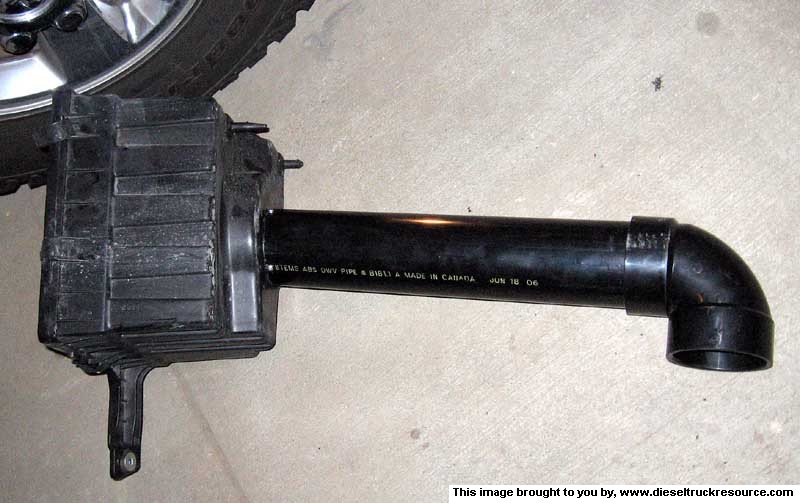
I put a 4" toilet flange and a 4" hole in the bottom of my airbox. I meant to run some dryer duct down to the bottom of the wheelwell but decided against it just after I got the flange on. The install was pretty easy and I did notice a little bit of a quicker spool up. I'm pretty **** about trending EGT's and such and did notice a little bit of a drop in EGT along with a little quicker cooldown.
I also have the Amsoil nanofilter (highly recommended) and a dieselpowerproducts cool hose between the airbox and turbo. I haven't removed the silencer ring but do have some good turbo whistle. I'm not at 400hp as I'm running the Smarty on SW1 (30hp) but easier air in cant hurt. A lot of people fret over pulling hot engine compartment air in but I think some folks did some testing and found the difference not to be that great when your moving.
Dieselpowerproducts has a kit that will draw air through a hole in the bottom of the airbox through a duct but for the price I decided I could do it for much cheaper! I'm happy with my mod.
Do a search on swiss cheese airbox and you'll find lots of info on this!
I would run out and get a pic of what I did for ya but I'm laid up with a broken femur. Right now I've got cabin fever and would love to run out anywhere!
I also have the Amsoil nanofilter (highly recommended) and a dieselpowerproducts cool hose between the airbox and turbo. I haven't removed the silencer ring but do have some good turbo whistle. I'm not at 400hp as I'm running the Smarty on SW1 (30hp) but easier air in cant hurt. A lot of people fret over pulling hot engine compartment air in but I think some folks did some testing and found the difference not to be that great when your moving.
Dieselpowerproducts has a kit that will draw air through a hole in the bottom of the airbox through a duct but for the price I decided I could do it for much cheaper! I'm happy with my mod.
Do a search on swiss cheese airbox and you'll find lots of info on this!
I would run out and get a pic of what I did for ya but I'm laid up with a broken femur. Right now I've got cabin fever and would love to run out anywhere!
Registered User
Joined: Jan 2006
Posts: 776
Likes: 1
From: Nickelsville, Va
Some people go another route and gut the stock intake tract. If you look in the center section theres some silencers and in the lower elbow there are some directional vanes. I didn't want to break mine apart so I went with the cool hose. You can get a nice looking metal pipe that replaces the straight silencer section from genosgarage.com
Dont know how my links will work out but....
Heres a link to the cool hose: <http://dieselpowerproducts.com/shopping/pgm-more_information.php?id=5&thiscat=193&frompage=Onl ine_Store&page_num=1&=SID>
And a link to the hose I mimicked with my toilet flange:
<http://dieselpowerproducts.com/index.php?customernumber=108936748765908&pr=PSM_Co ol_Power_Intake>
I guess I should also say I have nothing to do with these companies, I just think these products may be along the lines of what your wanting.
Dont know how my links will work out but....
Heres a link to the cool hose: <http://dieselpowerproducts.com/shopping/pgm-more_information.php?id=5&thiscat=193&frompage=Onl ine_Store&page_num=1&=SID>
And a link to the hose I mimicked with my toilet flange:
<http://dieselpowerproducts.com/index.php?customernumber=108936748765908&pr=PSM_Co ol_Power_Intake>
I guess I should also say I have nothing to do with these companies, I just think these products may be along the lines of what your wanting.



Trending Topics

Registered User
Joined: Nov 2005
Posts: 1,610
Likes: 0
From: Phoenix, AZ
www.psmbuick.com (or make your own) and a good drop in replacement filter (True Flow or one of the nano fibers).....the intake with the tube wont suck water, there's still the stock air intake on the side of the airbox....no vaccume.

Registered User
Joined: Sep 2006
Posts: 798
Likes: 0
From: Northern VA
I do a fair bit of heavy towing and am wanting to drop the EGT's a bit by working on the intake side of things. I have searched a ton and can't seem to find sufficently newbie info that would tell me how to mod the intake to match my setup (smarty on 3 and straight piped). As the truck is new I would like to keep it stock appearing under the hood. Is there anything I can do to the stock airbox and intake that will be okay for 400ish hp?
How do you know for sure that you need more CFMs than the stock airbox flows?
Do you know how much CFMs the stock airbox flows?
Do you know how much difference an aftermarket filter will make in the flow?
Has there ever been a study to determine this stuff?
Opinions:
If it were as simple as drilling holes in the plastic to increase airflow and make everthing awesome in the intake tract, why wouldn't the Dodge or Cummins engineers just do it from the factory? It would not only be free but save money to use less plastics in the molding process.
Drilling holes in your airbox is making this statement: "I don't care that the Cummins engineers who do this for a living spent a lot of time and money modeling the airflow for this truck, using tools that I probably don't comprehend and wouldn't know how to use even if I had them in my garage. I think HOLES are the answer and I'm drilling them. How much air does my engine need for my non-stock fueling? I have no idea. Gimme some holes!"
As for gutting the stock intake, what effect does that have on the actual airflow to the turbo? How do you know for sure that the turbo whistle you get isn't just a sign of too much turbulence and inefficient airflow?
Nothing personal, but anyone claiming they see "slightly lower" EGTs with their eyeballs is full of it. EGT's vary constantly with load and fueling, and there's no way the human mind records all that data constantly, calculating averages for any given driving condition. No one would be able to tell the difference between 750* and 725* without datalogging software and a big sample from which to calculate figures. After all, given the same stretch of road at the same time of day, how do you know that those extra little degrees aren't due to that full tank of fuel (extra weight) vice the half tank you had yesterday, or the headwind that's there today that you aren't aware of?
Figuring out airflow requirements and how to smooth out that air is a complicated business. That's why you weren't able to find anything; nothing much exists except for outrageous claims and personal opinion unsubstantiated by numbers. I'm not saying there's NOTHING out there, just that most of it is hot air, so to speak.

Registered User
Joined: Apr 2005
Posts: 249
Likes: 0
From: Wisconsin
Drilling holes in your airbox is making this statement: "I don't care that the Cummins engineers who do this for a living spent a lot of time and money modeling the airflow for this truck, using tools that I probably don't comprehend and wouldn't know how to use even if I had them in my garage. I think HOLES are the answer and I'm drilling them. How much air does my engine need for my non-stock fueling? I have no idea. Gimme some holes!"
Registered User
Joined: Sep 2006
Posts: 798
Likes: 0
From: Northern VA
Are these the same engineers who designed the OEM lift pumps that fail and fuel filter system that is inadequate to protect the injectors? If so, I don't put much faith in their efforts. I've modded my airbox with extra holes and replaced my liftpump with a Walbro plus added extra fuel filters. These changes have resulted in a better running and driving truck from my perspective. Fancy college degrees aren't necessarily a replacement for good old common sense.
You said the holes along with aftermarket stuff make your engine run better. How much more air do they flow? What's the difference in your EGTs or torque output? How is your filtration affected by the extra openings?
Lift pumps are easy. They're proven to fail and better designs have come out by other companies who hae taken the time to design a proper solution. Some companies have also taken the time to design aftermarket air boxes that may or may not be better than stock. The numbers are debatable because each company is trying to sell their product.
But as for drilling holes and gutting stock intake tubes, no one has ever done proper analysis to show if there is any gain to be made, yet the advice keeps going on - "Do it! It's a great mod!" Well, not it's not until some analysis or experimentation proves it to be. That, diesel comrade, should be the common sense position you're looking for on this subject.
Registered User
Joined: Apr 2005
Posts: 249
Likes: 0
From: Wisconsin
Registered User
Joined: Sep 2006
Posts: 798
Likes: 0
From: Northern VA
Many others do straight out recommend the holes.
Hopefully you guys are right and the holes are awesome. I'd like nothing more than to fix a deficiency for free with a drill I already own; I'd drill holes in a split second if there were proof they actually did anything.
Hopefully you guys are right and the holes are awesome. I'd like nothing more than to fix a deficiency for free with a drill I already own; I'd drill holes in a split second if there were proof they actually did anything.
Registered User
Joined: Apr 2005
Posts: 249
Likes: 0
From: Wisconsin
Fair enough, HOV. I don't have the absolute proof you're seeking, but my opinion and theory is that my airbox modification has helped my OEM air filters last longer, the filter minder doesn't prematurely "pull down" like it did before the mod, and I can now hear more turbo whistle. That last point is subjective, and not everyone wants to hear more turbo, but I figure if more noise can get out of the airbox, then more fresh air can get in.
I'm definitely not an engineer, but I did stay at a Holiday Inn Express once.
I'm definitely not an engineer, but I did stay at a Holiday Inn Express once.