


differential ring gear photos for comment


Registered User
Joined: Jun 2007
Posts: 90
Likes: 0
Yeah I have to agree with jkitterman-the wear pattern on the gears are nowhere near the machine marks that you highlighted in your pics. Those marks you highlighted are (1) away from the marked areas showing gear mesh, (2) have sharp, demarcated edges indicating machining-irregular wear or damage doesn't produce sharp edges like that, and (3) are at the edge of the ring gear-nowhere near where the pinion contacts (as shown by the pattern on the ring gear). I think everyone above is correct-unless you hear noise, leave it alone.
Trust me when I say casting "defects" can produce a lot of strange looking things on machined parts. The thing to remember is that just because a part has a casting defect DOESN'T mean that it's out of tolerance or not usable-as long as the defect doesn't involve areas of importance. If you want a great example, look at any of the cast (or, for that matter, forged) cranks from any old mopar big block-lots of defects on the crank counterweights, but the journals were machined true. Once the factory balanced the crank, the "defects" didn't make a squat bit of difference.
Leave your gears alone If the only reason you're staring at those gears is to change the diff oil, and the only reason you're changing the oil is because you're at 15K on it (and not because they're making noise), then your diff is just fine.
Trust me when I say casting "defects" can produce a lot of strange looking things on machined parts. The thing to remember is that just because a part has a casting defect DOESN'T mean that it's out of tolerance or not usable-as long as the defect doesn't involve areas of importance. If you want a great example, look at any of the cast (or, for that matter, forged) cranks from any old mopar big block-lots of defects on the crank counterweights, but the journals were machined true. Once the factory balanced the crank, the "defects" didn't make a squat bit of difference.
Leave your gears alone
If the only reason you're staring at those gears is to change the diff oil, and the only reason you're changing the oil is because you're at 15K on it (and not because they're making noise), then your diff is just fine.

Banned
Joined: May 2006
Posts: 3,421
Likes: 1
From: Colorado
Setting gears up shallow will not prevent ring gear deflection. Moreover, setting the pinion shallow would cause most of the loading to be put on the crown portion of the ring gear tooth.
Setting the pinion depth correctly would center the pattern between the root and the crown of the ring gear tooth and also between the heel and the toe of the ring gear tooth.
Setting the carrier bearing preloads correctly is what prevents ring gear deflection. Utilizing an inch/pounds recording torque wrench to measure Pinion Torque To Rotate(PTTR) and subtracting it from Total Torque To Rotate(TTTR) will determine the carrier bearing preload.
Setting the pinion depth correctly would center the pattern between the root and the crown of the ring gear tooth and also between the heel and the toe of the ring gear tooth.
Setting the carrier bearing preloads correctly is what prevents ring gear deflection. Utilizing an inch/pounds recording torque wrench to measure Pinion Torque To Rotate(PTTR) and subtracting it from Total Torque To Rotate(TTTR) will determine the carrier bearing preload.

Administrator
Joined: Jan 2007
Posts: 8,372
Likes: 172
From: Streator Illinois
Setting gears up shallow will not prevent ring gear deflection. Moreover, setting the pinion shallow would cause most of the loading to be put on the crown portion of the ring gear tooth.
Setting the pinion depth correctly would center the pattern between the root and the crown of the ring gear tooth and also between the heel and the toe of the ring gear tooth.
Setting the carrier bearing preloads correctly is what prevents ring gear deflection. Utilizing an inch/pounds recording torque wrench to measure Pinion Torque To Rotate(PTTR) and subtracting it from Total Torque To Rotate(TTTR) will determine the carrier bearing preload.
Setting the pinion depth correctly would center the pattern between the root and the crown of the ring gear tooth and also between the heel and the toe of the ring gear tooth.
Setting the carrier bearing preloads correctly is what prevents ring gear deflection. Utilizing an inch/pounds recording torque wrench to measure Pinion Torque To Rotate(PTTR) and subtracting it from Total Torque To Rotate(TTTR) will determine the carrier bearing preload.
Perhaps not so much ring gear deflection, but high torque WILL suck the pinion back. I ended up about .002 shallow for the best combination of pattern, noise, and R&P life on my car.
Administrator
Joined: Jan 2007
Posts: 8,372
Likes: 172
From: Streator Illinois
Banned
Joined: May 2006
Posts: 3,421
Likes: 1
From: Colorado
patdaly is talking about how we're seeing 2, 3 or more times the power through some of these gearsets than the designers ever intended. Even the strongest gears set up perfectly, steel-on-steel will only take so much....
OTOH, you can have a worn out gearset with sawdust in the oil whining away for years behind a tired 4-banger.
In a perfect world, I'd have titanium alloy gears with NASA-grade bearings and lubricants that could stand up to any tuner stack with dual CP3s and the biggest injectors they make pounding them all day. Then I woke up...
OTOH, you can have a worn out gearset with sawdust in the oil whining away for years behind a tired 4-banger.
In a perfect world, I'd have titanium alloy gears with NASA-grade bearings and lubricants that could stand up to any tuner stack with dual CP3s and the biggest injectors they make pounding them all day. Then I woke up...


Thread Starter
Registered User
Joined: Dec 2003
Posts: 53
Likes: 0
From: Connecticut
Thanks for additional answers. Consensus is leave it alone so I will. To measure backlash or pinion depth seems to require some dismantling which I won't try till warranty expires. When I first purchased truck there was no play in the driveline. I would expect a little, but I think it now excessive. So, whether this be too much backlash or lack of pinion depth, could this represent the majority of play in the drivetrain ? If so, I would consider buying replacement gearset at 70k. Comments ?
Sven
Sven

Registered User
Joined: Aug 2007
Posts: 129
Likes: 0
Actually, you can check the backlash and pattern without dismantling anything other than taking the differential cover off.
To check the backlash just set up a dial indicator on a ring gear tooth and rock the differntial back and forth. Take the reading to see how much play there is when your rock it back and forth.
As far as checking the pattern just jack up the rear end, paint about 5 ring gear teeth, and turn the differential one revolution in each direction. Then match the pattern up to a chart that has gear contact patterns such as this:
http://www.yukongear.com/Downloads/T...structions.pdf
To check the backlash just set up a dial indicator on a ring gear tooth and rock the differntial back and forth. Take the reading to see how much play there is when your rock it back and forth.
As far as checking the pattern just jack up the rear end, paint about 5 ring gear teeth, and turn the differential one revolution in each direction. Then match the pattern up to a chart that has gear contact patterns such as this:
http://www.yukongear.com/Downloads/T...structions.pdf

Registered User
Joined: Dec 2005
Posts: 465
Likes: 0
From: Draper, UT
Thanks for additional answers. Consensus is leave it alone so I will. To measure backlash or pinion depth seems to require some dismantling which I won't try till warranty expires. When I first purchased truck there was no play in the driveline. I would expect a little, but I think it now excessive. So, whether this be too much backlash or lack of pinion depth, could this represent the majority of play in the drivetrain ? If so, I would consider buying replacement gearset at 70k. Comments ?
Sven
Sven
Jared


Banned
Joined: Sep 2005
Posts: 758
Likes: 0
From: pacific north wet
carefulll what you read, and what patterns you look at!
factory gears are cut much diferently than aftermarket and setup is nowheres near the same!
when some one said .010" b/l is ok on used, used aftermarket yes, used oem , no.
latemodel gears set up tight! ie: .002-.003 b/l, older oem and aftermarket are in the .006-.010 range.
gota love internet based misinformation based on oldshool technology.
factory gears are cut much diferently than aftermarket and setup is nowheres near the same!
when some one said .010" b/l is ok on used, used aftermarket yes, used oem , no.
latemodel gears set up tight! ie: .002-.003 b/l, older oem and aftermarket are in the .006-.010 range.
gota love internet based misinformation based on oldshool technology.
Actually, you can check the backlash and pattern without dismantling anything other than taking the differential cover off.
To check the backlash just set up a dial indicator on a ring gear tooth and rock the differntial back and forth. Take the reading to see how much play there is when your rock it back and forth.
As far as checking the pattern just jack up the rear end, paint about 5 ring gear teeth, and turn the differential one revolution in each direction. Then match the pattern up to a chart that has gear contact patterns such as this:
http://www.yukongear.com/Downloads/T...structions.pdf
To check the backlash just set up a dial indicator on a ring gear tooth and rock the differntial back and forth. Take the reading to see how much play there is when your rock it back and forth.
As far as checking the pattern just jack up the rear end, paint about 5 ring gear teeth, and turn the differential one revolution in each direction. Then match the pattern up to a chart that has gear contact patterns such as this:
http://www.yukongear.com/Downloads/T...structions.pdf

Registered User
Joined: Oct 2004
Posts: 368
Likes: 0
From: South Carolina
Registered User
Joined: Aug 2007
Posts: 129
Likes: 0
carefulll what you read, and what patterns you look at!
factory gears are cut much diferently than aftermarket and setup is nowheres near the same!
when some one said .010" b/l is ok on used, used aftermarket yes, used oem , no.
latemodel gears set up tight! ie: .002-.003 b/l, older oem and aftermarket are in the .006-.010 range.
gota love internet based misinformation based on oldshool technology.
factory gears are cut much diferently than aftermarket and setup is nowheres near the same!
when some one said .010" b/l is ok on used, used aftermarket yes, used oem , no.
latemodel gears set up tight! ie: .002-.003 b/l, older oem and aftermarket are in the .006-.010 range.
gota love internet based misinformation based on oldshool technology.
Weather the gears are aftermarket gears or factory gears has no bearing on the backlash setting; however, it has everything to do with the manufacturing process involved.
For example, the gears manufactured by AAM(OEM) for our trucks call for a .005 to .007 backlash setting because they are manufactured using a two-cut design that allows a tighter backlash specification. Gears manufactured by US Gear(aftermarket) for our trucks call for a .008 to .012 backlash seting because they are manufactured using a five-cut design which requires a looser backlash specification.
There are not too many gear contact pattern charts for the two-cut design which is why I referred to the Yukon website. The ideal contact pattern for the two-cut design is slightly different than the five-cut design. The ideal contact pattern will still be centered heel to toe and root to crown, but the contact pattern will appear slanted or "biased" going diagonally across the tooth.
Below are two ideal contact patterns with a two-cut gears:
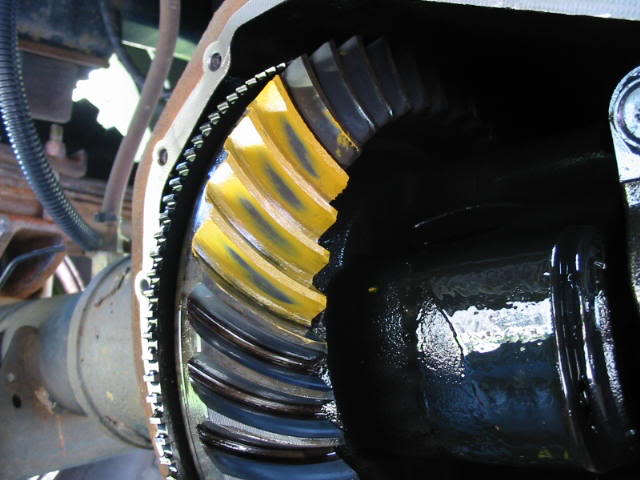
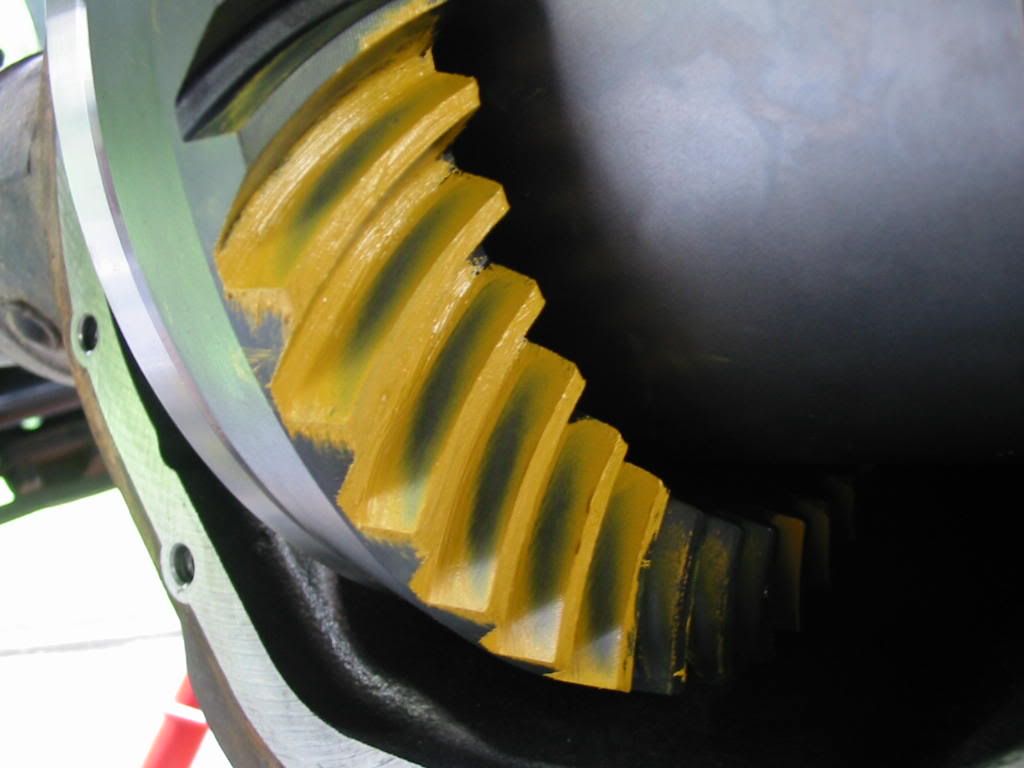
Below is an ideal contact pattern with a five-cut gear:
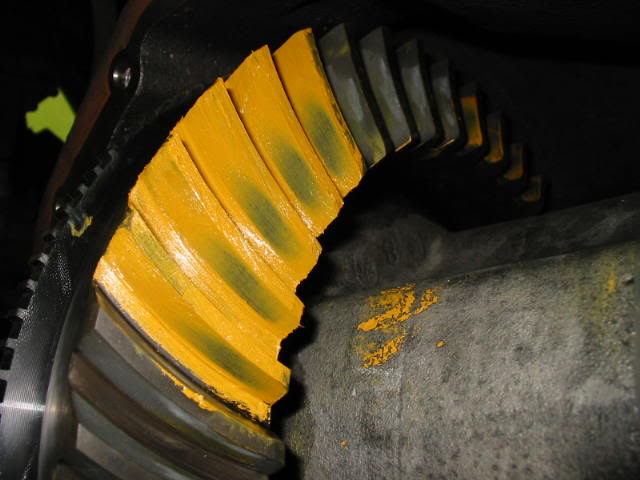

Cummins Guru


Joined: Feb 2008
Posts: 4,191
Likes: 65
From: Sunny Southern California Land of Fruits and Nuts
Since it's not on the wearing surface most likely done to remove rough edges during assembly by AA. If no metal particles on magnet I wouldn't worry about it.


Thread
Thread Starter
Forum
Replies
Last Post
ColinP
4th Gen Engine and Drivetrain-2010 and Up
5
Nov 28, 2012 06:09 PM
t-15 firefighter
3rd Gen Engine and Drivetrain -> 2003-2007
4
Jun 20, 2003 07:48 AM
General Diesel Discussion
63
May 31, 2003 03:28 PM