


Effect of Fuel Screw Adjustment on VE Pump Timing...


Thread Starter
Registered User
Joined: Jul 2013
Posts: 16
Likes: 0
From: Media, PA
Effect of Fuel Screw Adjustment on VE Pump Timing...
I've read that turning the full-power fuel screw on the VE Injection Pump alters pump timing, but haven't found anything explaining anything more about it.
How does this relationship work? As you turn the scew in (turning up the fuel), does this advance or retard the pump timing, and how much change are we talking about over the adjustment range of the screw (I'd assume only a few degrees at most)?
-Hans
How does this relationship work? As you turn the scew in (turning up the fuel), does this advance or retard the pump timing, and how much change are we talking about over the adjustment range of the screw (I'd assume only a few degrees at most)?
-Hans
Thread Starter
Registered User
Joined: Jul 2013
Posts: 16
Likes: 0
From: Media, PA
FWIW,
I've heard arguements for it doing both (advance & retard).
On one hand - We all know that as you turn the fuel screw in, idle speed increases, which is typically associated with an advance in injection timing. The fact that the engine wants to run away as the screw gets cranked in further and further would support this ideology.
-However-
On the other hand - People have made the arguement that turning in the screw increases fueling pressure sent to the injectors, and since pressure operates inversely to velocity in a transmission line, and it takes longer for the pump to build that higher pressure, turning the screw actually delays the start of the ignition event, thereby retarding timing.
I'm certainly no diesel injection pump expert, but it would be nice to know how this really works, as far as turning the full fuel screw and timing. Is it retarding or advancing timing, and if so, how much are we talking about over the adjustment range (a fraction of a degree, a few degrees, etc.)?
Does anyone out there know what is happening inside the VE pump when you crank up the fuel screw? (Beyond the obvious - "The screw presses on the tang with the governor spring connected to it" - answer)?
I'm curious to hear everyone's input on this.
-Hans
I've heard arguements for it doing both (advance & retard).
On one hand - We all know that as you turn the fuel screw in, idle speed increases, which is typically associated with an advance in injection timing. The fact that the engine wants to run away as the screw gets cranked in further and further would support this ideology.
-However-
On the other hand - People have made the arguement that turning in the screw increases fueling pressure sent to the injectors, and since pressure operates inversely to velocity in a transmission line, and it takes longer for the pump to build that higher pressure, turning the screw actually delays the start of the ignition event, thereby retarding timing.
I'm certainly no diesel injection pump expert, but it would be nice to know how this really works, as far as turning the full fuel screw and timing. Is it retarding or advancing timing, and if so, how much are we talking about over the adjustment range (a fraction of a degree, a few degrees, etc.)?
Does anyone out there know what is happening inside the VE pump when you crank up the fuel screw? (Beyond the obvious - "The screw presses on the tang with the governor spring connected to it" - answer)?
I'm curious to hear everyone's input on this.
-Hans

1st Generation Admin
Joined: Jan 2005
Posts: 4,601
Likes: 118
From: Buies Creek, NC
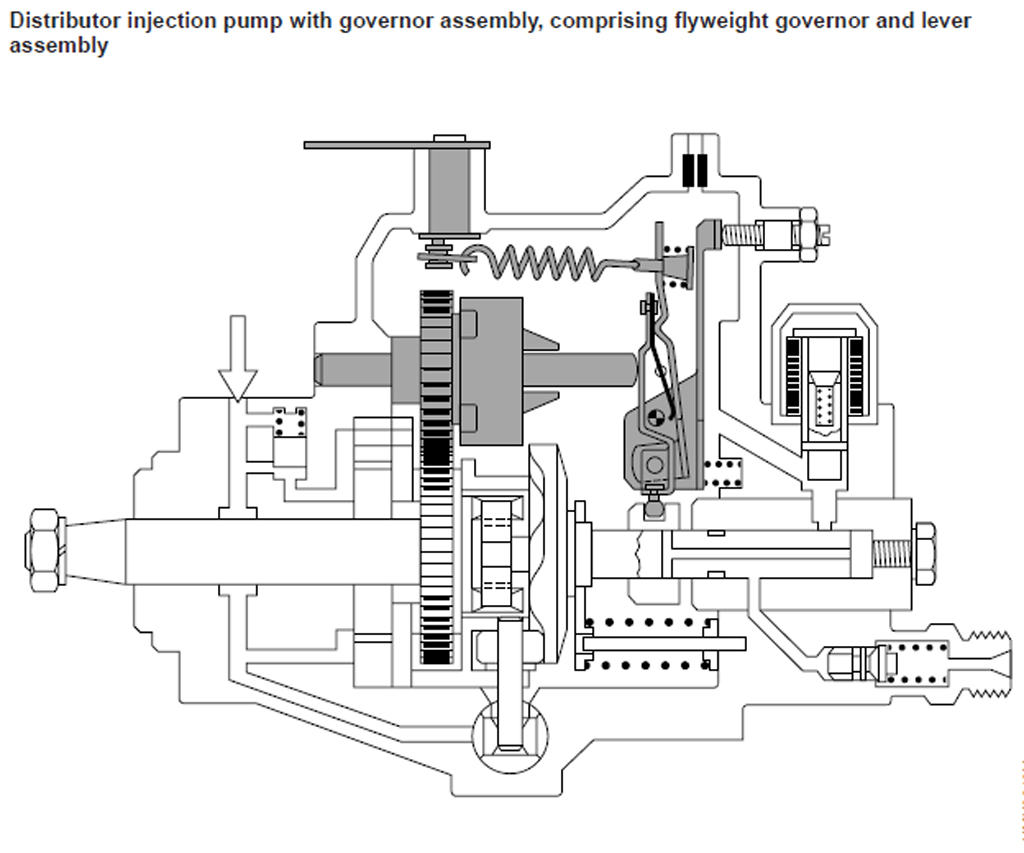
The following image shows the basic fuel control system of the VE IP - less the AFC circuit (for simplicity in this instance).
One can see the throttle lever at the top/left, the governor-spring top/center, and the main fuel-screw top/right. The governor itself is just below the throttle-lever and governor-spring. All of those tug or push on the lever-system (to the right of the governor) . . . . .
That lever-system ultimately moves the Control-Collar to cover or uncover the Spill-port of the Distributor Plunger (3rd from the top) . . . .
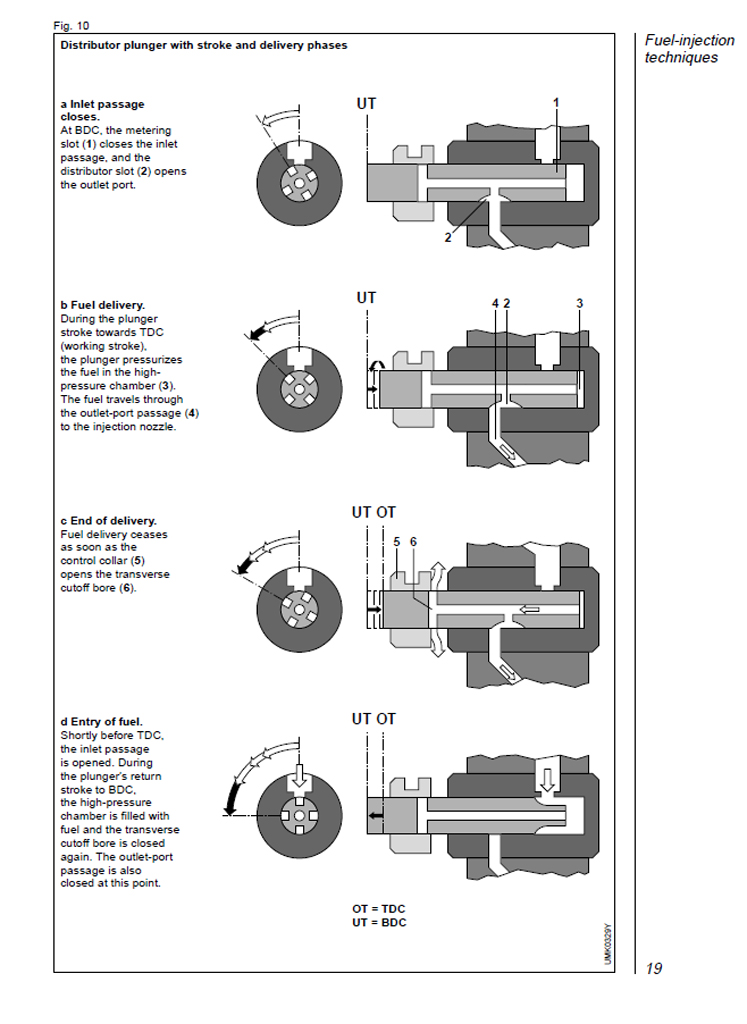
The more the control-collar covers the spill-port, the more fuel is moved to the injectors.
As is shown above, there is NO direct connection to the injection event timing device.
HOWEVER: the injection event timing device is powered by the IP's case pressure. The case pressure is determined by pump input-shaft speed (vane-pump speed), the IP case pressure relief-valve position, and the fixed over-flow restriction (in the fuel return line banjo fitting). With a steady throttle position, as the engine speed increases, the IP's case pressure goes up, eventually overcoming the timing device piston spring, and advances the injection event timing.
OK, fine.
Now, install larger injectors, etc . . . everything remains the same till you lean on the throttle and those larger injectors start moving enough fuel that you reach, and surpass the fuel volume capacity of the vane-pump. With that, the case pressure starts to drop. In doing so, there's now less case-pressure working against the timing device piston spring, and the timing advance backs off. Get off the throttle a little, reducing fuel demand, and the case-pressure goes back up, restoring the the more advance injection event timing.
Clear as mud?
Go pee and clear your desks, POP-Quiz!
As an FYI, our AFC circuit leans on the Tensioning-lever of the Lever System . . .
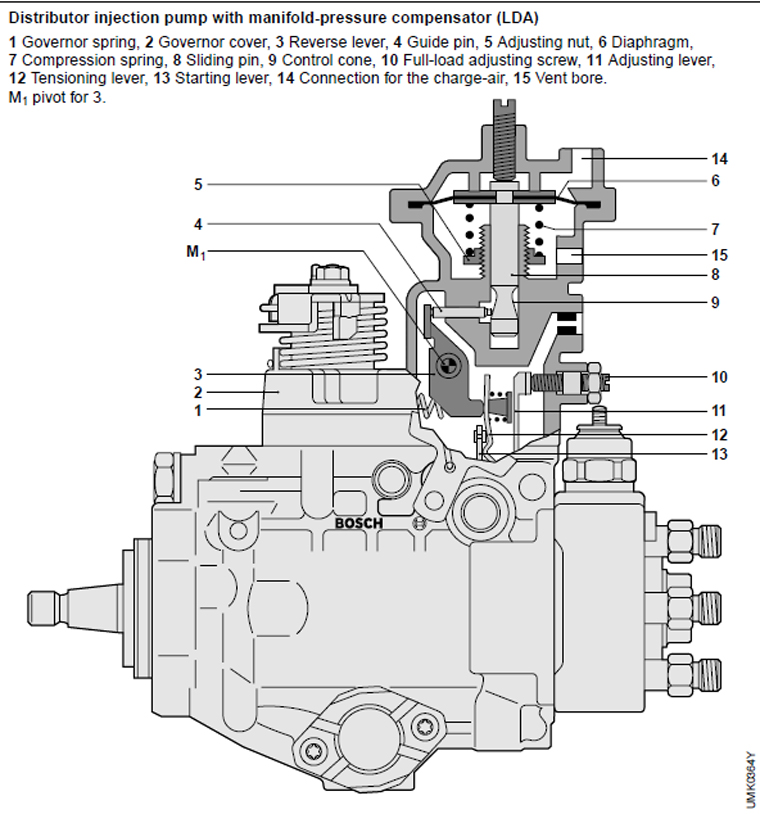
One can see the throttle lever at the top/left, the governor-spring top/center, and the main fuel-screw top/right. The governor itself is just below the throttle-lever and governor-spring. All of those tug or push on the lever-system (to the right of the governor) . . . . .
That lever-system ultimately moves the Control-Collar to cover or uncover the Spill-port of the Distributor Plunger (3rd from the top) . . . .
The more the control-collar covers the spill-port, the more fuel is moved to the injectors.
As is shown above, there is NO direct connection to the injection event timing device.
HOWEVER: the injection event timing device is powered by the IP's case pressure. The case pressure is determined by pump input-shaft speed (vane-pump speed), the IP case pressure relief-valve position, and the fixed over-flow restriction (in the fuel return line banjo fitting). With a steady throttle position, as the engine speed increases, the IP's case pressure goes up, eventually overcoming the timing device piston spring, and advances the injection event timing.
OK, fine.
Now, install larger injectors, etc . . . everything remains the same till you lean on the throttle and those larger injectors start moving enough fuel that you reach, and surpass the fuel volume capacity of the vane-pump. With that, the case pressure starts to drop. In doing so, there's now less case-pressure working against the timing device piston spring, and the timing advance backs off. Get off the throttle a little, reducing fuel demand, and the case-pressure goes back up, restoring the the more advance injection event timing.
Clear as mud?
Go pee and clear your desks, POP-Quiz!
As an FYI, our AFC circuit leans on the Tensioning-lever of the Lever System . . .
Thread Starter
Registered User
Joined: Jul 2013
Posts: 16
Likes: 0
From: Media, PA
Thanks, that was very helpful.
What that tells me (If I'm reading this correctly) is that cranking up the fuel screw is not really capable of advancing the start of the timing event any appreciable amount. (I say "appreciable", because by the laws of physics, changes to a three dimensional object (outside of the quantum level) also result in an alteration of the time dimension. One can extrapolate that the change in the orientation of the fuel plate and collar will indeed alter the velocity/pressure in that portion of the pump output section (at least momentarily), which will in turn effect the onset of the timing event... but I'd imagine that the resulting changes are more than likely small enough that for our purposes, they needn't be considered).
However, what is worth worrying about is the potential to create a situation where timing is retarded due to approaching/exceeding the mechanical limitations (of maintaining case pressure relative to flow rate) of the injection pump (assuming one is running large enough injectors/high enough engine speeds to create such a situation).
This makes quite a bit of sense, and explains the need for running more initial timing with larger injectors and increased RPMs.
It also explains why cranking the fuel screw in too much results in run away (given enough plate angle, the purge hole will remain covered through the entire pump cycle, creating a constant fueling situation) and sheds additional light on my earlier thread about jumping a tooth at the pump gear with stock injectors.
Thanks again for taking the time to type all that out, it's very much appreciated.
-Hans
What that tells me (If I'm reading this correctly) is that cranking up the fuel screw is not really capable of advancing the start of the timing event any appreciable amount. (I say "appreciable", because by the laws of physics, changes to a three dimensional object (outside of the quantum level) also result in an alteration of the time dimension. One can extrapolate that the change in the orientation of the fuel plate and collar will indeed alter the velocity/pressure in that portion of the pump output section (at least momentarily), which will in turn effect the onset of the timing event... but I'd imagine that the resulting changes are more than likely small enough that for our purposes, they needn't be considered).
However, what is worth worrying about is the potential to create a situation where timing is retarded due to approaching/exceeding the mechanical limitations (of maintaining case pressure relative to flow rate) of the injection pump (assuming one is running large enough injectors/high enough engine speeds to create such a situation).
This makes quite a bit of sense, and explains the need for running more initial timing with larger injectors and increased RPMs.
It also explains why cranking the fuel screw in too much results in run away (given enough plate angle, the purge hole will remain covered through the entire pump cycle, creating a constant fueling situation) and sheds additional light on my earlier thread about jumping a tooth at the pump gear with stock injectors.
Thanks again for taking the time to type all that out, it's very much appreciated.
-Hans
1st Generation Admin
Joined: Jan 2005
Posts: 4,601
Likes: 118
From: Buies Creek, NC
The downside is an increase in negative torque at the crankshaft. It quickly becomes a balancing act. The later IPs get around this by running a substantially higher injection pressure thus, allowing more fuel to be injected, in a comparatively narrower window (shorter time)..

Registered User
Joined: Oct 2008
Posts: 1,591
Likes: 11
From: Thunder Bay
David, have you found a practical means of maintaining sufficient case pressure to allow the dynamic advance to function under heavy load situations?
Sent from my Galaxy SIII via tapatalk 2
Sent from my Galaxy SIII via tapatalk 2
Trending Topics
Thread Starter
Registered User
Joined: Jul 2013
Posts: 16
Likes: 0
From: Media, PA
I'm not David, but here are my thoughts on the matter:
I would think that this is a two-fold problem, depending on one's fuel setup.
The first and most obvious limitation is going to be the lift pump and fuel line diameter. Since the VE pump can only safely handle around 15psi of input pressure without mods to the front seal, providing enough fuel to allow the injection pump to function properly and generate 17,000 psi from that low of an input pressure is going to require a pretty hefty feed pump and large diameter lines. The injection pump does self-feed to some degree, but not enough to maintain proper pressure without a functioning lift pump, especially with fuel modificiations.
In theory, that problem shouldn't be too hard to fix, assuming a beefy enough supply pump and large enough diameter lines. Worst case scenario, a little work to the case to retain the front seal, and you can safely bump up supply pressure, which would help considerably.
The second half of the problem is much more difficult to rectify. That would occur when you are demanding more from the injection pump than it is capable of producing, regardless of the supply modifications. At some point, you reach the mechanical limitations of the injection pump to meet fuel demands and maintain pressure... meaning no matter how much fuel you have to feed the pump, it is physically incapable of maintaining full pressure at the flow rate demanded by the injectors.
I believe this situation is what David was talking about in his last post, when he discussed case pressure dropping and dynamic advance being retarded. Pressure drops because the injection pump simply cannot produce the required flow rate and still maintain pressure (the two are linked by the laws of physics - it works very much like electricity, if you are familiar with Ohm's law).
At that point, short of totally re-engineering the pump itself, there really isn't much you can do. I know some guys go to the 14mm pump head, which can flow more fuel, but does so at a lower RPM than the 12mm head, so it's a bit of a give-and-take. And if you're looking at spending that kind of money, you're into the realm of doing a P-Pump swap, which is certainly another option.
Either way, in the second scenario, you're up against the mechanical limitations of the injection pump itself, and there really isn't much you can do to change that... but you can make sure that the fuel supply system is adequate to allow the injection pump to make the most power it can. Obviously, if the supply pump/lines reach their limits before the injection pump does, the pump will not be able to perform effectively.
So the first step is determining whether the cause of one's pressure drop is due to the supply system not being sufficient, or the injection pump itself reaching its mechanical limits, as they are two separate, but related issues.
-Hans
Registered User
Joined: Oct 2008
Posts: 1,591
Likes: 11
From: Thunder Bay
I'm basically probing to see if anyone has provided or found a resolution or even a partial resolution to the second half of that.
As for part 1. I have the ford 3/8" lines, which isn't as big as I would like but should suffice. I have a new pump with retained, updated front seal already on the truck and a pusher pump I need to install near the tank. All that should supply me with a constant pressure of whatever psi I want up to 24psi as that is what my regulator is limited to.
I know over on other forum Brad Ponci has said he runs 25 psi inlet pressure and currently has the fastest ve cummins on the planet. 47rh or not, it has officially broken into the 11s in the 1/4 mile. Well his daughter has the truck but you know what I mean...
Sent from my Galaxy SIII via tapatalk 2
As for part 1. I have the ford 3/8" lines, which isn't as big as I would like but should suffice. I have a new pump with retained, updated front seal already on the truck and a pusher pump I need to install near the tank. All that should supply me with a constant pressure of whatever psi I want up to 24psi as that is what my regulator is limited to.
I know over on other forum Brad Ponci has said he runs 25 psi inlet pressure and currently has the fastest ve cummins on the planet. 47rh or not, it has officially broken into the 11s in the 1/4 mile. Well his daughter has the truck but you know what I mean...
Sent from my Galaxy SIII via tapatalk 2

Thread
Thread Starter
Forum
Replies
Last Post
Zeb Christensen
1st Gen. Ram - All Topics
4
Mar 11, 2015 08:42 AM
jmd4993
1st Gen. Ram - All Topics
3
Jun 22, 2013 07:36 AM
Lyall
12 Valve Engine and Drivetrain
7
Jan 6, 2007 10:37 AM