


block tap for arp ?


Thread Starter
Registered User
Joined: Jul 2009
Posts: 490
Likes: 3
From: San Diego
block tap for arp ?
TGIF! hello everyone, im about to start bottom tapping the stud holes in my block so i can install the arp studs. maybe i missed it some where but im not sure how far down i am supposed to go below the factory depth. i have all my tools ready and just want to be sure i do it right. can anyone help? thanks!
Seva
Seva


Registered User
Joined: Dec 2008
Posts: 130
Likes: 0
From: Lincoln, Illinois
I wouldn't waste your time running a tap in the block holes unless they have alot of junk in them. It didn't make a difference on height for mine. plus the tap broke in one hole, won't ever buy a fastenal tap agian. you will have to have the rocker arm pedestals milled down though.

Registered User
Joined: Sep 2004
Posts: 963
Likes: 0
From: Folsom CA
grind the web out of the inside of the valve cover and dont waste your time or money milling the pedestals.
bottom tapping is also not a must, I have done them with and without bottom tapping and I will continue to install them without bootom tapping as it doesn't make a difference.
bottom tapping is also not a must, I have done them with and without bottom tapping and I will continue to install them without bootom tapping as it doesn't make a difference.

1st Generation Admin
Joined: Jan 2005
Posts: 4,601
Likes: 118
From: Buies Creek, NC
I don't mind being the stick in the mud . .. .
Bottom-tapping is required to ensure full integrity of the thread interface between the stud and block.
- Certainly the studs are of very strong material. The question is: Are the stock/OEM block threads capable of supporting the stresses presented by the properly installed stud?
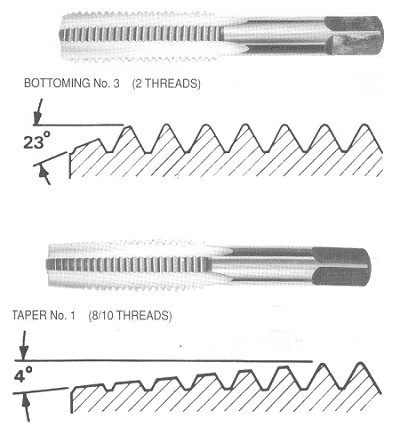
- As a matter of economical mass production, the bolt holes are threaded with a tap that has a lot of taper. This allows speed of production without excessive tool wear. With that, a stud that completely reaches the full depth of the bolt hole, is gonna have thread fitment issues. The resulting thread interface will be inconsistent at best thus, full strength cannot be realized. note the differnce in a standard tap and a bottomin tap in the image below . . .
- Those bolts that assemble the block, head and rocker pedestals: Those bolt holes are also part of the engine lube-oil feed that serves the rocker-arms, upper push-rod tips, as well as the upper portions of the valves. As such, those bolt holes will commonly be coated internally with cooked oil, carbon crunchys, etc that will interfere with realizing full thread strength. Especially there under the bottom tip of the factory bolt (our stock/OEM bolts do not "Bottom" in the hole).
- Those bolt holes at the exhaust manifold: With the elevated heat, anything that gets in there cooks and carbonizes, let alone the corrosion. Again, there's the interference with proper thread engagement.
Just for grins and giggles, there's the thing that all the makers of the stud kits, no matter who's brand, STRONGLY urge one to bottom-tap the block bolt holes. To be sure, they're not wasting ink and paper with providing a customer useless drivel for the money spent.
If one were to actually take the time to run a bottoming tap into their head prior to installing studs, The mess removed by the tap is difficult at best to argue with.
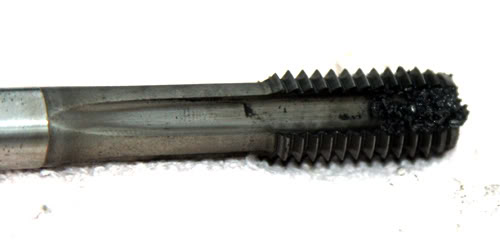
Oh, and those who say bottom-tapping their head damaged the threads and they would recommend one don't do it, . . . didn't do it correctly.
Bottom-tapping is required to ensure full integrity of the thread interface between the stud and block.
- Certainly the studs are of very strong material. The question is: Are the stock/OEM block threads capable of supporting the stresses presented by the properly installed stud?
- As a matter of economical mass production, the bolt holes are threaded with a tap that has a lot of taper. This allows speed of production without excessive tool wear. With that, a stud that completely reaches the full depth of the bolt hole, is gonna have thread fitment issues. The resulting thread interface will be inconsistent at best thus, full strength cannot be realized. note the differnce in a standard tap and a bottomin tap in the image below . . .
- Those bolts that assemble the block, head and rocker pedestals: Those bolt holes are also part of the engine lube-oil feed that serves the rocker-arms, upper push-rod tips, as well as the upper portions of the valves. As such, those bolt holes will commonly be coated internally with cooked oil, carbon crunchys, etc that will interfere with realizing full thread strength. Especially there under the bottom tip of the factory bolt (our stock/OEM bolts do not "Bottom" in the hole).
- Those bolt holes at the exhaust manifold: With the elevated heat, anything that gets in there cooks and carbonizes, let alone the corrosion. Again, there's the interference with proper thread engagement.
Just for grins and giggles, there's the thing that all the makers of the stud kits, no matter who's brand, STRONGLY urge one to bottom-tap the block bolt holes. To be sure, they're not wasting ink and paper with providing a customer useless drivel for the money spent.
If one were to actually take the time to run a bottoming tap into their head prior to installing studs, The mess removed by the tap is difficult at best to argue with.
Oh, and those who say bottom-tapping their head damaged the threads and they would recommend one don't do it, . . . didn't do it correctly.
Trending Topics
Registered User
Joined: Dec 2008
Posts: 130
Likes: 0
From: Lincoln, Illinois
I ran the stud down, measured the length sticking out. Ran a bottoming tap all the way down. Installed the stud and measured again there was no difference in measurments. Every engine is different, due to wear and abuse. Mine has been well cared for and never abused until I got ahold of it.

Administrator


Joined: Nov 2004
Posts: 4,084
Likes: 235
From: Southern California
And remember that if you do break off your tap, all is not tragic, it can be easily removed using a Broken Tap Extractor.
http://www.waltontools.com/products/extractr.htm
http://www.aircraftspruce.com/catalo...pextractor.php
Jim
http://www.waltontools.com/products/extractr.htm
http://www.aircraftspruce.com/catalo...pextractor.php
Jim

Registered User

Joined: Nov 2008
Posts: 453
Likes: 50
I have said this before when buying taps make sure that they are HIGHSPEED STEEL if the tap doesn't say HS or HSS on it its not a highspeed steel its is a CARBON STEEL tap carbon steel don't last and are very brittle Ken

Thread
Thread Starter
Forum
Replies
Last Post
LovinTheTorque
3rd Gen Engine and Drivetrain -> 2003-2007
10
Sep 14, 2013 12:02 PM
glarior
3rd Gen Engine and Drivetrain -> 2003-2007
9
May 17, 2011 07:46 PM
bgilbert
1st Gen. Ram - All Topics
21
Mar 2, 2006 04:01 PM