


Best Intercooler


Registered User
Joined: May 2006
Posts: 768
Likes: 8
From: OK
Thanks, Tony


Registered User
Joined: May 2004
Posts: 2,867
Likes: 0
From: Golden, Colorado
PS IC has 3.25" OD inlet/outlet.
Registered User
Joined: May 2006
Posts: 768
Likes: 8
From: OK
I can make 28psi manifold pressure, the only thing is I can't use it all and stay at 1200deg pulling a 6% grade for a couple miles. You won't either, sure you could use that much power to accelerate to speed and the exhaust temps will only get to 1300deg, but if you stay in it for any longer and they'll get a bunch hotter than that! Come on up here to elevation and pull your 5th wheel over a pass and try to use all of your fuel making 31psi. NOT going to happen.
PS IC has 3.25" OD inlet/outlet.
PS IC has 3.25" OD inlet/outlet.
Thanks, Tony

Registered User
Joined: Jul 2009
Posts: 251
Likes: 1
From: sheet hole called California

1st Generation Admin
Joined: Jan 2005
Posts: 4,601
Likes: 118
From: Buies Creek, NC
Actually, the addition of the intercooler in 1991.5 had nothing to do with engine performance (HP/torque wise). The IC was added as an emissions control deal. I can't remember the exact thing but it seems the reduction in combustion temperatures lessens the production of oxides of nitrogen (don't quote me on the chemical/compound). 

Registered User
Joined: Mar 2008
Posts: 4,389
Likes: 114
From: Orange County, California
i'll quote you cuz you're right. higher combustion temperatures lead to higher nitrous oxide (NOx) and low combustion temperatures lead to higher hydrocarbons (HC's) aka unburnt fuel. you'll never be able to get rid of either one. you'll only have an equilibrium.
Registered User
Joined: Jul 2009
Posts: 251
Likes: 1
From: sheet hole called California
Actually, the addition of the intercooler in 1991.5 had nothing to do with engine performance (HP/torque wise). The IC was added as an emissions control deal. I can't remember the exact thing but it seems the reduction in combustion temperatures lessens the productions of oxides of nitrogen (don't quote me on the chemical/compound).
 they never cared about power in the first place.

Registered User
Joined: Jul 2008
Posts: 1,506
Likes: 0
From: Goshen, Ky
The stock 1st Gen Intercooler can support 500+rwhp, as Bill Gilbert has proved. That's more than enough for any daily driver. (VE)
Registered User
Joined: Mar 2008
Posts: 4,389
Likes: 114
From: Orange County, California
if you think about it, it was a power upgrade. the only reason they made the same power as the non i/c motors was using smaller injectors. with the addition of the i/c, obviously the intake air temperature was reduced. and when you cool the intake air, it becomes more dense. the air then has more oxygen molecules for the fuel (when atomized) to bond to/mix with and ignite for a more efficient combustion process. more fuel burned the less unburnt fuel there was (no smoke in stock form). as was stated in my last post, low combustion temperatures or more unburnt fuel leads to higher hydrocarbons (HC's) and less unburnt fuel leads to higher combustion temperatures, thus leading to higher nitrous oxide (NOx). hence always having an equilibrium.


Registered User
Joined: May 2004
Posts: 2,867
Likes: 0
From: Golden, Colorado
Registered User
Joined: Jul 2009
Posts: 251
Likes: 1
From: sheet hole called California
 problem i had is the zig zag stuff between the rows or colums started unraveling like a button thread.
Registered User
Joined: Mar 2008
Posts: 4,389
Likes: 114
From: Orange County, California
here's BC847's intercooler if anyone is curious...
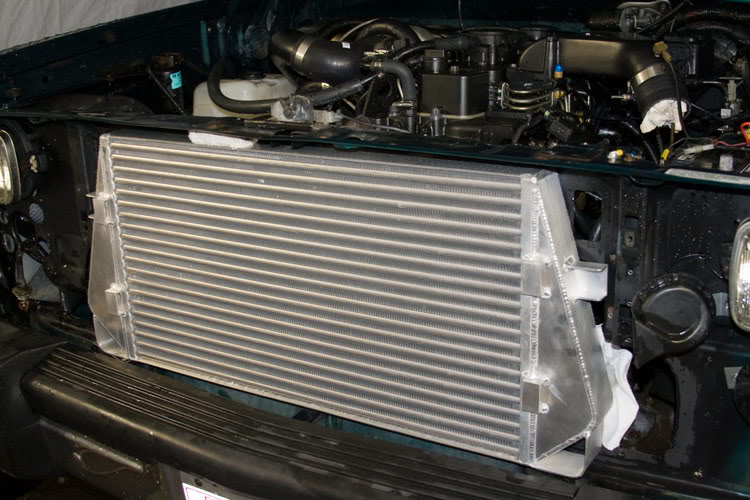
from cumminsforum.com he writes "Joe Hellman of Hellman Performance can make anything you want and guarantee it to 100psig."
from cumminsforum.com he writes "Joe Hellman of Hellman Performance can make anything you want and guarantee it to 100psig."