


92 w250 bad brakes


Thread Starter
Registered User
Joined: May 2007
Posts: 1,159
Likes: 7
From: Maryland
92 w250 bad brakes
Well I installed new shoes and adjusted them, wheel cylinders, front pads and brake lines then bleed the system and the pedal still goes all the way to the floor. The master cylinder was replaced by precious owner and looks recent.
I put a vacuum gauge on the test port (sensor) and it pulls 30" right away but when pumping the brakes goes to zero, one pump and goes to 10" I thought it could be the booster which looks old maybe original from factory.
I've read the sticky threads on brakes several times and some others I found using the search engine here but I still can't decide since I don't know what is the real problem with this brakes, a booster/master cylinder would provably cost Me $140 and some claim the brakes are still spongy and respond almost late. Would it fix it if I install a hydrobooster? I have a hydro on My GMC stepvan and the master looks about the same as the one on the w250, don't know the bore size on it but it will definitely stop a 1 ton. Should I go this route?
Thanks in advance for the advise.
I put a vacuum gauge on the test port (sensor) and it pulls 30" right away but when pumping the brakes goes to zero, one pump and goes to 10" I thought it could be the booster which looks old maybe original from factory.
I've read the sticky threads on brakes several times and some others I found using the search engine here but I still can't decide since I don't know what is the real problem with this brakes, a booster/master cylinder would provably cost Me $140 and some claim the brakes are still spongy and respond almost late. Would it fix it if I install a hydrobooster? I have a hydro on My GMC stepvan and the master looks about the same as the one on the w250, don't know the bore size on it but it will definitely stop a 1 ton. Should I go this route?
Thanks in advance for the advise.

Registered User
Joined: Jan 2008
Posts: 7,547
Likes: 2
From: Quinton, New Jersey (middle of nowhere)
You should bypass the RWAL dump valve on the driver side inner frame rail, right above the rear. That thing can make your brake pedal feel like crap. Just undo the lines going into and out of it and hook them together with a short piece, or replace the whole line and go straight to the splitter on the axle tube.
Thread Starter
Registered User
Joined: May 2007
Posts: 1,159
Likes: 7
From: Maryland
I have hydrobooster on all My other trucks but one, I'm seriously considering adapting a hydrobooster from a chevy on this thing but I can do what You say first and see what happens, it wont cost Me much since I already have a coupler.
Thanks.
Thanks.

Thread Starter
Registered User
Joined: May 2007
Posts: 1,159
Likes: 7
From: Maryland
Well today I bypassed that rear valve inside the frame and the brakes feel much better, still bare minimum but they stop the truck. Next thing I do to this brakes is a hydroboost and I was actually looking at the same You just said.
Trending Topics

Registered User


Joined: Dec 2010
Posts: 6,838
Likes: 1,683
From: Land of the Toxic Avenger
Instead of having a brake booster that's powered by a vacuum pump, the booster is powered by a pressure and return hose system, similar to a power steering unit.
If Im not mistaken, you then need to install a fluid pump on your engine to create the pressure to move the fluid to the booster. I guess you can use your power steering pump, but that might detract from presssure to your gear..
http://www.google.com/search?q=hydro...w=1244&bih=968
No thanks....
I'll stick with my vacuum booster, as my brakes work perfect.
If Im not mistaken, you then need to install a fluid pump on your engine to create the pressure to move the fluid to the booster. I guess you can use your power steering pump, but that might detract from presssure to your gear..
http://www.google.com/search?q=hydro...w=1244&bih=968
No thanks....
I'll stick with my vacuum booster, as my brakes work perfect.

Registered User
Joined: Nov 2011
Posts: 4,479
Likes: 211
From: Isanti, MN
On of my pet peeves is when folks try to fix a basic serious problem by upgrading. Trying to upgrade the operating system on a computer that's virus or malware infected for instance.
If the original brakes don't have good pedal, something is wrong in the system. It doesn't necessarily have to be a hydraulic fault, though it often is. Here's some possibilities I've seen in my 40 years of wrenchin', in addition to just plain bad parts, sometimes new bad parts.
Air in lines
Wrong shoes
Soft, ready to rupture hose
Copper brake line
Warped rotor or drum
Oil soaked braking surface
Cracked rotor
Mis adjusted master cylinder
Bad pedal linkage
Leaks all over
The thought is, if you have one of these faults, and you upgrade the pressure producing part of the system, you're setting yourself for catastrophic failure, and Murphy's law will make certain that is at the worst time possible, like when yer headed for a soccer van full of kids with 10K in tow going downhill.
If the original brakes don't have good pedal, something is wrong in the system. It doesn't necessarily have to be a hydraulic fault, though it often is. Here's some possibilities I've seen in my 40 years of wrenchin', in addition to just plain bad parts, sometimes new bad parts.
Air in lines
Wrong shoes
Soft, ready to rupture hose
Copper brake line
Warped rotor or drum
Oil soaked braking surface
Cracked rotor
Mis adjusted master cylinder
Bad pedal linkage
Leaks all over
The thought is, if you have one of these faults, and you upgrade the pressure producing part of the system, you're setting yourself for catastrophic failure, and Murphy's law will make certain that is at the worst time possible, like when yer headed for a soccer van full of kids with 10K in tow going downhill.


Registered User
Joined: Mar 2005
Posts: 1,167
Likes: 2
From: SW Pennsylvania - Greene County
The pump has two returns and one pressure. The pressure line goes first to the hydra-boost where it internally is teed then on to the power steering box. Both the steering box and the brake unit have their own return lines to the pump reservoir. This one is shown with a power steering box cooler installed:
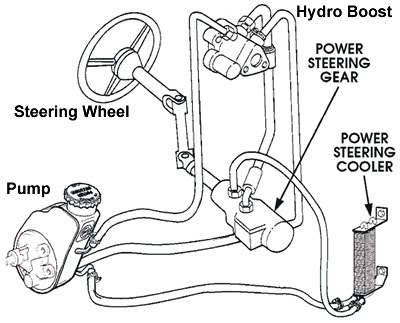
Chrysler actually installed this type of system in the D100/W100 pick up trucks with the first early failed diesel engine attempt.

Adminstrator-ess

Joined: Mar 2003
Posts: 22,594
Likes: 19
From: New Holland, PA
On of my pet peeves is when folks try to fix a basic serious problem by upgrading. Trying to upgrade the operating system on a computer that's virus or malware infected for instance.
If the original brakes don't have good pedal, something is wrong in the system. It doesn't necessarily have to be a hydraulic fault, though it often is. Here's some possibilities I've seen in my 40 years of wrenchin', in addition to just plain bad parts, sometimes new bad parts.
Air in lines
Wrong shoes
Soft, ready to rupture hose
Copper brake line
Warped rotor or drum
Oil soaked braking surface
Cracked rotor
Mis adjusted master cylinder
Bad pedal linkage
Leaks all over
The thought is, if you have one of these faults, and you upgrade the pressure producing part of the system, you're setting yourself for catastrophic failure, and Murphy's law will make certain that is at the worst time possible, like when yer headed for a soccer van full of kids with 10K in tow going downhill.
If the original brakes don't have good pedal, something is wrong in the system. It doesn't necessarily have to be a hydraulic fault, though it often is. Here's some possibilities I've seen in my 40 years of wrenchin', in addition to just plain bad parts, sometimes new bad parts.
Air in lines
Wrong shoes
Soft, ready to rupture hose
Copper brake line
Warped rotor or drum
Oil soaked braking surface
Cracked rotor
Mis adjusted master cylinder
Bad pedal linkage
Leaks all over
The thought is, if you have one of these faults, and you upgrade the pressure producing part of the system, you're setting yourself for catastrophic failure, and Murphy's law will make certain that is at the worst time possible, like when yer headed for a soccer van full of kids with 10K in tow going downhill.
Sent from my Android powered HTC HD2 - how cool is that?

Registered User
Joined: Nov 2006
Posts: 3,238
Likes: 574
From: Central KY
The pump has two returns and one pressure. The pressure line goes first to the hydra-boost where it internally is teed then on to the power steering box. Both the steering box and the brake unit have their own return lines to the pump reservoir. This one is shown with a power steering box cooler installed:
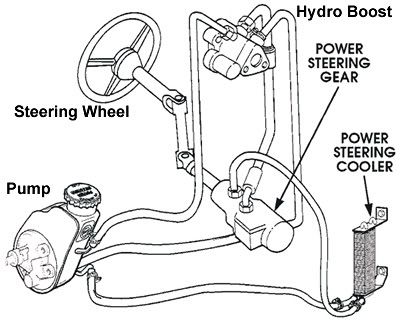
Chrysler actually installed this type of system in the D100/W100 pick up trucks with the first early failed diesel engine attempt.
Interesting, didn't know that. This is from the 70s with the Perkins?

Registered User
Joined: Oct 2004
Posts: 427
Likes: 0
From: Kansas City, MO
On of my pet peeves is when folks try to fix a basic serious problem by upgrading. Trying to upgrade the operating system on a computer that's virus or malware infected for instance.
If the original brakes don't have good pedal, something is wrong in the system. It doesn't necessarily have to be a hydraulic fault, though it often is. Here's some possibilities I've seen in my 40 years of wrenchin', in addition to just plain bad parts, sometimes new bad parts.
Air in lines
Wrong shoes
Soft, ready to rupture hose
Copper brake line
Warped rotor or drum
Oil soaked braking surface
Cracked rotor
Mis adjusted master cylinder
Bad pedal linkage
Leaks all over
The thought is, if you have one of these faults, and you upgrade the pressure producing part of the system, you're setting yourself for catastrophic failure, and Murphy's law will make certain that is at the worst time possible, like when yer headed for a soccer van full of kids with 10K in tow going downhill.
If the original brakes don't have good pedal, something is wrong in the system. It doesn't necessarily have to be a hydraulic fault, though it often is. Here's some possibilities I've seen in my 40 years of wrenchin', in addition to just plain bad parts, sometimes new bad parts.
Air in lines
Wrong shoes
Soft, ready to rupture hose
Copper brake line
Warped rotor or drum
Oil soaked braking surface
Cracked rotor
Mis adjusted master cylinder
Bad pedal linkage
Leaks all over
The thought is, if you have one of these faults, and you upgrade the pressure producing part of the system, you're setting yourself for catastrophic failure, and Murphy's law will make certain that is at the worst time possible, like when yer headed for a soccer van full of kids with 10K in tow going downhill.
I also agree. I find that the brakes on these trucks are often molested. My truck the shoes were on backwards. My abs works and I love it. I also had poor pedal feel. When I got the park brake working and Adjusted the pedal height and feel improved dramatically. I had a dually with no abs and great pedal feel but it was treacherous to drive. Rear brakes were too aggressive, nothing like coming to a stop sideways at a light.

Registered User
Joined: Mar 2010
Posts: 789
Likes: 0
On of my pet peeves is when folks try to fix a basic serious problem by upgrading. Trying to upgrade the operating system on a computer that's virus or malware infected for instance.
If the original brakes don't have good pedal, something is wrong in the system. It doesn't necessarily have to be a hydraulic fault, though it often is. Here's some possibilities I've seen in my 40 years of wrenchin', in addition to just plain bad parts, sometimes new bad parts.
Air in lines
Wrong shoes
Soft, ready to rupture hose
Copper brake line
Warped rotor or drum
Oil soaked braking surface
Cracked rotor
Mis adjusted master cylinder
Bad pedal linkage
Leaks all over
The thought is, if you have one of these faults, and you upgrade the pressure producing part of the system, you're setting yourself for catastrophic failure, and Murphy's law will make certain that is at the worst time possible, like when yer headed for a soccer van full of kids with 10K in tow going downhill.
If the original brakes don't have good pedal, something is wrong in the system. It doesn't necessarily have to be a hydraulic fault, though it often is. Here's some possibilities I've seen in my 40 years of wrenchin', in addition to just plain bad parts, sometimes new bad parts.
Air in lines
Wrong shoes
Soft, ready to rupture hose
Copper brake line
Warped rotor or drum
Oil soaked braking surface
Cracked rotor
Mis adjusted master cylinder
Bad pedal linkage
Leaks all over
The thought is, if you have one of these faults, and you upgrade the pressure producing part of the system, you're setting yourself for catastrophic failure, and Murphy's law will make certain that is at the worst time possible, like when yer headed for a soccer van full of kids with 10K in tow going downhill.
I have a very low pedal