


Would you trust this gooseneck hitch??


Thread Starter
Chapter President
Joined: Nov 2005
Posts: 739
Likes: 0
From: On the road...
Would you trust this gooseneck hitch??
I bought the truck not to long ago and realized that the gooseneck hitch is welded to the frame. I wasn't to concerned about it due to never planning on using it. Plans change and now I do. It is built like this. A 12" wide, frame to frame 1" thick steel plate welded onto 1 1/4 by 1 1/4" steel blocks welded to the frame. A friend of mine says that everything is "triple stitched" as far as the welds go and that it is very strong. However it is only welded on one side, and not both. Honestly the welds look like they were done by a machine that's how clean they are. I am looking at towing my 12000lb 5th wheel with it that has a tongue weight of roughly 2300 lbs. Thoughts??

Registered User
Joined: May 2007
Posts: 102
Likes: 0
From: Hill AFB, UT
When I bought my truck, it had something similar, but the welds looked like bird droppings. It worked OK, but it had sagged about 1/2" in the middle.
I was able to cut it out with a plasma cutter without damaging the frame and installed a B&W turnover. Now I don't worry about it.
I was able to cut it out with a plasma cutter without damaging the frame and installed a B&W turnover. Now I don't worry about it.

I dont always get the death wobble, But when I do, I just buy a new truck.
Joined: Mar 2009
Posts: 146
Likes: 0
From: east texas
id trust it, back in the day they just took a 1/2in plate and layed it in the bed bolted it to the frame and welded a ball to it....your set up is definatly stronger than that!!

Muted one day, Banned the next....... Ah the life of a DTR 1%'er
Joined: Jan 2005
Posts: 2,187
Likes: 0
From: Ohio: Home of the disappointing sports teams
Sounds pretty trust worthy to me.. Take a picture and post it up.. Chaikwa (DTR's Master Fabricator) or Blake (DTR Master Welder) could help tell weather or not its up to the task

Administrator
Joined: Jan 2004
Posts: 2,331
Likes: 2
From: Kalamazoo, Michigan
I wouldn't trust it for 4 reasons;
1) it's welded to the frame. That's a BIG no-no.
 In general, frames shouldn't be welded upon. They are tempered for one thing, and unless that is taken into account by pre and post weld heating, they can become brittle where they are welded. Additionally, truck frames today are substantially thinner, (because they're tempered), than they were back when trucks were trucks.
 2) It sounds as if they welded it to the top, (or flange), of the frame. Even back in the day, that was always something that was discouraged. Even in big trucks.
3) It's welded on one side. Even tho it's stitch welded, which IS stronger than a continuous weld, (in general), it needs to be welded on both sides to attain any kind of strength. Again, this is if it's in the configuration I am imagining it is in, on top of the frame rails.
4) A plain, flat plate, even one that is an inch thick, doesn't have a lot of strength laying in the flat position. I've seen heavy channel sag in that same configuration, and channel has two legs much like a frame rail that strengthens it laterally. If the flat plate had a couple of pieces of flat stock welded to it the long way, I'd have a lot more confidence in it to resist bending.
I used to make hitches much like you are describing, except I used 8 or 10 inch channel. I would weld 'ears' to each end that would extend downward over the outside of each frame rail and would be bolted to the frame. Even then, I've seen a couple of them bend slightly from extremely heavy trailers.
Even if you took the present hitch off and installed a proper hitch, (like a turn over ball for example), I would keep a close eye on the frame for signs of cracking. Just because the weld would be removed, the temper of the steel still remains altered. Depending on the method of removal, it could be worse than when the hitch plate was welded in place.
Thread Starter
Chapter President
Joined: Nov 2005
Posts: 739
Likes: 0
From: On the road...
Well crap I was hoping it would be strong enough to not have to buy a 5th wheel for it. Ah well...a slider hitch is probably a better option anyway. Thanks for the replies everyone!
I was hoping it would be strong enough to not have to buy a 5th wheel for it. Ah well...a slider hitch is probably a better option anyway. Thanks for the replies everyone!
Trending Topics
Muted one day, Banned the next....... Ah the life of a DTR 1%'er
Joined: Jan 2005
Posts: 2,187
Likes: 0
From: Ohio: Home of the disappointing sports teams
Even though Chaikwa is usually a 'sharp, pointy, needle like object' he goes and post something thats actually very informative. Thanks you sir, I actually learned something today. 
89dieselkong- Sorry about the hitch.
89dieselkong- Sorry about the hitch.

Administrator / Severe Concussion Aficionado
Joined: Jul 2008
Posts: 5,491
Likes: 15
From: Home: Kaplan, LA - Pipelining In: Pecos, Tx
Well
If I did the welding I would trust it. Not knowing who did the welding would raise a flag in my mind.
Every gooseneck I have every put on a truck prior to my '11 B&W was welded to the frame.
I would take a 12" piece of channel and invert a 6" channel inside, full pen, full weld.
I would then LH it to the frame.
But, like Scott, I have a bit of experience with such things and this should not be done by your average Joe with a Home Depot Hobart.
If I did the welding I would trust it. Not knowing who did the welding would raise a flag in my mind.
Every gooseneck I have every put on a truck prior to my '11 B&W was welded to the frame.
I would take a 12" piece of channel and invert a 6" channel inside, full pen, full weld.
I would then LH it to the frame.
But, like Scott, I have a bit of experience with such things and this should not be done by your average Joe with a Home Depot Hobart.
Thread Starter
Chapter President
Joined: Nov 2005
Posts: 739
Likes: 0
From: On the road...
Here's a question then, those companies that do the longbed conversions on the Mega cabs, are they weakening the frames as well? I understand that they have the fishmouth curve on the part of the frame that goes over the original, but wouldn't the part where they weld to to the original frame weaken it in the same way? (Not trying to argue, but now I'm concerned about my frame strength with it already being welded )
)
)
Administrator
Joined: Jan 2004
Posts: 2,331
Likes: 2
From: Kalamazoo, Michigan

You're not talking about welding to the top flange are you? You'd still have to pre and post heat with LH, right? And how close to the bend of the flange would you get on the frame rail? These frames are so thin now, even with proper welding I don't know how it could be trusted. It's not like they're a 1/4" thick or better. And on 'big truck' frames there's almost always a sticker somewhere that instructs NOT to weld to frame flanges.
Administrator
Joined: Jan 2004
Posts: 2,331
Likes: 2
From: Kalamazoo, Michigan
Here's a question then, those companies that do the longbed conversions on the Mega cabs, are they weakening the frames as well? I understand that they have the fishmouth curve on the part of the frame that goes over the original, but wouldn't the part where they weld to to the original frame weaken it in the same way? (Not trying to argue, but now I'm concerned about my frame strength with it already being welded)
)In the pic below you can see that the frame on the truck has been cut at a 45 degree angle and the piece to be welded on to extend it is cut at the same 45 degree angle. The other piece you see leaning against the extension is what will be bolted on the inside of the frame and centered at the weld seam. I don't know if they do this on light frames or not.


With age comes the cage
Joined: Jul 2007
Posts: 2,710
Likes: 3
From: The Gas Patch
This is from the up-fitters guide for welding on the frame:
Welding
1. Avoid welding near the fuel tank, fuel lines, brake lines or other components that
may be damaged.
2. Components near the welding area which could be damaged by excessive heat
must be removed or adequately shielded.
3. Disconnect the battery(ies), negative terminal posts, and the main ground to the
TIPM / Battery (See Figure A)
4. Precautionary measures should be used to prevent electrical system component or
wiring damage.
5. The frame e-coating must be removed from the weld and surrounding area.
6. Use proper welding techniques to avoid stress risers that may adversely affect
frame performance.
After welding:
1. Carefully inspect electrical components and wiring for shorts or other damage.
2. Apply protective coating to the areas where the coating was removed.
If lengthening the frame:
1. In preparation for welding, clean the e-coat from the frame surface with a wire
wheel or equivalent.
2. Use a mild (low carbon) steel material of comparable thickness to the rails.
3. Chamfer the two mating areas to be joined by welding.
4. If extending the rear of the frame, include a reinforcement that is welded to the
extension channel and extends forward far enough to allow bolting through the
rear crossmember lower rivet (requiring drilling out this rivet).
5. Disconnect the battery (ies negative terminal posts, and the main ground to the
TIPM/Battery (See Figure A).
6. Butt weld the frame and extension together on the top and side omitting welding
on the lower flange if extending the rear of the frame as above.
7. Grind smooth the outer surface of the vertical web of the rail. Clamp on a
reinforcement plate ¼” mild steel 4 “x12 “. If extending the rear of the frame,
drill two holes in the reinforcement through the upper shear plate hole and the
lower rear crossmember hole. ‘Mirror’ two more of these holes in the
reinforcement through the extension piece (See Figure C). Stitch weld the
reinforcement onto the rail and extension avoiding the corners. Install ½” bolts
with flange heads (or hardened washers) into the four holes.
8. Coat the frame with a corrosion protective coating. Reconnect the electrical
components.
Yes it can be done safely, what you have described on your set-up probably was what we call a "Gov Project"
on a job site as the materials you listed and labor involved in building the same would have cost more than
buying and installing a B&W set-up that is bolted on and comes with that little "Warm-N-Fuzzy" liability insurance policy.
This is the my 5500 set-up that was welded together and bolted to the chasisis:
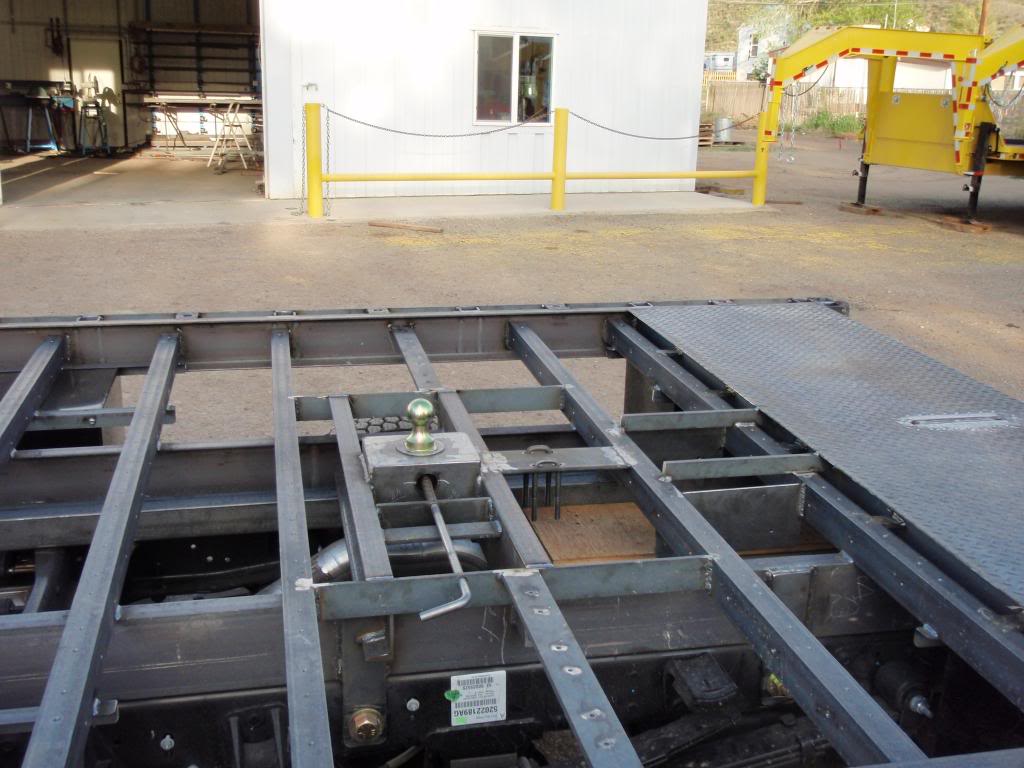

Once again post us some pics or take it and have it checked over by a qualified welding shop..
Welding
1. Avoid welding near the fuel tank, fuel lines, brake lines or other components that
may be damaged.
2. Components near the welding area which could be damaged by excessive heat
must be removed or adequately shielded.
3. Disconnect the battery(ies), negative terminal posts, and the main ground to the
TIPM / Battery (See Figure A)
4. Precautionary measures should be used to prevent electrical system component or
wiring damage.
5. The frame e-coating must be removed from the weld and surrounding area.
6. Use proper welding techniques to avoid stress risers that may adversely affect
frame performance.
After welding:
1. Carefully inspect electrical components and wiring for shorts or other damage.
2. Apply protective coating to the areas where the coating was removed.
If lengthening the frame:
1. In preparation for welding, clean the e-coat from the frame surface with a wire
wheel or equivalent.
2. Use a mild (low carbon) steel material of comparable thickness to the rails.
3. Chamfer the two mating areas to be joined by welding.
4. If extending the rear of the frame, include a reinforcement that is welded to the
extension channel and extends forward far enough to allow bolting through the
rear crossmember lower rivet (requiring drilling out this rivet).
5. Disconnect the battery (ies negative terminal posts, and the main ground to the
TIPM/Battery (See Figure A).
6. Butt weld the frame and extension together on the top and side omitting welding
on the lower flange if extending the rear of the frame as above.
7. Grind smooth the outer surface of the vertical web of the rail. Clamp on a
reinforcement plate ¼” mild steel 4 “x12 “. If extending the rear of the frame,
drill two holes in the reinforcement through the upper shear plate hole and the
lower rear crossmember hole. ‘Mirror’ two more of these holes in the
reinforcement through the extension piece (See Figure C). Stitch weld the
reinforcement onto the rail and extension avoiding the corners. Install ½” bolts
with flange heads (or hardened washers) into the four holes.
8. Coat the frame with a corrosion protective coating. Reconnect the electrical
components.
Yes it can be done safely, what you have described on your set-up probably was what we call a "Gov Project"
on a job site as the materials you listed and labor involved in building the same would have cost more than
buying and installing a B&W set-up that is bolted on and comes with that little "Warm-N-Fuzzy" liability insurance policy.
This is the my 5500 set-up that was welded together and bolted to the chasisis:
Once again post us some pics or take it and have it checked over by a qualified welding shop..