


ladder bars


Thread Starter
Registered User
Joined: Apr 2008
Posts: 36
Likes: 0
From: sloansville ny
ladder bars
i am looking to make ladder bars for my truck. if any one has any threads on the best way to do this or has any ideas where to find something like that please let me know.i wanna make them from scratch. Thanks

Registered User
Joined: Jan 2008
Posts: 1,719
Likes: 0
From: Houston


Registered User
Joined: Jan 2008
Posts: 1,719
Likes: 0
From: Houston

Registered User
Joined: Dec 2008
Posts: 1,409
Likes: 2
From: Colorado Springs, CO
Traction bars and ladder bars may look similar, but they function very differantly. Ladder bars need a coil over conversion, they can't be used with leaf springs. Ladder bars are not very street friendly, as they bind with unequal articulation.

Registered User
Joined: Sep 2006
Posts: 4
Likes: 0
Here is one with a shackle.
http://offroaddesign.com/catalog/tractionbar.htm
Here is one with a slip joint.
http://gmfullsize.com/forum/showpost...53&postcount=7
Registered User
Joined: Dec 2008
Posts: 1,409
Likes: 2
From: Colorado Springs, CO
That's a traction bar. It's designed for off road use and leaf springs. The picture is even labeled "traction bar".
This is a ladder bar. It's designed for drag racing and coil overs.
http://www.bearsperformanceproducts....s/Graphic3.jpg
This is a ladder bar. It's designed for drag racing and coil overs.
http://www.bearsperformanceproducts....s/Graphic3.jpg
Trending Topics
Registered User
Joined: Dec 2008
Posts: 1,409
Likes: 2
From: Colorado Springs, CO
In the pictures, you can see that a ladder bar has both attachement points above or below the axle centerline. Most traction bars have only one bar. The one shown above has two bars. But the second bar only re-inforces the first one. And, there's only one. No matching bar on the other side to cause binding.
Traction bars only attach to the axle at one point. That allows that one point to pivot as the axle moves up and down. The pinion angle changes as the axle moves up and down. That costs power, but allows you to use them with leaf springs. And you can use them on a 4x4 because they allow good articulation.
The big differance is the pinion angle. A ladder bar is designed to change the pinion angle as the axle moves up and down through it's arc. That's a good thing for drag racers; with every change in pinion angle from 0*, you lose power. It's a small amount of power, but it's there.
The ultimate ladder bar is a 4 link. It allows you set the instant center as far foreward as you want to, and change it between rounds. But they're pretty much restricted to drag only cars, because they bind so bad.
A stock Mustang (and many GM cars) use a 4 link, but they're parallel. They don't bind, but they don't work that well, either
Traction bars only attach to the axle at one point. That allows that one point to pivot as the axle moves up and down. The pinion angle changes as the axle moves up and down. That costs power, but allows you to use them with leaf springs. And you can use them on a 4x4 because they allow good articulation.
The big differance is the pinion angle. A ladder bar is designed to change the pinion angle as the axle moves up and down through it's arc. That's a good thing for drag racers; with every change in pinion angle from 0*, you lose power. It's a small amount of power, but it's there.
The ultimate ladder bar is a 4 link. It allows you set the instant center as far foreward as you want to, and change it between rounds. But they're pretty much restricted to drag only cars, because they bind so bad.
A stock Mustang (and many GM cars) use a 4 link, but they're parallel. They don't bind, but they don't work that well, either
Registered User
Joined: Sep 2006
Posts: 4
Likes: 0


Registered User
Joined: Dec 2008
Posts: 1,409
Likes: 2
From: Colorado Springs, CO
That's not a four link, it's a 3 link. You only have 3 connections to the axle. A very differant set up, designed to do exactly what you're doing with it. Oddly enough, many road race cars use a similar set up, often with an added Watts Link.
Pretty cool truck, BTW.
This is a 4 link:
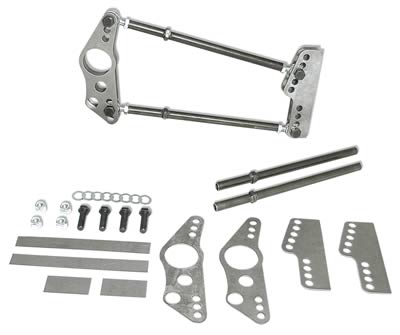
Notice there are actually 4 rods - 2 on each side. They connect from above and below the axle in the same vertical plane, to a foreward frame connection. Again, a big goal is keeping the pinion angle the same throughout the range.
On a stock car like a Mustang or many GM cars, they also have 4 "bars" in a similar configuration. But they are parallel on the vertical plane. On a 4 link drag car the bars are not parallel, and would eventually intersect if they were long enough. Changing that angle adjusts the suspension for better squat and weight transfer.
Pretty cool truck, BTW.
This is a 4 link:
Notice there are actually 4 rods - 2 on each side. They connect from above and below the axle in the same vertical plane, to a foreward frame connection. Again, a big goal is keeping the pinion angle the same throughout the range.
On a stock car like a Mustang or many GM cars, they also have 4 "bars" in a similar configuration. But they are parallel on the vertical plane. On a 4 link drag car the bars are not parallel, and would eventually intersect if they were long enough. Changing that angle adjusts the suspension for better squat and weight transfer.


Registered User
Joined: Dec 2008
Posts: 1,409
Likes: 2
From: Colorado Springs, CO
Yes, that's a 4 link. Notice how the top bars are also attached to the frame at an up angle, just like the lower bars. That's what prevents the binding and allows the full droop. By keeping the top bars short, it will change the pinion angle as the axle droops, preventing the U joints from binding.
What you don't get is a good transfer of energy to the frame, as there is no instant center. The bar lines never intersect. And that's a good trade off in this application.
Also note how the upper bars are angled inward. That keeps the axle centered.
This particular 4 link set up is not as efficient as the 3 link. Each side is limited by the length of the top bar. You won't get as much axle articulation. A long third link in the center will allow a much greater axle angulation than two short bars. The disadvantage to the 3 link is you have to find a way to keep the axle centered - like a watts link, panhard bar, or Y shaped 3rd link as shown above.
Life's full of trade offs.
Still, to get back to the original question, notice that none of those rock crawlers use a ladder bar or leaf springs. Those two systems just are not compatable with a large articulation range.
What you don't get is a good transfer of energy to the frame, as there is no instant center. The bar lines never intersect. And that's a good trade off in this application.
Also note how the upper bars are angled inward. That keeps the axle centered.
This particular 4 link set up is not as efficient as the 3 link. Each side is limited by the length of the top bar. You won't get as much axle articulation. A long third link in the center will allow a much greater axle angulation than two short bars. The disadvantage to the 3 link is you have to find a way to keep the axle centered - like a watts link, panhard bar, or Y shaped 3rd link as shown above.
Life's full of trade offs.
Still, to get back to the original question, notice that none of those rock crawlers use a ladder bar or leaf springs. Those two systems just are not compatable with a large articulation range.

Registered User
Joined: May 2005
Posts: 308
Likes: 0
From: Kingsport, TN
I just put Glacier Diesel's bars on my truck and they are awesome. Ride is great plus I don't have to adjust anything when I go from towing to unloaded. I highly recommend. These are the updated version. Tac

Registered User
Joined: Jan 2009
Posts: 33
Likes: 0