


Truck Died!!!


Registered User
Joined: Jul 2003
Posts: 7,129
Likes: 0
From: The Great White North
They only thing is you need a special fitting to go onto the schreader fiitting on the banjo bolt....can be hard to find in a short period of time in Canada....How quick do you need the truck up and running?
If you need some help finding the FP gauge parts, jsut let me know. I would be happy to help.
If you need some help finding the FP gauge parts, jsut let me know. I would be happy to help.

Thread Starter
Registered User
Joined: Jun 2006
Posts: 1,288
Likes: 0
From: Thamesford, Ontario Canada
We really don't need the truck up and running by a certain date. If you could help me locate the pieces for a fuel pressure gauge I would greatly appreciate it! Because I really don't feel like spending $230 US for a gauge right now, even though they are worth it We do not have autozones in Canada, so we'll be taking the truck down to our local garage, or I might even ask my teacher at school if I can borrow it one night
Thanks
Dinner
We do not have autozones in Canada, so we'll be taking the truck down to our local garage, or I might even ask my teacher at school if I can borrow it one night Thanks
Dinner
Registered User
Joined: Jul 2003
Posts: 7,129
Likes: 0
From: The Great White North
Thread Starter
Registered User
Joined: Jun 2006
Posts: 1,288
Likes: 0
From: Thamesford, Ontario Canada
Registered User
Joined: Jul 2003
Posts: 7,129
Likes: 0
From: The Great White North
Ok, heres the deal dinner...
This is what the setup looks like:

You remove the plug on top of the fuel filter (just as shown in the pic) and hook up a temporary guage there. The connection is 1/8" npt...Its probably easiest just to use a 12-18" grease gun hose and get youself a 0-15 or 0-30 psi pressure guage [1/8" npt bottom mount style (it doesnt matter what kind)], and a 1/8" coupling.
I dont have any more pics but you will just have to screw the grease gun hose into the port in the pic and then attach your guage to the hose. This is a simple system just for testing and we can deal with a permanent guage after you get this figured out.
The best thing for you to do would be to scan it and check fuel pressure. Clear as mud??? Post away if you have any questions.
This is what the setup looks like:
You remove the plug on top of the fuel filter (just as shown in the pic) and hook up a temporary guage there. The connection is 1/8" npt...Its probably easiest just to use a 12-18" grease gun hose and get youself a 0-15 or 0-30 psi pressure guage [1/8" npt bottom mount style (it doesnt matter what kind)], and a 1/8" coupling.
I dont have any more pics but you will just have to screw the grease gun hose into the port in the pic and then attach your guage to the hose. This is a simple system just for testing and we can deal with a permanent guage after you get this figured out.
The best thing for you to do would be to scan it and check fuel pressure. Clear as mud???
Post away if you have any questions.

Registered User
Joined: Feb 2007
Posts: 16
Likes: 0
From: Escondido
Your VP may not be toast. Remain optimistic! If your FP doesn't supply your VP with fuel, then how could the VP squirt anything!
Do not even put a stock FP back on. Invest in an up grade! I love my Airdog but it was $600. There are many other fine options for less than $200.
Do not even put a stock FP back on. Invest in an up grade! I love my Airdog but it was $600. There are many other fine options for less than $200.
Registered User
Joined: Jul 2003
Posts: 7,129
Likes: 0
From: The Great White North

Thread Starter
Registered User
Joined: Jun 2006
Posts: 1,288
Likes: 0
From: Thamesford, Ontario Canada
Thanks for the Pictures and list of supplies. Tonight I went out and just loosened the Banjo Bolt Coming from the Fuel Filter, into the VP a little bit. When I turned the key to just on, fuel was spraying out of there.
So what do you guys think. Should I still scan for codes, or are you pretty sure it's my VP?
So what do you guys think. Should I still scan for codes, or are you pretty sure it's my VP?

Administrator
Joined: Aug 2001
Posts: 3,529
Likes: 2
From: Disputanta, Virginia
 Hope this helps a little,,,,
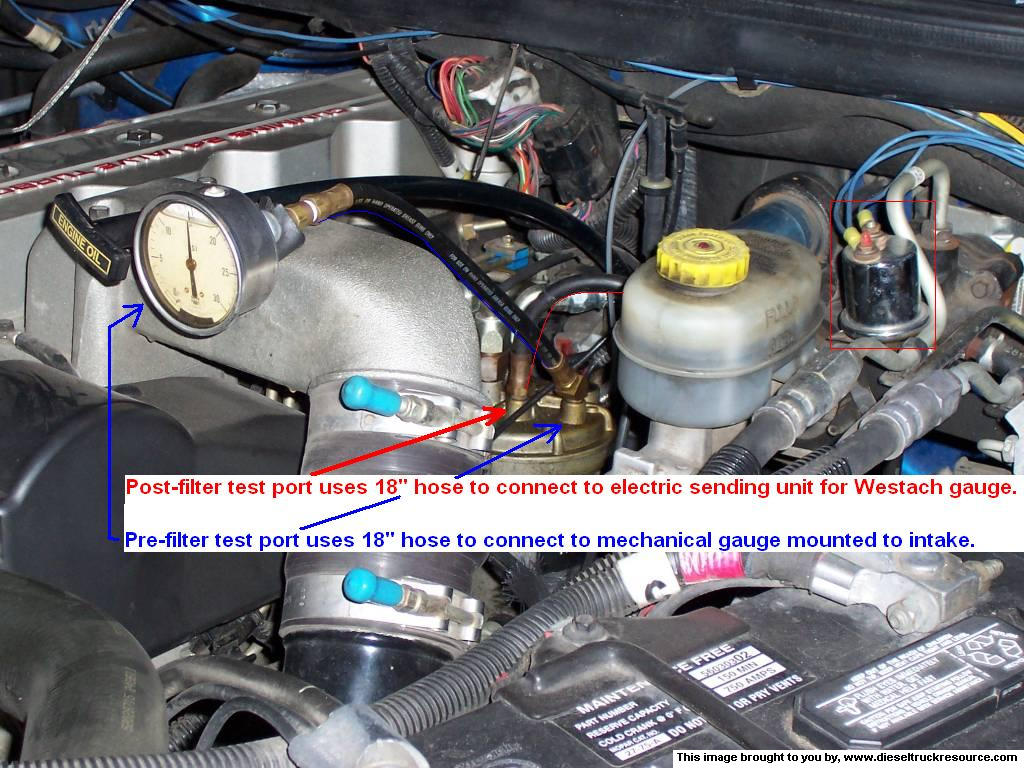
Click on picture for larger view
Here is the set-up on my 99.
The gauge under the hood is reading the pressure between the lift pump and the filter (BLUE arrow).
The RED arrow is pointing to the test port that reads the pressure between the filter and the injection pump and this is where my inside dash gauge reads from.
You will want to connect your test gauge to the port closest to the center of the filter housing (the one the RED arrow is pointing to)
The hoses are grease gun extensions (a couple of dollars) and the gauge (0-30psi) was a freebie from work.
The first test gauge I made was a gauge off of an old air regulator,,,,, did the trick until I did the current set-up.

Administrator
Joined: Aug 2001
Posts: 3,529
Likes: 2
From: Disputanta, Virginia
Thanks for the Pictures and list of supplies. Tonight I went out and just loosened the Banjo Bolt Coming from the Fuel Filter, into the VP a little bit. When I turned the key to just on, fuel was spraying out of there.
So what do you guys think. Should I still scan for codes, or are you pretty sure it's my VP?
So what do you guys think. Should I still scan for codes, or are you pretty sure it's my VP?

Sorry,,,

Registered User
Joined: Feb 2004
Posts: 663
Likes: 0
From: Northern Iowa
Dinner,
Couple of thoughts here, coming from one who has 12V experance and fluid dynamics experance. Please understand that while it's safety realted, i'mot trying to hinder, but help prevent an injury. IF you are going to be trying to see what kind of fuel flow you could be getting from a LP or VP-44, you need safety glasses (minimum) and need to keep clear of any path fuel could flow. Pressures like those suggested will penetrate your skin and can enter your bloodstream at a few thousand PSI. I've actually witnessed a co-worker who had his arm torn open by hydraulic oil at 1500 psi and at a 90* C operating temperature. Believe me, there are times to try your hand tinkering, and other times that it's best to take it in.
Good luck, I do hope it's the LP and not the VP-44.
Couple of thoughts here, coming from one who has 12V experance and fluid dynamics experance. Please understand that while it's safety realted, i'mot trying to hinder, but help prevent an injury. IF you are going to be trying to see what kind of fuel flow you could be getting from a LP or VP-44, you need safety glasses (minimum) and need to keep clear of any path fuel could flow. Pressures like those suggested will penetrate your skin and can enter your bloodstream at a few thousand PSI. I've actually witnessed a co-worker who had his arm torn open by hydraulic oil at 1500 psi and at a 90* C operating temperature. Believe me, there are times to try your hand tinkering, and other times that it's best to take it in.
Good luck, I do hope it's the LP and not the VP-44.
