


Diesel fuel economy experiment


Registered User
Joined: Apr 2003
Posts: 6,564
Likes: 6
From: Cummins Technical Center, IN
Originally Posted by Fronty Owner
The carnot cycle is the ideal 4 cycle combustion process.
the amount of work comes from a rise in temperature between the intake and exhaust cycles.
fuel burns at a certain temperature.
if the intake temperature is close to the combustion temperature you get less work.
This applies to gas, diesel, JP8, or what ever your fuel of choice.
the amount of work comes from a rise in temperature between the intake and exhaust cycles.
fuel burns at a certain temperature.
if the intake temperature is close to the combustion temperature you get less work.
This applies to gas, diesel, JP8, or what ever your fuel of choice.
Actually, Carnot efficiency has NOTHING to do with intake temps, specifically. Rather, it's the temp the combustion event reaches (which is, of course, affected by intake temps).
So for proper Carnot reference in our engines (specifically, the Delta Temp), you'd use the peak combustion temp minus EGT.
Thus, the hotter the combustion event, and the cooler the exhaust, the more efficient the process.
This is generally why higher compression ratios are more efficient. They also mean a higher expansion ratio, extracting more work from a given amount of energy by make the hot part hotter and the cool part cooler.
Like a McDLT

So, if a higher intake temp actually raised the temp of the combustion event, you'd actually have a HIGHER carnot efficiency with hotter intake temps.
The guys in the gassavers forum are correct in their theory.
The other reasont that hot air increases efficiency is that more of the available energy of the fuel is extracted, much like thermal barrier coating on pistons helps reduce heat loss and help MPG. If the intake air is hotter, then less heat is "lost" heating the air to combustion temp as the flame front advances.
Of course, this all assumes adequate oxygen is available. This is a valid assumption for a lean burn Diesel unless you are way overfueled. Even then, you'd not going to be overfueled with the cruise control set at 70 just cruising down the road.
FYI-- the worst MPG I've EVER gotten with my truck were in temps in the teens at about 78mph. 13mpg-- empty. Next worst was 15.5 TOWING.
Yes, cold weather kills mpg.
It's worth noting that that my clutch slipped for the first time under these conditions. More power than ever before, but less MPG than ever before, too.
Clutch never slipped again until I went way bigger on injectors AND went down to sea level.
The reason our trucks have an intercooler is for emissions, not much for any other reason.
See, with higher intake temps come higher PEAK combustion temps. Higher peak combustion temps means more NOx.
So, just as factory timing gets more retarded to reduce emissions (and also reduces MPG), so is the effect of an intercooler. Better emissions, and more "performance", but lower MPG.
Now consider EGR. It's coming, and the reason is to reduce peak combustion temps that cause NOx by making less oxygen available and slowing the rate of combustion.
NOx= MPG, the more you have of one, the more you have of the other.
Higher peak combustion temps (which increase the Delta T and improve Carnot Efficiency), also bring higher NOx levels.
Look at the some of the emissions stuff already in use on some diesels, like COOLED EGR. EGR is effective in reducing NOx, but cooling really helps the effectiveness, because it gives a "double whammy" to NOx producing conditions (hi temp and pressure).
PS-- don't overplay the density angle. Intercoolers aren't there for increasing oxygen density (and helping to make power) so much as reducing intake temps and NOx. You could increase density by increasing avg boost, too-- but this comes with higher intake temps, not lower-- which is bad for NOx emissions.
PS2-- It's interesting to note that NOx forms at high temp and pressure. You really don't even need to burn a fuel to create it. If you had a super-high temp pressure chamber, you could make NOx just from atmospheric air-- no fuel needed.
jh

Thread Starter
Registered User
Joined: Oct 2004
Posts: 427
Likes: 0
From: Kansas City, MO
The HAI also requires you to increase throttle body angle for the amount of work required. The increased TB angle reduces the pumping effect. Theory of course.
I will note recently I and brother have been working on an HAI for his altima. So far we have a 10% mileage increase. Want to see how a convoluted HAI looks. Crushbent 2.5" exhaust pipe breathing into the stock airbox. Notice the crimp by the battery.
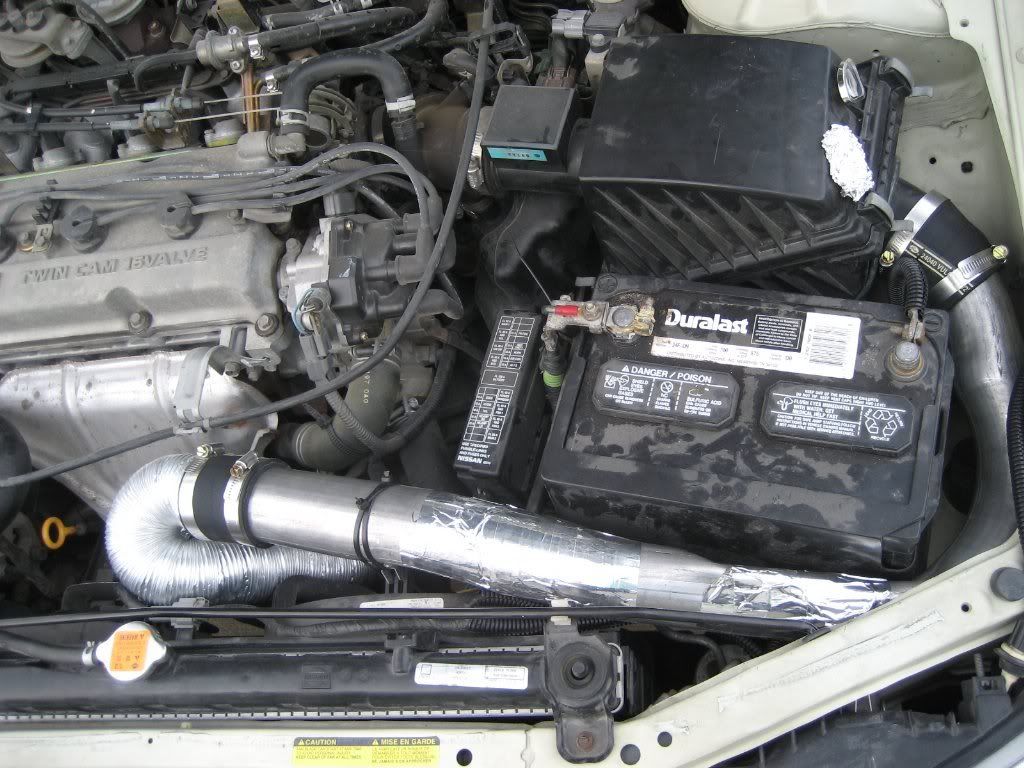
I will try to do some testing on my brothers f250 psd, but finacially its really not feasable to drive that vehicle very much.
I will note recently I and brother have been working on an HAI for his altima. So far we have a 10% mileage increase. Want to see how a convoluted HAI looks. Crushbent 2.5" exhaust pipe breathing into the stock airbox. Notice the crimp by the battery.
I will try to do some testing on my brothers f250 psd, but finacially its really not feasable to drive that vehicle very much.

'People of Wal-Mart' 2010 finalist
Joined: Feb 2005
Posts: 456
Likes: 0
From: Oklahoma/Texas
http://www.grc.nasa.gov/WWW/K-12/airplane/otto.html
The otto cycle, similar to the carnot with your internal combustion functions overlayed.
The diesel engine with its compression ignition system needs a to have enough heat to burn the fuel (gasser equivialant is a higher spark voltage and gap), but it still comes down to work is the difference between your compresstion temperature and your power temperature.
Now, for efficency, If your doing anything with your HAI, your essentially detuning the engine. I dont think your getting more work out of the fuel, just fooling the computer to inject less fuel (for less O2) and adjust the timing to get rid of detonation and get the NOx levels back in the legal range.
The otto cycle, similar to the carnot with your internal combustion functions overlayed.
The diesel engine with its compression ignition system needs a to have enough heat to burn the fuel (gasser equivialant is a higher spark voltage and gap), but it still comes down to work is the difference between your compresstion temperature and your power temperature.
Now, for efficency, If your doing anything with your HAI, your essentially detuning the engine. I dont think your getting more work out of the fuel, just fooling the computer to inject less fuel (for less O2) and adjust the timing to get rid of detonation and get the NOx levels back in the legal range.

Banned
Joined: Aug 2003
Posts: 1,451
Likes: 1
Originally Posted by Fronty Owner
Now, for efficency, If your doing anything with your HAI, your essentially detuning the engine. I dont think your getting more work out of the fuel, just fooling the computer to inject less fuel (for less O2) and adjust the timing to get rid of detonation and get the NOx levels back in the legal range.
I would think that it would be eaisier to install a potentiometer or something on whatever sends air temperature readings to the computer...
Thread Starter
Registered User
Joined: Oct 2004
Posts: 427
Likes: 0
From: Kansas City, MO
The saturn uses a map sensor and the ECU is less intelligent. I run a 242 degree resistor in place of the IAT. So basically I target intake temps around 160 degrees and the ECU uses a fuel map that is 75 degrees hotter. Using those parameters the AF ratio is around 15.7 to 1. Its no honda lean burn(k series, insight, etc) but it gets the job done. The saturn is an easy beast to tweak.
The nissan is MAF and smarter. Initially we ran the IAT in the inlet tract. This worked until the ECU retrimed. Now we're running the IAT in ambient air outside the engine compartment. This is working for now. If it retrims again we're going to try a mil eliminator on the aftercat o2 sensor. We could also hack the maf. Maybe try an EFIE(which alters o2 sensor readings). We're still experimenting.
The nissan is MAF and smarter. Initially we ran the IAT in the inlet tract. This worked until the ECU retrimed. Now we're running the IAT in ambient air outside the engine compartment. This is working for now. If it retrims again we're going to try a mil eliminator on the aftercat o2 sensor. We could also hack the maf. Maybe try an EFIE(which alters o2 sensor readings). We're still experimenting.
Thread Starter
Registered User
Joined: Oct 2004
Posts: 427
Likes: 0
From: Kansas City, MO
Originally Posted by Begle1
That's what it sounds like to me...
I would think that it would be eaisier to install a potentiometer or something on whatever sends air temperature readings to the computer...
I would think that it would be eaisier to install a potentiometer or something on whatever sends air temperature readings to the computer...
Thread Starter
Registered User
Joined: Oct 2004
Posts: 427
Likes: 0
From: Kansas City, MO
Both cars run a knock sensor. If detonation occurs the computer pulls timing and you loose power and economy. A lightly loaded engine running lean will run cooler simply because there is less fuel to heat the mixture.
Thread Starter
Registered User
Joined: Oct 2004
Posts: 427
Likes: 0
From: Kansas City, MO
Originally Posted by Fronty Owner
Just keep us in the loop on any long term problems that ever arrises.
I got my data from a gassavers member with 190k on is saturn. I'm not really worried though.

Registered User
Joined: Jan 2006
Posts: 56
Likes: 0
I've always thought it would be cool to run a gas engine like a diesel. Give it all the air it wants and control it with fuel. It would be a very lean burning engine. Of course this causes all kinds of emissions concerns but it would be a great experiment. Great thread by the way keep it up!

Thread
Thread Starter
Forum
Replies
Last Post
svanni
3rd Gen High Performance and Accessories (5.9L Only)
3
Jan 3, 2007 04:14 PM
ppsi
3rd Gen High Performance and Accessories (5.9L Only)
7
May 28, 2004 09:10 PM
24 Valve Engine and Drivetrain
6
Apr 18, 2003 12:07 PM

