When you click on links to various merchants on this site and make a purchase, this can result in this site earning a commission. Affiliate programs and affiliations include, but are not limited to, the eBay Partner Network.
It depends on where your transmission temperature probe is located. If it's in the hot line leaving the trans (sensing the hottest fluid) to go to the coolers, that could be normal if your doing a lot of stop and go driving. Especially if you are pulling a trailer. Once the torques converter locks, then the temps will stabilize nicely, this happens when your on the highway during steady cruise. Typical temperatures there are about 60º-80º F above the ambient outdoor temperature. So if it is 85º outside, I want to see my trans temp around 145º-165º.
Can't advise about the lift, not something I ever did to my truck.
For blowby, some venting is normal. A lot is not normal. Blowy can be a good indication on the health of your engine, namely the piston rings and valve guides. There is a catch with our Cummins however. To keep common components between the diesel engine Rams, and the gas engine Rams, there is a vacuum pump installed on the Cummins. This allows all Rams to share the vacuum operated cruise control and HVAC components, the brake booster on the older Rams, as well as the 4x4 equipment. The vacuum pump provides the suction force required to operate those accessories on the diesels, since the engine cannot provide vacuum. The problem here is when there is a vacuum leak. The vacuum pump becomes an air pump at this point, as the "exhaust" of the vacuum pump goes into the crankcase, which is then vented overboard via the blowby tube. If you suspect blowby problems, make sure you don't have a vacuum leak first, otherwise you'll end up chasing your tail. Here's a good video which illustrates this problem: https://www.youtube.com/watch?v=8oxp-uIqpMQ
Big thanks for the reply. I unfortunately am dealing with the vacuum leak as my HVAC dampers are fixed in the defrost position, and my air system only works on cold as well. I suspect that this is probably why i'm seeing so much vapor from the blowby tube. I've been using small pieces of vacuum tube to try and fix the lines, replacing the 90 degree elbow at the pump itself, and two cracked sections along the firewall above the engine but it's still leaking. I'm likely just going to be replacing the lines on the whole system soon enough.
I posted this in the HELP section but i'll add it here too.
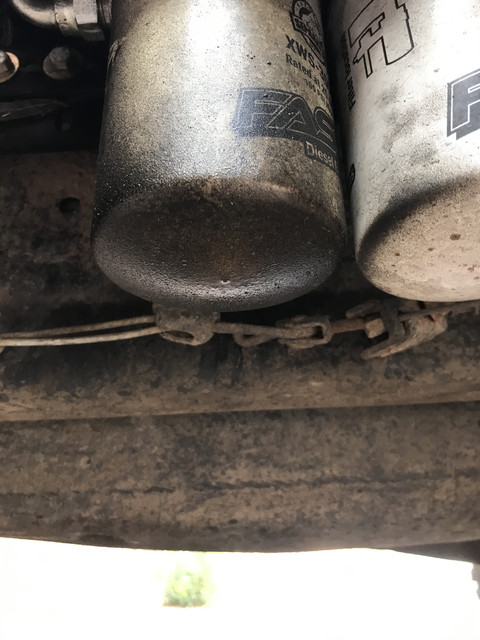
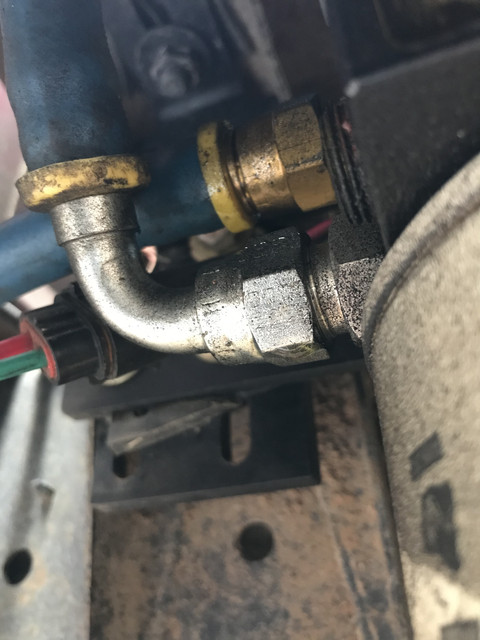
Dealing with *******/boost drop right now. I found leaking at the water separator return line as well as the line from my FASS to the injector pump. Any feedback would be appreciated to help fix this! Hoping I didn't roast my VP44, i've been experiencing this for about 2-3 days now over 100 or so miles of driving.
Big thanks for the reply. I unfortunately am dealing with the vacuum leak as my HVAC dampers are fixed in the defrost position, and my air system only works on cold as well. I suspect that this is probably why i'm seeing so much vapor from the blowby tube. I've been using small pieces of vacuum tube to try and fix the lines, replacing the 90 degree elbow at the pump itself, and two cracked sections along the firewall above the engine but it's still leaking. I'm likely just going to be replacing the lines on the whole system soon enough.
The temperature control is electric only, and is the only component in the interior HVAC system that is not vacuum operated. Two most common issues here is either the actuator died or the little plastic shaft between the actuator and blend door broke (common Ram problem). If it is the little shaft, it is repairable, just search for Dodge Ram Heater Treater. The actuator is replaceable without dropping the dash, but it is awkward to access.
If you have a Mityvac, it is really easy to isolate sections of the vacuum system and check for leaks. Using a standard vacuum gauge tee'd into the system may not reveal the leak since the vacuum pump is quite strong, and unless you have a big leak, may not notice a big drop in the gauge. I just fixed a leak myself recently when my A/C went to defrost only. My vacuum test gauge still showed about 25" of vacuum, even with the leak. Using the Mityvac, I was able to disconnect and cap off lines and test individual segments of the vacuum system and figure out specifically where my leak was, and where it wasn't. Turns out my entire system was fine, up until the rubber 90º fitting on the passenger side. That line that pokes through the firewall was what leaked, had very little slack to cut out the damaged part and splice it back with a rubber coupling.
That Mityvac tool is well worth the money and is a very handy tool to have. Mine is the version that does both pressure and vacuum.
For your fuel system, you likely may just have to snug up some fittings. An air leak on the suction side of the lift pump will cause it to run funny (stutter/misfire). Happened to me a few months ago, ended up being a loose fitting on my FASS DDRP pre filter. These fuel systems on our VP44 Rams do not tolerate air very well.
No sure how modified your fuel system is, and whether it retained the banjo fitting or those were replaced with AN fittings. What all do you have in your fuel system?
I have a FASS Signature series, it's either a 100 or 165 GPH. It's connected to the VP44 with the AN fitting. I snugged the fittings on the pump itself, but I could probably check this again, I just primed both the particulate filter and the fuel water separator (not sure if the second one is even necessary) on saturday and it seemed to temporarily improve the performance. I should probably check the AN fitting at the VP44 for tightness as well.
Most noticeably, the hiccups/******* are occurring under gentle throttle application from 1400-1800 rpms in first gear. I also will have occasional boost pressure drop (I have no fuel pressure gauge) around 70-80 mph.
I plan to open the diesel tank cover this week and see what's going on inside there. I believe I still have the in-tank pump although I can't be sure, I want to switch to a sump/draw straw. I can't get the lock ring off easily though so I will be ordering a lock ring tool.
When I key the ignition, the pump initially sounds OK but after 15-20 seconds starts to make some pulsating/cavitation sounds, but these occurred from the moment I owned the truck/before the fueling issue was apparent and I had assumed this was the normal sound of the pump. I cannot hear the sound of my pump over my exhaust while the truck is running so I am unable to determine if it is overamping.
When I key the ignition, the pump initially sounds OK but after 15-20 seconds starts to make some pulsating/cavitation sounds, but these occurred from the moment I owned the truck/before the fueling issue was apparent and I had assumed this was the normal sound of the pump. I cannot hear the sound of my pump over my exhaust while the truck is running so I am unable to determine if it is overamping.
This sounds like a lot of air being sucked in- a leak at the pressure side would be quite visible by now. (You'd need diesel proof waders)
Any advice on leak hunting? Ive used snoop before at work (soapy water) to detect leaks in pressurized gas lines but i'm a little hesitant to squirt soapy water at fuel system. What lines does the "suction side" include? Just the line from the factory fuel pump cover to the FASS? The fuel water separator line?
I had what I believed was a minor oil leak from the back area of the block somewhere that I could identify. It doesn’t smell like diesel but if I locate the T with the banjo bolt on the back of the block that area looks moist. Starting to wonder if this is related to my *******/stumbling issue and if it’s diesel leaking not oil.
For leak hunting on the suction side soapy water is a no go- it will not bubble, it would just be sucked in.
You can do an optical inspection, check the elbows where the fuel hoses connect to the tank- they often have pinhole corrosion. Also the hard lines from the tank forward are often corroded.
Sometimes it helps to slightly pressurize the tank and watch for diesel coming out. If the hole is in the tank you need to remove the in tank module and check there.
After your recommendation I went and checked fittings on the suction side. I was amazed to find I got a full additional thread of tightness on the 90 degree fitting on the suction side of my FASS, as well as a quarter turn or so extra on the hose from that fitting to the tank module lid. This whole ordeal is making me realize just how sensitive this truck is to air intrusion.
After tightening that the truck runs like a boss, full power again. Although I might still detect a hiccup going into 2nd gear which now makes me wonder if my tranny is slipping, or if there is another lesser leak somewhere else.
I suppose I should be thankful that as I deal with big issues on the truck, all the smaller things become apparent to be taken care of as well.
I don't know how your truck is plumbed, but there are 2 points on these engines that will net you horrible fuel mileage and bad performance.
A: Air induction- plugged filter, leaks in the boost system
B: Aerated fuel- will usually happen on the suction side of the lift pump, and hard to find. Go after every bit of hose or pipe, check every fitting until you are below lowest fuel level in the tank.
Now for the "why"- diesel is not compressible, and the injection system is designed for that. Add air, which is quite compressible, you find that the injection timing is really off, even though the pump does everything correctly.
That was the basic idea behind the FuelAirSeparatorSystem and why it was/is good. But it has only a certain capacity to get air out of the fuel. Get more air in and you have the same old problems..
Thank you for the knowledge AlpineRAM you are truly a legendary resource. 🙏 The plot thickens.
The problem reappeared after the truck sat overnight and felt even more pronounced after sitting at work during the day. I messed with the in-tank module a little bit but not enough to fully remove it from the truck before it started raining. I was able to blow the dirt off the top of the module as well as around the top of the gasket below the lock ring. I didn’t fully remove the module to inspect because I don’t know how to remove the push fitting w/ pipe clamp that is holding the suction line tubing onto the top of the module. I also am struggling to remove the fitting for the stock return line from the overflow valve.
I am starting to wonder if there is restriction in the in-tank module and this, coupled with any leaks still remaining in the suction line are resulting in air in my lines and loss of prime after the truck sits.
When the ignition is keyed, and I loosen the particulate filter below the lift pump, I either have vacuum which results in a noticeable suction of air or I have no sound at all but the diesel is not at the correct level, requiring a few moments to fill the particulate filter before it begins to overflow again. This prime is lost almost immediately because I begin to hear the cavitation/pulsating sounds and the filter has lost its fuel level again. I repeated this process 5 or 6 times, and spilled more than my share of diesel on my arms and clothing.
youd think I would learn after two rounds of getting diesel in my clothing...
I feel we are getting closer to a solution (cough, a draw straw)
Edit: I should add, the in tank fuel sender is 99% certain to be the Delphi unit sold by autozone. Why on earth do I have a fuel sender in line with my FASS? Seems retarded.
For the quick-connect fittings on the tank there is a tool that moves the spring tabs outwards so you can pull the line off.
If you still have the stock fuel filter in place you can check for aerated fuel by running a transparent hose from the water drain to the filler neck, open water drain valve, bump key and watch for bubbles or milky/cloudy appearance of the fuel in the hose.
When I replaced my tank sensor, I don't remember the line fittings giving me much problems. I dropped my tank in order to do that.
Diesel_Rob, if you still have the original fuel lines, you'll want to replace than with a straight run of rubber fuel hose. The original setup is a mix of steel tubing and semi flexible plastic tubing. The plastic tubing on my truck cracked before the lift pump, causing a suction side leak. Mine would run weird at times but not often. Fuel pressure gauge would fluctuate as well. What really clued me to that problem was a small stain on the driveway and the occasional smell of diesel fuel. These kind of leaks can also cause hard starts as the fuel drains back to the tank and now you have some air in the lines.
Again, the original fuel lines are not known for longevity. Either the steel lines rust out or the plastic gets brittle over time and crack. The fuel line size is 3/8" for the supply line, and 5/16 for the return line.
You could also have another semi common problem inside the tank, where a screw inside the tank module rubs a hole in the pickup line, causing an air leak once the fuel level drops below that hole. Only way to pin that one down is to drop the tank and inspect the module.
For the quick-connect fittings on the tank there is a tool that moves the spring tabs outwards so you can pull the line off.
If you still have the stock fuel filter in place you can check for aerated fuel by running a transparent hose from the water drain to the filler neck, open water drain valve, bump key and watch for bubbles or milky/cloudy appearance of the fuel in the hose.
Originally Posted by jrs_dodge_diesel
When I replaced my tank sensor, I don't remember the line fittings giving me much problems. I dropped my tank in order to do that.
Diesel_Rob, if you still have the original fuel lines, you'll want to replace than with a straight run of rubber fuel hose. The original setup is a mix of steel tubing and semi flexible plastic tubing. The plastic tubing on my truck cracked before the lift pump, causing a suction side leak. Mine would run weird at times but not often. Fuel pressure gauge would fluctuate as well. What really clued me to that problem was a small stain on the driveway and the occasional smell of diesel fuel. These kind of leaks can also cause hard starts as the fuel drains back to the tank and now you have some air in the lines.
Again, the original fuel lines are not known for longevity. Either the steel lines rust out or the plastic gets brittle over time and crack. The fuel line size is 3/8" for the supply line, and 5/16 for the return line.
You could also have another semi common problem inside the tank, where a screw inside the tank module rubs a hole in the pickup line, causing an air leak once the fuel level drops below that hole. Only way to pin that one down is to drop the tank and inspect the module.
Thanks again for the feedback guys.
The fuel system in my truck is plumbed as follows
Suction side: In-tank sending unit -> half inch rubber hose -> FASS Signature Series -> half inch rubber hose -> VP44 (no banjo bolts on this side) Return side: VP44 -> overflow valve -> stock line -> tee -> stock line -> in tank sending unit return
Injector return--------------------------------------------^^
When I removed the suction side fitting on the FASS Signature Series lift pump to tighten it, I believe in not replacing the teflon tape I potentially exacerbated the issue of pulling air into the system. I will be re-sealing this ASAP.
Is it possible i'm already doing significant damage to my VP44 in the time i've been driving it from last week until now with these air issues? Should I stop driving the truck all together until these issues are resolved?
I plan to install a draw straw kit ASAP as well, because it's clear to me I am getting restriction through the in-tank unit. Is this the right plan of action? Should I install a sump instead?
Unless you are pushing big horsepower, the factory module and 3/8" supply line will flow more than enough fuel for your engines' needs. I have experience with big diesel engines, and for reference, a 3,100 HP Caterpillar only required a 1" fuel pipe.
The original factory tank module is a decent unit, except for the fuel sender (common problem), and includes the pickup screen that does a good job of keeping crud out of the lines. The "replacement" factory tank module with the in tank pump did a worse job than the block mounted lift pump that it replaced. Since you are running a FASS pump, the in tank pump isn't doing much and could be restricting fuel delivery. If it were mine, I would convert it back to the original pickup module without the pump.
I agree, I would put new Teflon tape there in order to prevent a potential air leak.
As far as VP44 damage, IMO you should be fine. Unless it was running completely dry, the wear should be minimal. Mine is still running well even with my two air leak incidents. I wouldn't drive it with a known air leak until you've repaired the fuel system and test it. and If you don't have one already, I would invest in a fuel pressure gauge. That will help you catch problems.