


Speedo : a potential simple fix


Thread Starter
Registered User
Joined: Mar 2011
Posts: 20
Likes: 0
Speedo : a potential simple fix
Lost speedo and OD this morning, so I thought it was time to read the good post about the Speedo in the Sticky. I got lost in amazement at how complicated Dodge's speedo is: worm gear, pinion gear, gear box.... wow! so many gizmos
Looking for a simple reliable cheap speedo fix, I hooked up some instruments to the speedo connector, letting me send some fake speedo signals into the ECM.
To have the actual speedo show exactly 100 km/hour (we're in Canada here...), it must receive a signal from the sensor that is 130.5 Hz, which means 130.5 pulses per second.
With the truck actually going 100kph, having 30'' tires and a 3.54 rear axle, the driveshaft would be spinning 41.1 revs per second, and if we could generate 3 electrical pulses for each revolution of the driveshaft, we would get a speedo signal of 123.3 pulses/sec, which would be 94.5% accurate. Not perfect, but very useable.
If we had 28'' tires with a 3.54 axle, or 30'' tires with a 3.71 axle, our speedo signal would be 99% accurate. (makes no difference if the actual display were in mph or kph)
To generate 3 pulses per driveshaft revolution, all we need to do is get 3 small and powerful magnets (think Neodymium magnets), sort their poles (mark 1 side of each magnet so that all marked sides repel each other), space them regularly around the driveshaft will same poles facing outward, and glue them in place. We would then fabricate a bracket to hold a speedo sensor approx. 1/4'' from the revolving magnets.
(The ECM is pretty sensitive. It picks up the signal as long as it's at least 0.9 VAC, so there's no need to put the sensor too close to the magnets.)
This idea is still untested, though. Depending on my speedo's mood and my personal endurance to driving without OD , I might be trying it soon.
Looking for a simple reliable cheap speedo fix, I hooked up some instruments to the speedo connector, letting me send some fake speedo signals into the ECM.
To have the actual speedo show exactly 100 km/hour (we're in Canada here...), it must receive a signal from the sensor that is 130.5 Hz, which means 130.5 pulses per second.
With the truck actually going 100kph, having 30'' tires and a 3.54 rear axle, the driveshaft would be spinning 41.1 revs per second, and if we could generate 3 electrical pulses for each revolution of the driveshaft, we would get a speedo signal of 123.3 pulses/sec, which would be 94.5% accurate. Not perfect, but very useable.
If we had 28'' tires with a 3.54 axle, or 30'' tires with a 3.71 axle, our speedo signal would be 99% accurate. (makes no difference if the actual display were in mph or kph)
To generate 3 pulses per driveshaft revolution, all we need to do is get 3 small and powerful magnets (think Neodymium magnets), sort their poles (mark 1 side of each magnet so that all marked sides repel each other), space them regularly around the driveshaft will same poles facing outward, and glue them in place. We would then fabricate a bracket to hold a speedo sensor approx. 1/4'' from the revolving magnets.
(The ECM is pretty sensitive. It picks up the signal as long as it's at least 0.9 VAC, so there's no need to put the sensor too close to the magnets.)
This idea is still untested, though. Depending on my speedo's mood and my personal endurance to driving without OD
, I might be trying it soon.

Registered User
Joined: Mar 2008
Posts: 4,389
Likes: 114
From: Orange County, California
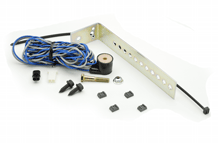
I'm working with a kit from Dakota Digital utilizing the same method you described. A "calibration box" called a Universal Speedometer Signal Interface in conjunction with their sending unit that consists of 4 magnets and magnetic pick up sensor

Thread Starter
Registered User
Joined: Mar 2011
Posts: 20
Likes: 0
I just found out that Dogde's speed sensor is not a coil type, it's just a small reed switch! Holding the sensor close to your ear and turning the small shaft, you can hear the reed clicking on and off.
So actually, the computer doesn't want a voltage signal, but a simple contact closure.
So if you test your speed sensor like I tested mine last week, don't think that it is bad because you get an open circuit!
I wasted $30 on a new sensor because of this. My old sensor is fine, I just had a bad contact, probably at the sensor plug.
So actually, the computer doesn't want a voltage signal, but a simple contact closure.
So if you test your speed sensor like I tested mine last week, don't think that it is bad because you get an open circuit!
I wasted $30 on a new sensor because of this. My old sensor is fine, I just had a bad contact, probably at the sensor plug.

Thread
Thread Starter
Forum
Replies
Last Post
Dodgeboy3196
3rd Generation Ram - Non Drivetrain - All Years
2
Nov 13, 2009 06:57 AM
Nor_Cal_Angler
HELP!
6
Sep 2, 2007 07:51 AM
somis13
Performance and Accessories 2nd gen only
2
Jan 11, 2007 03:40 PM