


Relay keeps dying! HELP!


Thread Starter
Registered User
Joined: Jun 2005
Posts: 1,737
Likes: 0
From: Springfield, TN
Relay keeps dying! HELP!
I've got a WM setup with a radio shack "30 amp auto relay" the second one died today after only 3-5 uses of the WM. the WM is triggered by a boost switch (set to 15psi) the boost switch triggers the relay and the source to the relay is straight to the battery. the line from the boost switch has an inline fuse that has not blown... someone please help, i don't want to keep buying these things a $7 a pop without finding the problem!
Technical data:
Coil Voltage: 12v
Pull-in Voltage: 6v
Coil Resistance: 66ohms
Nominal current: 160mA
Drop-out voltage: 3.6v
SPST contacts: 30A at 12VDC
that's what is on the back of the relay pack... when the truck is running the alternator is putting out about 14.6-14.8 volts... could that have anything to do with it? HELP i am supposed to dyno tomorrow!
Technical data:
Coil Voltage: 12v
Pull-in Voltage: 6v
Coil Resistance: 66ohms
Nominal current: 160mA
Drop-out voltage: 3.6v
SPST contacts: 30A at 12VDC
that's what is on the back of the relay pack... when the truck is running the alternator is putting out about 14.6-14.8 volts... could that have anything to do with it? HELP i am supposed to dyno tomorrow!

Registered User
Joined: Aug 2005
Posts: 114
Likes: 0
From: Northeast PA, about an hour from everywhere
If it is a contact problem (relay clicks but does not close or open contacts), you can solve it by going to napa or auto zone, or wherever and get one rated at 40amps. You can also put a "snubber" across the switched leads. A simple snubber can be made up of one resistor 100ohms/1watt, and one capacitor 220nf/400v (both are radio shack parts). If you have a choice use a non electrolytic capacitor (electrolytics are polasrity sensitive and you might have to try it each direction to see if it is working i.e. if the relay contacts fail again it needed to be the other way. Wire them in series with your switched contact terminals. This will eliminate the spark on opening and closing the contacts. It will help the relay carry a high startup "inductive" load, like a motor or pump.
If it is a coil problem (relay will not click or hum or buz when it fails), you have a major over voltage problem - not likely. The coil should be ok with 14-15 volts. Napa might have a 24 volt relay.
If it is a coil problem (relay will not click or hum or buz when it fails), you have a major over voltage problem - not likely. The coil should be ok with 14-15 volts. Napa might have a 24 volt relay.

 "More Power Woof Woof Woof"
Thread Starter
Registered User
Joined: Jun 2005
Posts: 1,737
Likes: 0
From: Springfield, TN
the relay size should not be the problem, there are somewhere around 30 other people running the same setup from what i'm told. with the motor off and the pump disonnected i powered the relay and hear it click, so it was working, or at least trying to work. i pulled the cover off the relay and found that the contact that is supposed to be pulled down was melted to the plastic retainer arm. i freed it and the relay is working fine, the other relay was the same way. the question is, how do i stop it from doing that from now on?
i will post the picture as soon as it's approved.
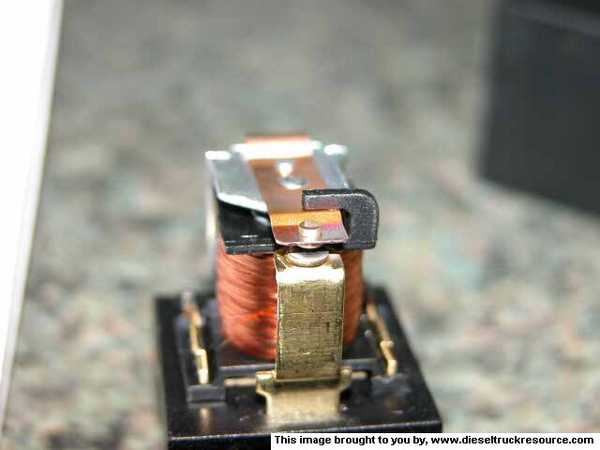
i will post the picture as soon as it's approved.
Registered User
Joined: Aug 2005
Posts: 114
Likes: 0
From: Northeast PA, about an hour from everywhere
The contacts have failed. The pump will pull (you said above) 12 amps. But it pulls 2 maybe three times that at startup, depending on model of pump, load on it at startup, etc. That initial spark heats the contacts.
The pump may be pulling more than it should at start up.
The simple snubber I spoke about above will all but eliminate the spark.
A starter relay will carry much more current, but you have to be careful about the duty cycle of the coil. In normal use a starter is only actuated for a few seconds at a time - plenty of time to cool down - nowhere near continuous duty. I tried to use one in a different application, and after about half an hour the coil heated up and failed.
The pump may be pulling more than it should at start up.
The simple snubber I spoke about above will all but eliminate the spark.
A starter relay will carry much more current, but you have to be careful about the duty cycle of the coil. In normal use a starter is only actuated for a few seconds at a time - plenty of time to cool down - nowhere near continuous duty. I tried to use one in a different application, and after about half an hour the coil heated up and failed.
Trending Topics
Thread Starter
Registered User
Joined: Jun 2005
Posts: 1,737
Likes: 0
From: Springfield, TN
the pump pulling any number of times should not make a difference. the feed is coming from the boost switch, which clicks on once i hit 15psi, as long as i don't let the boost rise and fall rapidly around 15psi i should not see the problem you are talking about. i appreciate your knowledge, i don't understand the "snubber" i have no clue that the two parts that made it are, lol. i'd be glad to listen if you would educate me.
Registered User
Joined: Aug 2005
Posts: 114
Likes: 0
From: Northeast PA, about an hour from everywhere
I haven't the foggiest idea how to put a drawing up here. So let's try this:
You are using two leads from the relay to switch your pump on and off. Those switch contacts, for reasons known only to them, those contacts are sparking and heating up, welding themselves to the innards of the relay.
What you need to do is either:
1) eliminate the sparking by reducing the current draw - that particular pump might be somewhat defective, we have no way to tell that now. or
2) soften, or buffer the sparking action. We can do that electronicaly with two parts, both available at Radio Shack. They are connected end to end (series) and are connected across the two switched leads of the relay. They will not interfere with the relay operation, won't conduct any current to mess up your water/meth system. What they will do is absorb the excess current instead of allowing it to spark inside the relay.
Part one is a resistor. 100 ohms/1watt. Radio Shack sells them in packs of 4 or 5 for about a buck.
Part two is a capacitor. 220nf (might say uf on the package) and 400v
Capacitors are typically electrolytic, or non-polar. The non-polar would be preferred, but either will do. This will also cost around a buck or so. Your Radio Shack guy may or may not know the parts - (depends if he is an electronics guy or a cell phone salesman) but there should be someone in the store to help you find what you need..
This will get you going. It is an old electronics fix for high current draw across marginal switch contacts.
The ultimate question is "Why does this particular pump, in this particular application, draw enough current to melt down a 30 amp relay?"
You are using two leads from the relay to switch your pump on and off. Those switch contacts, for reasons known only to them, those contacts are sparking and heating up, welding themselves to the innards of the relay.
What you need to do is either:
1) eliminate the sparking by reducing the current draw - that particular pump might be somewhat defective, we have no way to tell that now. or
2) soften, or buffer the sparking action. We can do that electronicaly with two parts, both available at Radio Shack. They are connected end to end (series) and are connected across the two switched leads of the relay. They will not interfere with the relay operation, won't conduct any current to mess up your water/meth system. What they will do is absorb the excess current instead of allowing it to spark inside the relay.
Part one is a resistor. 100 ohms/1watt. Radio Shack sells them in packs of 4 or 5 for about a buck.
Part two is a capacitor. 220nf (might say uf on the package) and 400v
Capacitors are typically electrolytic, or non-polar. The non-polar would be preferred, but either will do. This will also cost around a buck or so. Your Radio Shack guy may or may not know the parts - (depends if he is an electronics guy or a cell phone salesman) but there should be someone in the store to help you find what you need..
This will get you going. It is an old electronics fix for high current draw across marginal switch contacts.
The ultimate question is "Why does this particular pump, in this particular application, draw enough current to melt down a 30 amp relay?"

Registered User
Joined: Dec 2003
Posts: 1,215
Likes: 1
From: texas
The pump in question cant pull more than the fuse allows, I built his system and its protected by 15 amp fuse. If the pump draw exceeds 15 amps =/- it shoukd blow. I'm not exactly sure why the relay is failing. I dont wire them exactly like his anymore (no reason) so i built test system in shop after talking to him. The results with a 220 psi pump pulling 23 amps, I cycled it 75 times and there were no failures of the relay. As of this date theres 37 systems identical to his running, except for frostie whos to skeered hook it up.
So I'm curious as why his are failing, any ideas would be welcome, theres also a scematic in my photo gallery of the current way thier wired.
Micia I'l build you a snubber, it will work, but it shouldnt need it, I'm curious if this relay may not be 100% duty cycle, its supposed to be but packaging errors have occured before.
So I'm curious as why his are failing, any ideas would be welcome, theres also a scematic in my photo gallery of the current way thier wired.
Micia I'l build you a snubber, it will work, but it shouldnt need it, I'm curious if this relay may not be 100% duty cycle, its supposed to be but packaging errors have occured before.
Registered User
Joined: Aug 2005
Posts: 114
Likes: 0
From: Northeast PA, about an hour from everywhere
Check out this link, Talks about relays failing - calls them el cheapos.
Are you using one of these?
http://mymiata.paladinmicro.com/MiataRelays.htm
Are you using one of these?
http://mymiata.paladinmicro.com/MiataRelays.htm

Registered User
Joined: May 2006
Posts: 697
Likes: 0
Just a thought, but you might want to test the amperage draw from that pump motor. Could have a shorted field coil or something? I don't know if a faulty system ground could contribute to the problem, but also worth checking.

Administrator


Joined: Nov 2004
Posts: 4,084
Likes: 235
From: Southern California
You need to get a Genuine Bosch relay; the generic look alikes are just that, Look Alike.
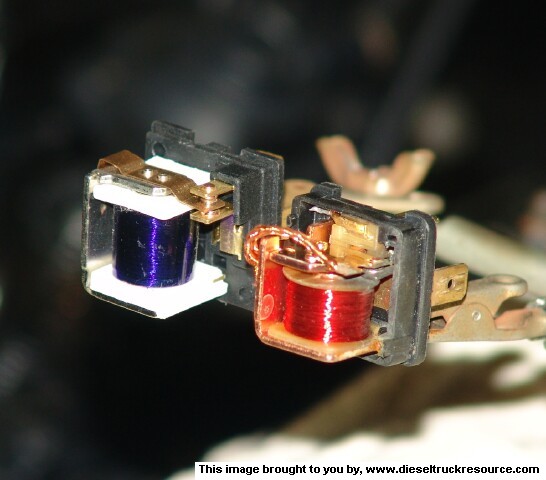
The Genuine Bosch is on the left and a generic is on the right.
I use an excessive amount of relays on my truck and have rarely had a Bosch relay fail except for when a terminal was loose and burned up the terminals.
I have never had a generic relay survive.
A 30-amp relay should work with no problem but if I were at the store buying one, I would pick up the 40-amp unit for a few dollars more.
When you go wandering around a wrecking yard pull any of the ISO relays from the imports Volvo, BMW, Mercedes and you will have a good supply of Bosch relays. Some of them might be relabeled but the pinout will be the same.
Also check the diagram on the side of the coil, as some have an internal quench diode and those ones will be polarity sensitive.
The best cure would be to install a high current solenoid.
These are made by White Rodgers and will switch 100 amps and have a continuous duty coil. You can get these at Graingers
Coincidently they are the same ones used on out grid heaters.
http://www.grainger.com/Grainger/wwg...mId=1611784827
Is the pump the same kind as the ones used for RV potable water systems?
Jim
The Genuine Bosch is on the left and a generic is on the right.
I use an excessive amount of relays on my truck and have rarely had a Bosch relay fail except for when a terminal was loose and burned up the terminals.
I have never had a generic relay survive.
A 30-amp relay should work with no problem but if I were at the store buying one, I would pick up the 40-amp unit for a few dollars more.
When you go wandering around a wrecking yard pull any of the ISO relays from the imports Volvo, BMW, Mercedes and you will have a good supply of Bosch relays. Some of them might be relabeled but the pinout will be the same.
Also check the diagram on the side of the coil, as some have an internal quench diode and those ones will be polarity sensitive.
The best cure would be to install a high current solenoid.
These are made by White Rodgers and will switch 100 amps and have a continuous duty coil. You can get these at Graingers
Coincidently they are the same ones used on out grid heaters.
http://www.grainger.com/Grainger/wwg...mId=1611784827
Is the pump the same kind as the ones used for RV potable water systems?
Jim

Registered User

Joined: Aug 2005
Posts: 2,309
Likes: 26
From: Smithfield, VA
The contacts have failed. The pump will pull (you said above) 12 amps. But it pulls 2 maybe three times that at startup, depending on model of pump, load on it at startup, etc. That initial spark heats the contacts.
The pump may be pulling more than it should at start up.
The simple snubber I spoke about above will all but eliminate the spark.
A starter relay will carry much more current, but you have to be careful about the duty cycle of the coil. In normal use a starter is only actuated for a few seconds at a time - plenty of time to cool down - nowhere near continuous duty. I tried to use one in a different application, and after about half an hour the coil heated up and failed.
The pump may be pulling more than it should at start up.
The simple snubber I spoke about above will all but eliminate the spark.
A starter relay will carry much more current, but you have to be careful about the duty cycle of the coil. In normal use a starter is only actuated for a few seconds at a time - plenty of time to cool down - nowhere near continuous duty. I tried to use one in a different application, and after about half an hour the coil heated up and failed.
Registered User
Joined: May 2006
Posts: 697
Likes: 0
Bosch relays are good and the bubble wrapped stuff hanging on a peg at the discount parts store aren't good. However there's many more options for getting high quality electrical components if you look into Industrial Quality parts. Prices are higher but the quality cannot even be compared simply because junk parts have no quality. Check out the Continuous Duty relays at the link and you'll see the difference. Quality is often worth the extra price. There's usually an industrial electric supplier in big cities, but the net is only a keyboard away.
http://texasindustrialelectric.com/relays.asp
http://texasindustrialelectric.com/relays.asp