


Dual Batteries In a first gen?


Registered User
Joined: Aug 2006
Posts: 216
Likes: 0
From: Lacombe,Alberta
I have two grp 31s on the stock tray, just required raotaing them 90* and some slight trimming of the fender. Truck starts a -30C after sitting for a week not plugged in.
I find that with a single battery if I need to run the grid heaters more than twice it doesn't leave enough juice for cranking at below 0 temps.
I find that with a single battery if I need to run the grid heaters more than twice it doesn't leave enough juice for cranking at below 0 temps.
but we play with our trucks to make them better.jmo


Registered User
Joined: Mar 2006
Posts: 753
Likes: 1
From: Salina, Kansas
OK. I've read that the grid heaters are not needed. And, somewhere here, I read that they were.
The only problem I've had is after a week or so, allowing the grid heater to cycle has slowed my starter to the point of needing a jump.
Mine either cranks over fast enough to start instantly, or if the battery is a little weak, and it turns a little slower, it will make no attempt to fire.
Bypassing the grid cycle avoids this problem, though. And, that's OK, right?
The only problem I've had is after a week or so, allowing the grid heater to cycle has slowed my starter to the point of needing a jump.
Mine either cranks over fast enough to start instantly, or if the battery is a little weak, and it turns a little slower, it will make no attempt to fire.
Bypassing the grid cycle avoids this problem, though. And, that's OK, right?

Registered User
Joined: Mar 2004
Posts: 4,767
Likes: 5
From: port crane, NY
Someone stop me if I'm wrong (like that's ever happened ) but I think the grid heaters were only provided to control white smoke when cold--more of a consumer friendly-ness addition than anything. The air that is heated by the grids likely doesn't even have time to get to a cylinder before the first hole fires on the cold air that's in it.
Moving on, I noticed the folks with dual setups happen to be from the great white north where they experience cold for real and I can't really comment on what they're cold start needs are. The worst I'll likely see this season is -10f or so.
Moving on a bit more, and somewhat off topic, is a list of what IS needed to start your Cummins in less than ideal temperatures:
1:A completely air-tight fuel system. These things run so good that it's easy to forget that it took an extra half-crank the past month to get it running...that was your warning. Single or dual battery, you've only got so much crank-time and the 'ol gal won't run on air...
2:A battery(ies) and charging system that is in tip-top shape. As I understand it, the reserve capacity (RC) of the battery is very important to us--perhaps someone that knows batteries would care to explain. For us early truck owners, a spare voltage regulator from Mopar behind the seat is a must. Not so sure about the later trucks--I guess maybe you should get friendly with the location and operation of your crank sensor.
3:Use an additive with anti-gel and use the proper proportion for the amount of fuel you're taking on. Having the super-duper emergency 911 bottle isn't a bad idea either. Always have a spare fuel filter.
Maybe Dave will merge this to a new thread if there's enough interest about cold weather precautions, otherwise, it's just my .02
) but I think the grid heaters were only provided to control white smoke when cold--more of a consumer friendly-ness addition than anything. The air that is heated by the grids likely doesn't even have time to get to a cylinder before the first hole fires on the cold air that's in it. Moving on, I noticed the folks with dual setups happen to be from the great white north where they experience cold for real and I can't really comment on what they're cold start needs are. The worst I'll likely see this season is -10f or so.
Moving on a bit more, and somewhat off topic, is a list of what IS needed to start your Cummins in less than ideal temperatures:
1:A completely air-tight fuel system. These things run so good that it's easy to forget that it took an extra half-crank the past month to get it running...that was your warning. Single or dual battery, you've only got so much crank-time and the 'ol gal won't run on air...
2:A battery(ies) and charging system that is in tip-top shape. As I understand it, the reserve capacity (RC) of the battery is very important to us--perhaps someone that knows batteries would care to explain. For us early truck owners, a spare voltage regulator from Mopar behind the seat is a must. Not so sure about the later trucks--I guess maybe you should get friendly with the location and operation of your crank sensor.
3:Use an additive with anti-gel and use the proper proportion for the amount of fuel you're taking on. Having the super-duper emergency 911 bottle isn't a bad idea either. Always have a spare fuel filter.
Maybe Dave will merge this to a new thread if there's enough interest about cold weather precautions, otherwise, it's just my .02

Registered User
Joined: Apr 2006
Posts: 321
Likes: 0
From: Charlotte
"need the dual batteries"...no
"has anybody done this"...yes

Greg

Adminstrator-ess

Joined: Mar 2003
Posts: 22,594
Likes: 19
From: New Holland, PA
OK. I've read that the grid heaters are not needed. And, somewhere here, I read that they were.
The only problem I've had is after a week or so, allowing the grid heater to cycle has slowed my starter to the point of needing a jump.
Mine either cranks over fast enough to start instantly, or if the battery is a little weak, and it turns a little slower, it will make no attempt to fire.
Bypassing the grid cycle avoids this problem, though. And, that's OK, right?
The only problem I've had is after a week or so, allowing the grid heater to cycle has slowed my starter to the point of needing a jump.
Mine either cranks over fast enough to start instantly, or if the battery is a little weak, and it turns a little slower, it will make no attempt to fire.
Bypassing the grid cycle avoids this problem, though. And, that's OK, right?
Greg makes an excellent point about the fuel system. If you can hear your truck cranking when you start it, figure out what's wrong. One of these trucks with a tight fuel system will start almost instantly in normal temps. You should never hear the starter cranking unless it's very cold.
The earliest trucks had a grid heater controller that didn't energize the grids until 15 degrees. That should give you an idea of when they actually start to be necessary.

Registered User
Joined: Aug 2003
Posts: 2,021
Likes: 7
From: Cochrane Alberta
I don'y like all the popping and banging and white smoke that comes when I don't use the grid heaters. For me using the grid heaters sits up there with letting the turbo cool down before shutting the engine off. It won't do any immediate damage but they put it on there for a reason so why not use it.
Registered User
Joined: Aug 2003
Posts: 2,021
Likes: 7
From: Cochrane Alberta
BTW when I had a single battery anything above -20C it was fine, when it dipped below that and it wasn't plugged in was when I noticed that it started to get iffy and after sitting for a week at -25C there was no hope, so in went the duals. Two regular car batteries would be fine as well, I used grp 31s as I work on firetrucks and so have a cheap supply of used but still good grp 31s.
The coldest I've statred at was -32C, not plugged in, sitting for 10 days.
So if you typically don't see temps colder than -20C I would just stick with one good battery.
Remember the efficiency of a battery drops dramatically as the temp drops.
The coldest I've statred at was -32C, not plugged in, sitting for 10 days.
So if you typically don't see temps colder than -20C I would just stick with one good battery.
Remember the efficiency of a battery drops dramatically as the temp drops.

Registered User
Joined: Apr 2007
Posts: 50
Likes: 0
From: Skagit County, WA
Did dual batts come as a factory option? I've got two Optima Reds in my '92, and I think they're about 8 years old now. They're getting weak, and I'm looking at an expensive replacement!

Registered User
Joined: Jul 2007
Posts: 676
Likes: 1
From: Port Orchard, WA

Aye!
My 93' has a ol' Napa battery in it that's about 4 yrs old. I plug it in with temps under 32 F and things always start right up. I have not plugged it in a few times when the temp reached 15 F, the pickup still started. The only thing I don't like about not running the block heater under 32 F is the oil pressure takes many seconds until it registers upon startup. I also hate waiting for the grid heater to cycle for several minutes. The lowest temp I've seen so far this season with the pickup was around 0 F. The pickup started and ran smooth despite the bitter cold temps. It also takes a long time for the pickup to warm up to operating temperature, but that's where distance and load come into play.
My 93' has a ol' Napa battery in it that's about 4 yrs old. I plug it in with temps under 32 F and things always start right up. I have not plugged it in a few times when the temp reached 15 F, the pickup still started. The only thing I don't like about not running the block heater under 32 F is the oil pressure takes many seconds until it registers upon startup. I also hate waiting for the grid heater to cycle for several minutes. The lowest temp I've seen so far this season with the pickup was around 0 F. The pickup started and ran smooth despite the bitter cold temps. It also takes a long time for the pickup to warm up to operating temperature, but that's where distance and load come into play.

Registered User


Joined: Sep 2004
Posts: 4,053
Likes: 135
From: Tijeras, New Mexico, 7,000ft up
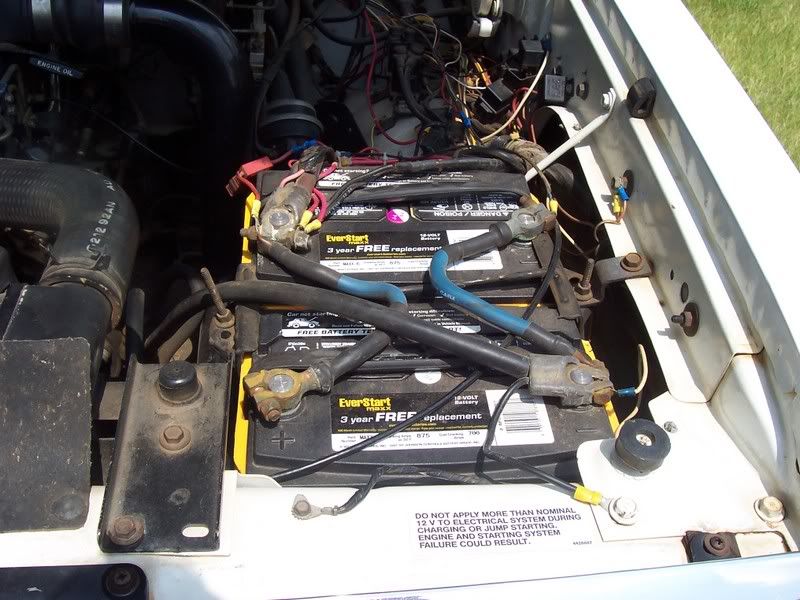
Just curious, where is your second battery located? My truck had a battery box hanging underneath, but I got high centered on it cutting wood one time and decided to get rid of it. One Optima has worked fine for me.


Chapter President
Joined: Nov 2005
Posts: 858
Likes: 0
From: Ridgecrest, CA
 NeverStart??
Hey rlyons, how are those NeverStarts working for you?
I have considered using them but my brother works at Wal-Mart and he says they have a 65 -75% return rate new off the shelf for bad batteries. Says they get old or broken in the shipping process. Any body else have any problems with EverStart batteries from Wal-Mart?
I can get a group 31 from Auto-zone or Kragens for under $90 I was considering dual Optima red-top's but they are just too darn much right now. I like the dual battery idea for looks and having the extra juice in a pinch. But I think I will stick with a G-31. Unless I can find two good batteries for less than one G-31.