


Air Shutoff and turned up my pump


Thread Starter
Administrator


Joined: Nov 2004
Posts: 4,084
Likes: 233
From: Southern California

I liked the "sshhp" when you pulled the shutoff off the intake. 
Jim, do you have an extra-loud turn signal flasher or is it really that quiet in your truck? I think that's why you can't hear the turbo.
Don't worry about 1400 on the pyro unless you plan to hold it there for more than 15-20 seconds. I'd be a little more concerned about that pegged boost gauge. I've seen turned up non-intercooled trucks make 50 psi so you need to get an accurate reading. That's just hot air and it's really to much RPM for the turbo.
Jim, do you have an extra-loud turn signal flasher or is it really that quiet in your truck? I think that's why you can't hear the turbo.
Don't worry about 1400 on the pyro unless you plan to hold it there for more than 15-20 seconds. I'd be a little more concerned about that pegged boost gauge. I've seen turned up non-intercooled trucks make 50 psi so you need to get an accurate reading. That's just hot air and it's really to much RPM for the turbo.
Just for a few seconds my engine became one giant 6-cylinder vacuum pump, so I guess this a good indication that my valves are good?
I am thinking about drilling and tap my aluminum block and install a vacuum gauge to see how much it is pulling and how long it will hold a vacuum, a different kind of a leak down test.
I was wondering if anyone would hear my turn signal flasher, yes it is a Heavy Duty electronic flasher made by Dietz and is made for tractor-trailer to flash all of the lights.
It is mounted on the floorboard and you can feel it as well as hear it.
The cab is really quiet inside compared to what it used to be with all of the insulation I have added but I am still getting some of the low frequency rumble I think from the exhaust resonating through the floorboard and probably the back of the cab.
I was thinking about wrapping the muffler with some high temperature fiberglass insulation and then some foil backed insulation, kind of like a glass pack muffler inside out.
What do you think?
Also at times you might hear a Beep Beep..
That is an electronic speed indicator and is set to alert me at 72 MPH.
Jim

Registered User
Joined: Feb 2005
Posts: 2,658
Likes: 85

Have you been next to a 747 spooling up? I don't think they sound anything alike. Then again what would I know :-) It sounds cool though to say that your little turbo sounds like a 747 engine.
 The air starter for those engines have bigger turbines than our turbos :-)
A photo I took while at work in Korea with one of our customer's Aircraft in mod:

Thread Starter
Administrator
Joined: Nov 2004
Posts: 4,084
Likes: 233
From: Southern California
if you are out of adjustment on the idle screw you can reindex the throttle shaft and crank the idle screw back out.
That is exactly what I did.
and i think you have an electronic flasher mine sounds like that.
You win on this one too, It is a Dietz and is a big square box about 2 1/2" square.
Jim you dont happen to have tape over you front door vents do you?
the area where the wires go into the door?
if so that makes a difference in the sound of the turbo
That is exactly what I did.
and i think you have an electronic flasher mine sounds like that.
You win on this one too, It is a Dietz and is a big square box about 2 1/2" square.
Jim you dont happen to have tape over you front door vents do you?
the area where the wires go into the door?
if so that makes a difference in the sound of the turbo
Like I said, when you slam the doors there are no rattles and it will pop your ears, sometimes people will get in and will not pull the door hard enough to overcome the pressure and can’t latch the door until you crack open the window.
Have you ever got in a car and closed the door and the car rattles for the next few seconds, mine doesn’t.

Registered User
Joined: Jan 2008
Posts: 7,547
Likes: 2
From: Quinton, New Jersey (middle of nowhere)
Wow, That is a really tight cab from what you're explaining. God I'd love to see a truck like yours in person, and ride in it. I can't ever imagine a first gen having no rattles or squeeks.
sounds like you're in the "I need a 3200 spring club" now.
Wannadiesel basicly did the same tweaks to our 91 NON i/c that you did to your truck. And we loved it and it ran good but when you install the 3200 spring you can really use all that added power and throttle response will be like that of a new truck.
If your AFC setup is not modified (fuel pin) then i'd say you were'nt smoking that much with your air mods. As soon as you touch the fuel pin though expect a coal train with all that added fuel screw.
,Brandon
sounds like you're in the "I need a 3200 spring club" now.
Wannadiesel basicly did the same tweaks to our 91 NON i/c that you did to your truck. And we loved it and it ran good but when you install the 3200 spring you can really use all that added power and throttle response will be like that of a new truck.
If your AFC setup is not modified (fuel pin) then i'd say you were'nt smoking that much with your air mods. As soon as you touch the fuel pin though expect a coal train with all that added fuel screw.
,Brandon

Registered User
Joined: May 2004
Posts: 2,867
Likes: 0
From: Golden, Colorado
So Jim, you re-indexed your throttle shaft and still can't get your idle down? If so and assuming you indexed it the right way then the only way to lower the idle is going to be backing out the full fuel screw.
Aaron
Aaron

alwaysonDTR
Joined: Dec 2007
Posts: 2,551
Likes: 0
From: Keizer, oregon
Uh yes I sure do, I closed off the flow through vents and also the space between the fender well and body has a piece of foam rubber to block the airflow and deaden the sound.
Like I said, when you slam the doors there are no rattles and it will pop your ears, sometimes people will get in and will not pull the door hard enough to overcome the pressure and can’t latch the door until you crack open the window.
Have you ever got in a car and closed the door and the car rattles for the next few seconds, mine doesn’t.
Like I said, when you slam the doors there are no rattles and it will pop your ears, sometimes people will get in and will not pull the door hard enough to overcome the pressure and can’t latch the door until you crack open the window.
Have you ever got in a car and closed the door and the car rattles for the next few seconds, mine doesn’t.
i drove my blue and sliver truck around for a few weeks without door panels and the turbo was really loud.
Thread Starter
Administrator
Joined: Nov 2004
Posts: 4,084
Likes: 233
From: Southern California
Wow, That is a really tight cab from what you're explaining. God I'd love to see a truck like yours in person, and ride in it. I can't ever imagine a first gen having no rattles or squeeks.
sounds like you're in the "I need a 3200 spring club" now.
Wannadiesel basicly did the same tweaks to our 91 NON i/c that you did to your truck. And we loved it and it ran good but when you install the 3200 spring you can really use all that added power and throttle response will be like that of a new truck.
If your AFC setup is not modified (fuel pin) then i'd say you were'nt smoking that much with your air mods. As soon as you touch the fuel pin though expect a coal train with all that added fuel screw.
,Brandon
sounds like you're in the "I need a 3200 spring club" now.
Wannadiesel basicly did the same tweaks to our 91 NON i/c that you did to your truck. And we loved it and it ran good but when you install the 3200 spring you can really use all that added power and throttle response will be like that of a new truck.
If your AFC setup is not modified (fuel pin) then i'd say you were'nt smoking that much with your air mods. As soon as you touch the fuel pin though expect a coal train with all that added fuel screw.
,Brandon
All that I have done to my AFC is a new diaphragm and the pin is set to its deepest side, washer is out and replaced with an o-ring.
I will have to see if I can shoot a video out the back to show how much it is not smoking.
Jim
Thread Starter
Administrator
Joined: Nov 2004
Posts: 4,084
Likes: 233
From: Southern California
My linkage is so tight (zero play) that I can adjust the idle by adjusting the threaded rod between the Heim joints.
Jim
Thread Starter
Administrator
Joined: Nov 2004
Posts: 4,084
Likes: 233
From: Southern California
Hello Jim. So you have made your fist full fuel screw pump adjustment, congratulations. Did you happen to look out the rear view mirror when you were full power all the way up the freeway on ramp? I would bet that you blacked it out with the fuel settings you have. 2.5 turns on a non i/c is a lot!!! Since you cannot idle down enough with the lever almost touching the pump head, I think you are more fueled than I ever have been. I would easily guess that you were encroaching 50+ psi boost - that gauge was moving fast all the way past max!
I have adjusted my Fuel screw over one hundred of times over the years. I get to the point where I get tired of the fire breathing monster, so I turn it back down, then want to feel the power and turn it back up etc, but I have settled down at a point where I haven't touched it for a long time. at full fuel around 3000 RPM I can hit 38 PSI but I never leave it there long. When I am accelerating thru the gears at lower RPM I hit about 30 PSI max with the MWE slot doing it's job because the turbo is making a loud scream. When I didn't have a MWE in that condition I'd get flutter. (Full Fuel at 1400 rpm-2500)
I found my optimum fuel screw point using this method:
Slowly roll on the fuel lever incrementally until you reach 2500 (or higher if you want)
If at any point with no load the engine starts to increase in RPM (overriding the governor) back off the fuel screw. If you can throttle to 2500 with 3/4 throttle or thereabouts and it equalizes, then you can turn the fuel up until the gov starts to be overridden, then back it off until the gov can control it again, usually you can do this in 1/8th turn increments to find the sweet spot.
The point you have it at you aren't getting a runaway but I'd imagine that if you put it at about 1/8 throttle and hold it, it rpms would climb/runaway to 3000+. I bet that any throttle position just off idle will yield a slow RPM climb/runaway condition even though you're not increasing the fuel lever.
The slow climbing of rpm is like a gasser engine, and I don't like the drive and feel of that. I like the fact that a diesel the throttle can be like a tractor RPM lever, select your governed RPM by pedal position and it will hold it there.. I can stab mine to 3/4" and it will climb to a point in the high 2000s and stay there without climbing. (no tach) This is how stock engines are and the gov will be able to hold it back like that with significant higher fueling. This is how the governor in the VE pumps were designed to operate. I imagine if someone was a really crafty engineer they could figure out how to modify the gov springs / weights or return springs to allow for full governed control with much more fueling.. But as it is, I settled with the setting that allows me to have governed control over all pedal positions without runaway. The seat of the pants feel isn't much different from my fueling now compared to if it were maxxed out again.
Practically speaking, I have plenty of fuel now even though I could turn it up plenty more without runaway at idle.. I have smoke and could have a lot more with AFC adjustments, or could have hardly any at all. I had to monitor the pyro when towing the w200 1972 crew up the hills and actually had to shift to third once up a grade to allow the engine to wind up more to control egts at 50mph, I would be losing RPM with it pegged at 1200 in fourth. So needless to say, I have more fuel than I need to tow. I'd need to look at intercooling it to get lower EGT at this point but I don't mind going a little bit slower if needed up hills when towing, it isn't nearly enough of a difference that it would affect my overall trip time.
Just my .02
I have adjusted my Fuel screw over one hundred of times over the years. I get to the point where I get tired of the fire breathing monster, so I turn it back down, then want to feel the power and turn it back up etc, but I have settled down at a point where I haven't touched it for a long time. at full fuel around 3000 RPM I can hit 38 PSI but I never leave it there long. When I am accelerating thru the gears at lower RPM I hit about 30 PSI max with the MWE slot doing it's job because the turbo is making a loud scream. When I didn't have a MWE in that condition I'd get flutter. (Full Fuel at 1400 rpm-2500)
I found my optimum fuel screw point using this method:
Slowly roll on the fuel lever incrementally until you reach 2500 (or higher if you want)
If at any point with no load the engine starts to increase in RPM (overriding the governor) back off the fuel screw. If you can throttle to 2500 with 3/4 throttle or thereabouts and it equalizes, then you can turn the fuel up until the gov starts to be overridden, then back it off until the gov can control it again, usually you can do this in 1/8th turn increments to find the sweet spot.
The point you have it at you aren't getting a runaway but I'd imagine that if you put it at about 1/8 throttle and hold it, it rpms would climb/runaway to 3000+. I bet that any throttle position just off idle will yield a slow RPM climb/runaway condition even though you're not increasing the fuel lever.
The slow climbing of rpm is like a gasser engine, and I don't like the drive and feel of that. I like the fact that a diesel the throttle can be like a tractor RPM lever, select your governed RPM by pedal position and it will hold it there.. I can stab mine to 3/4" and it will climb to a point in the high 2000s and stay there without climbing. (no tach) This is how stock engines are and the gov will be able to hold it back like that with significant higher fueling. This is how the governor in the VE pumps were designed to operate. I imagine if someone was a really crafty engineer they could figure out how to modify the gov springs / weights or return springs to allow for full governed control with much more fueling.. But as it is, I settled with the setting that allows me to have governed control over all pedal positions without runaway. The seat of the pants feel isn't much different from my fueling now compared to if it were maxxed out again.
Practically speaking, I have plenty of fuel now even though I could turn it up plenty more without runaway at idle.. I have smoke and could have a lot more with AFC adjustments, or could have hardly any at all. I had to monitor the pyro when towing the w200 1972 crew up the hills and actually had to shift to third once up a grade to allow the engine to wind up more to control egts at 50mph, I would be losing RPM with it pegged at 1200 in fourth. So needless to say, I have more fuel than I need to tow. I'd need to look at intercooling it to get lower EGT at this point but I don't mind going a little bit slower if needed up hills when towing, it isn't nearly enough of a difference that it would affect my overall trip time.
Just my .02
Then the next day when I had more time to play with it I was expecting to see smoke behind me when I was hard on the throttle, there wasn't.
Like I said before the only reason I stopped where I did with the screw was because I could not get the idle down low enough it was late and I needed the truck to run by morning.
I still have not checked my fuel pressure so maybe that is why, I still am not getting enough fuel to make smoke.
I am very happy with the performance where it is at and at the point where I need to start thinking about the welfare of my transmission from all of the new found torque.
One thing I did notice is there is a bit more smoke on initial startup and it does smell more like a semi tractor.
I will see if I can set up the camera to look out the back to see where I have been.
Jim

Registered User
Joined: Mar 2007
Posts: 365
Likes: 0
From: Minnesota
I've been wondering if it would be possible to put a big butterfly valve or something in the intake somewhere to give a diesel some engine braking. That'd be a hell of a lot cheaper than an exhaust brake.
Thread Starter
Administrator
Joined: Nov 2004
Posts: 4,084
Likes: 233
From: Southern California
How much should I turn it?
I need to adjust the smoke screw on my pump a bit now.
Now I will get a bit of smoke from a stop if I leave too hard or if I power brake,
under full throttle there is hardly any smoke, just low speed.
I can easly make 20-PSI boost with light throttle at a stop.
I cannot have any excessive smoke here in California.
I just found out in the rain that if I were to build 20 PSI boost that I am sliding my locked front wheels on the wet pavement.
Guess it is time to install a Line –Lok or Roll Control on my brakes for control. I had these on all of my cars.
http://www.hurst-shifters.com/hurst-...4Pa38Ta38Nc310
Thanks
I need to adjust the smoke screw on my pump a bit now.
Now I will get a bit of smoke from a stop if I leave too hard or if I power brake,
under full throttle there is hardly any smoke, just low speed.
I can easly make 20-PSI boost with light throttle at a stop.
I cannot have any excessive smoke here in California.
I just found out in the rain that if I were to build 20 PSI boost that I am sliding my locked front wheels on the wet pavement.
Guess it is time to install a Line –Lok or Roll Control on my brakes for control. I had these on all of my cars.
http://www.hurst-shifters.com/hurst-...4Pa38Ta38Nc310
Thanks

Adminstrator-ess
Joined: Mar 2003
Posts: 22,594
Likes: 19
From: New Holland, PA
Until you are happy with the power or it runs away, whichever comes first.
I need to adjust the smoke screw on my pump a bit now.
Now I will get a bit of smoke from a stop if I leave too hard or if I power brake,
under full throttle there is hardly any smoke, just low speed.
I can easly make 20-PSI boost with light throttle at a stop.
I cannot have any excessive smoke here in California.
Pull the AFC cover off and carve out that ring inside it so the AFC cone can come up higher. You will also want to grind the protruding threads off the AFC cone. Set the smoke screw so that the AFC cone is as high as it can be without the fuel pin dropping in the notch near the bottom. The higher you can run the AFC cone, the less governor lever travel you will get with no boost. As you turn up the fuel screw, you will need to run the star wheel up more to prevent smoke as the turbo comes up on boost. The limiting factor there is coil bind, use grease to mark your progress as you adjust the star wheel so you don't wind up limiting power by going too far up. This setup will let you run the main fuel screw in further without getting a big puff when you stomp on it.
I need to adjust the smoke screw on my pump a bit now.
Now I will get a bit of smoke from a stop if I leave too hard or if I power brake,
under full throttle there is hardly any smoke, just low speed.
I can easly make 20-PSI boost with light throttle at a stop.
I cannot have any excessive smoke here in California.
Thread Starter
Administrator
Joined: Nov 2004
Posts: 4,084
Likes: 233
From: Southern California
So for the past week I have been driving around with a boost gauge that leaves me wondering just how much boost there really is.
So it looks like I will be looking for a 60-PSI gauge in the near future.
But I wanted to know just how much I was producing so I went into the garage and put together a little test gauge.
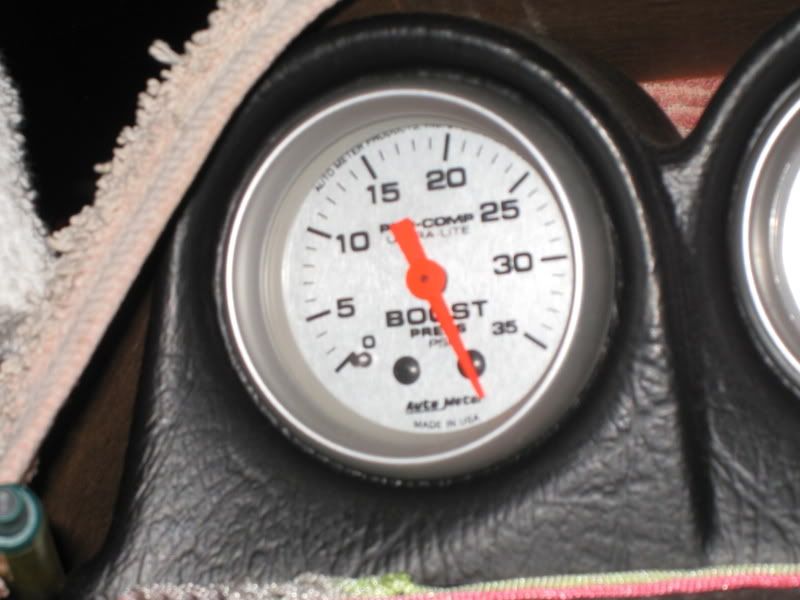
I installed a Tee in the boost line where the line enters the crossover. From there I install a short piece of hose and set up a test gauge so I could get an accurate reading.
I used one of my gauges that has a tattletale needle that will follow the needle to its highest reading and stay there. I have all kind of neat things.
I did not want to mount the gauge on the crossover because the vibration might have damaged the gauge.
Then I went out and took a short trip down the freeway.
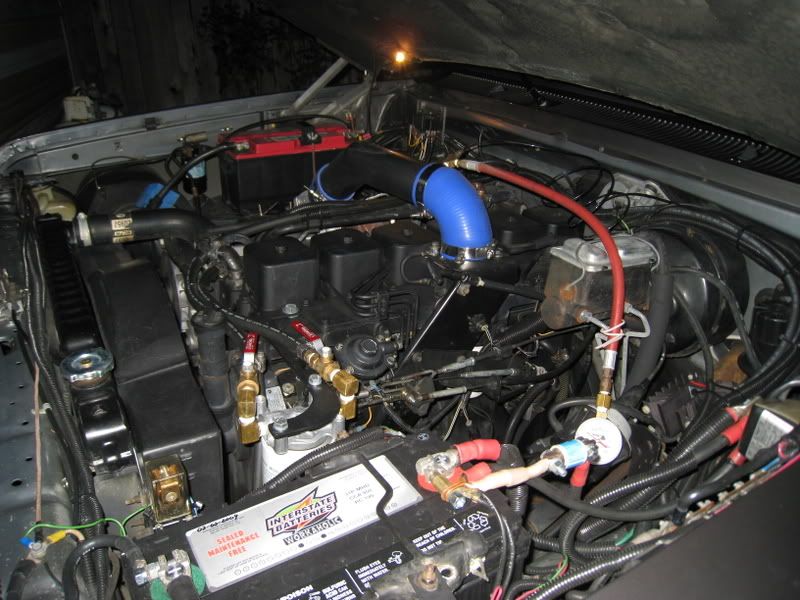
When I got back I went and checked the gauge. WOW
When I installed the new compressor upgrade and built my new free flowing crossover I
more than doubled my boost pressure.
I am now cranking out about 56 pounds.
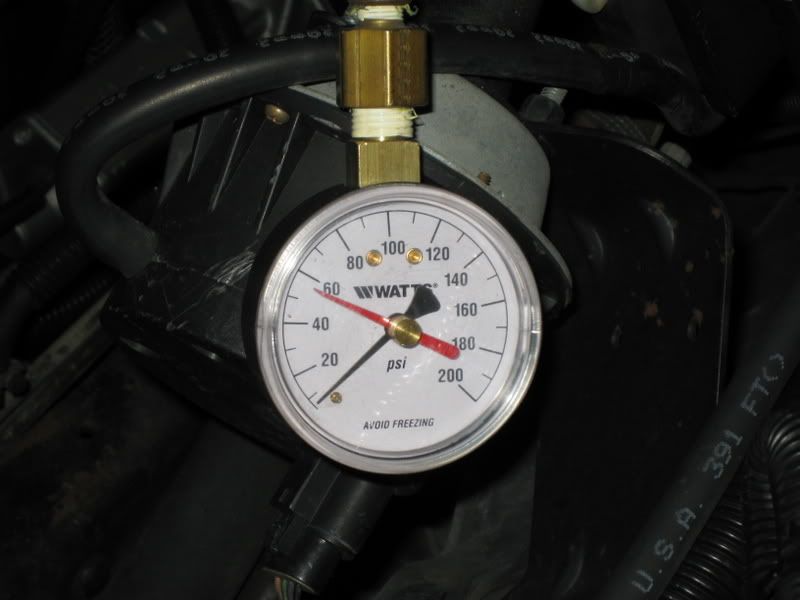
So now what is the plan, I really don’t think I need more fuel and obviously this is only intermittent since I don’t drive around with a heavy throttle, I would run out of room too quickly.
What is the maximum pressure I can run before the head gaskets will fail.
Why do you think I am getting so much boost? Other people are only talking about 30 PSI when they install the upgrade.
Do you think the 3” crossover and extra large inlet flange helped?
Also I think I need to install a transmission temperature gauge, it will be interesting to see how much heat I am generating.
So what do you think?
Jim
So it looks like I will be looking for a 60-PSI gauge in the near future.
But I wanted to know just how much I was producing so I went into the garage and put together a little test gauge.
I installed a Tee in the boost line where the line enters the crossover. From there I install a short piece of hose and set up a test gauge so I could get an accurate reading.
I used one of my gauges that has a tattletale needle that will follow the needle to its highest reading and stay there. I have all kind of neat things.
I did not want to mount the gauge on the crossover because the vibration might have damaged the gauge.
Then I went out and took a short trip down the freeway.
When I got back I went and checked the gauge. WOW
When I installed the new compressor upgrade and built my new free flowing crossover I
more than doubled my boost pressure.
I am now cranking out about 56 pounds.
So now what is the plan, I really don’t think I need more fuel and obviously this is only intermittent since I don’t drive around with a heavy throttle, I would run out of room too quickly.
What is the maximum pressure I can run before the head gaskets will fail.
Why do you think I am getting so much boost? Other people are only talking about 30 PSI when they install the upgrade.
Do you think the 3” crossover and extra large inlet flange helped?
Also I think I need to install a transmission temperature gauge, it will be interesting to see how much heat I am generating.
So what do you think?
Jim
Registered User
Joined: May 2004
Posts: 2,867
Likes: 0
From: Golden, Colorado
Every truck is different, the more timing you have at those higher pressures the higher you cylinder pressure will be and the more likely to have a gasket failure. Personally I think with basically stock turbo anything more than 40psi is just extra heat into the engine and will not gain you any power.
I think an s300 variant would be a wise turbo choice, or even a wastegated HX-40. A intercooler would help also, but not as much as a bigger turbo.
Being non-intercooled motor you have very large injectors that will put out lots of fuel, thats why you get so much psi.
Aaron