


FP Gauge install ???'s


Thread Starter
Registered User
Joined: Mar 2006
Posts: 624
Likes: 2
From: S.E., Michigan
FP Gauge install ???'s
I recently bought gauges for my 96 12v.
The fuel pressure is mechnical, and I'm curious what all I need to get it up and working?
The reason I ask is because I have to sell the fuel pressure gauge because its only a 0-30psi, and I need a 0-40 or 0-60 one.
My question is do I need to keep the banjo bolt and pressure line for my next gauge? (another mechinical isspro 0-60 Fuel psi I'm buying soon)
I know i'll need the some pressure line, but do I need the banjo bolt?
how do the 12v's tap into the fuel system?
If i dont need the BB (banjo bolt), I would like to sell the gauge as a package to the next guy (any 24v owner).
Thanks guys,
I did alot of searching, but the fuel pressure gauge (for the 12v) isn't covered that great... or else i just couldnt find the right thread,

The fuel pressure is mechnical, and I'm curious what all I need to get it up and working?
The reason I ask is because I have to sell the fuel pressure gauge because its only a 0-30psi, and I need a 0-40 or 0-60 one.
My question is do I need to keep the banjo bolt and pressure line for my next gauge? (another mechinical isspro 0-60 Fuel psi I'm buying soon)
I know i'll need the some pressure line, but do I need the banjo bolt?
how do the 12v's tap into the fuel system?
If i dont need the BB (banjo bolt), I would like to sell the gauge as a package to the next guy (any 24v owner).
Thanks guys,
I did alot of searching, but the fuel pressure gauge (for the 12v) isn't covered that great... or else i just couldnt find the right thread,

Banned
Joined: Apr 2006
Posts: 901
Likes: 0
From: Magnolia, TX
Is the banjo bolt you have one for a 12v or 24v, as they are different... It's pretty easy, get a 18mm (I think) socket pull the BB out and grind the small nipple on the head flat. Use a punch and mark it for the center, drill and tap it and reinstall. Then hook up your needle valve straight to that and then just running a pressure gauge tubing kit to your gauge (or some other type of high pressure hose). Make sure on all the connections you use a liquid thread sealent that is safe for diesel fuel/fuel line useage. Hope this helps man! 
Thread Starter
Registered User
Joined: Mar 2006
Posts: 624
Likes: 2
From: S.E., Michigan
Thanks,
So, the banjo bolt I have (from a 24v) won't work.
(Came with the 0-30 psi gauge)
But the banjo bolt I need to use is actually on my truck already?
Comes stock on the truck, and just needs the drilling mod to install the needle valve?
So, the banjo bolt I have (from a 24v) won't work.
(Came with the 0-30 psi gauge)
But the banjo bolt I need to use is actually on my truck already?
Comes stock on the truck, and just needs the drilling mod to install the needle valve?

Registered User
Joined: Dec 2004
Posts: 3,411
Likes: 2
From: Laredo
needs to be tapped, Infidel has some nice pictures... here they are..
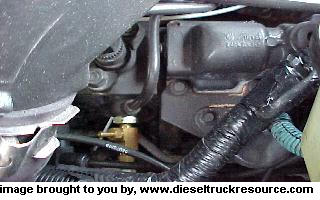
Rick

Registered User
Joined: Dec 2003
Posts: 14,672
Likes: 9
From: Montana
A 24 valve BB won't work, as far as I know no one makes a tapped banjo for a 12 valve.
Tapping is easy, remove the injection pump inlet bolt (don't loose sealing washers) and drill up though the center with a tight fitting bit, this will perfectly center the hole. That size bit will work with most 1/8" pipe taps, if not enlarge just the first 1/2" from the top with a larger bit.
Don't know if your kit came with a gauge snubber or needle valve but you must use one or the other on the 12 valve or the gauge will be impossible to read in the short time before it self destructs.
Needle valves are available at most places that sell plumbing or at Napa. Run the valve barely cracked open.
Tapping is easy, remove the injection pump inlet bolt (don't loose sealing washers) and drill up though the center with a tight fitting bit, this will perfectly center the hole. That size bit will work with most 1/8" pipe taps, if not enlarge just the first 1/2" from the top with a larger bit.
Don't know if your kit came with a gauge snubber or needle valve but you must use one or the other on the 12 valve or the gauge will be impossible to read in the short time before it self destructs.
Needle valves are available at most places that sell plumbing or at Napa. Run the valve barely cracked open.

Registered User
Joined: Mar 2005
Posts: 2,615
Likes: 0
From: Nevada
So any needle valve will work? Do the gauge instructions tell you to use a needle valve? I've heard something about an isolator?
Is there anywhere else to temporarily hook up a fp gauge? I might get one to go in the 3-pod piller but then again I might just get a cheapo to test the system in my driveway. Do most people just use the plastic tubing for the mechanical fp gauges? I'm afraid it might rip and spill fuel all over the cab.
I'm getting one so I can diagnose a problem (if there is one). I have a feeling either my overflow valve, some fuel lines, or my lift pump need to be replaced. I get crappy fuel mileage and when I get on it, I hear a lot of engine chatter. Valves might need some adjusting too...
Is there anywhere else to temporarily hook up a fp gauge? I might get one to go in the 3-pod piller but then again I might just get a cheapo to test the system in my driveway. Do most people just use the plastic tubing for the mechanical fp gauges? I'm afraid it might rip and spill fuel all over the cab.
I'm getting one so I can diagnose a problem (if there is one). I have a feeling either my overflow valve, some fuel lines, or my lift pump need to be replaced. I get crappy fuel mileage and when I get on it, I hear a lot of engine chatter. Valves might need some adjusting too...
Registered User
Joined: Dec 2003
Posts: 14,672
Likes: 9
From: Montana
There is an adaptor that replaces the filter bleed screw available from TST for $25 they say it is only for temporary use though http://www.tstproducts.com/index.asp...PROD&ProdID=62
It's better to have a cab mounted gauge so you can measure pressure under load.
I use plastic tubing similar to boost gauge line and slip it though some 1/4" line to protect against cuts, kinks and abrasion.
It's better to have a cab mounted gauge so you can measure pressure under load.
I use plastic tubing similar to boost gauge line and slip it though some 1/4" line to protect against cuts, kinks and abrasion.
Trending Topics
Registered User
Joined: Mar 2005
Posts: 2,615
Likes: 0
From: Nevada
Apparently the Autometer fp gauges don't come with tubing. I was gonna get some copper tubing but the copper tubing Autometer offers says it is NOT for fuel/brake pressure gauges. So what gives? They recommend using the #4 steel braided tubing, which runs over $50. Should I just go ahead and use copper tubing anyway?

Registered User
Joined: Mar 2005
Posts: 2,615
Likes: 0
From: Nevada
BTW, so the banjo bolt is the only place to tap for the fp gauge?
Thread Starter
Registered User
Joined: Mar 2006
Posts: 624
Likes: 2
From: S.E., Michigan
There is an adaptor that replaces the filter bleed screw available from TST for $25 they say it is only for temporary use though http://www.tstproducts.com/index.asp...PROD&ProdID=62
and why replace it?
whats it have to do with this... im new.


Banned
Joined: Feb 2006
Posts: 1,048
Likes: 0
From: Central "By God" Texas
Filter bleed screw is on top of one of the filter banjos. I was thinking of using it but it is just as easy to drill the banjo the goes into the injection pump. It is a 21/64 drill bit with a 1/8 npt tap. Real quick and easy. Then you thread a 1/8 needle valve into the banjo, and personally I used 1/4 fuel hose run to the gauge with a -4 an fitting for the gauge. The hose is kind of large but fits fine.

Registered User
Joined: Jul 2006
Posts: 440
Likes: 0
From: Los Angeles, CA
I can't seem to find it now, but I learned all I needed to know from a nice long post that Infidel had. Here's how I did mine. I took the banjo bolt out, drilled and tap it with 1/8 NPT. Then I screwed in a needle valve like this one, to the banjo bolt:
http://www.sourceautomotive.biz/needle_valve.htm
From the needle valve I used a 30" piece of rubber fuel line (250psi) from Geno's Garage, like this one:
http://www.genosgarage.com/prodinfo....mber=VULCAN-FH
I ran this rubber line to the fender, then I used 1/8 copper tubbing, like this kit, which has everything you need:
http://store.summitracing.com/partde...0&autoview=sku
I then ran the copper tubing straight to the gauge inside the cab. You can't run the copper tubing directly the the banjo bolt because vibrations from the engine will cause it to crack and leak, that's why you need the rubber line. I prefer copper over plastic tubing because I've had plastic kink and brake, I've also had rats chew a hole on it and make a big mess of fuel.
For the gauge I used a surplus water pressure gauge, which is a 60psi, high quality, Auto Meter Industrial, all metal, made in USA, heavy duty gauge. I don't care that is says Water Pressure, I made a label to read Fuel Pressure. The best thing is that it only costs $10, available here:
http://www.surpluscenter.com/item.as...atname=engines
I mounted the gauge low under the dash, in case it should ever leak, it will simply drip on the floor mats. Remember to seal all NPT connections with Permatex 2, and not teflon tape.
Shut off the needle valve, start the engine, then just barely open the valve, I mean just open it a very small tad. It will take a few seconds, but you should see fuel pressure. If you see the needle fluctuate, then keep closing the valve until the needle is steady. Once you get it just right where you want it, you can tighten down the packing nut on the needle valve, this will keep it set where it is.
From the service manual, here is what you should see for fuel pressure:
17-22psi at idle
25-35psi at 2500 RPM, no load.
Oh, and don't worry about having fuel in the cab. Diesel is no where near as flammable as gas, if you should ever have a leak, I can almost guarantee you that your truck won't burst into flames. When you first start the truck, after installing the gauge, put a rag under the gauge, in case there is a loose fitting and you get a small leak. I've been running mechanical fuel and oil pressure gauges, with copper tubing, for years and I've never had a problem. Good luck.
http://www.sourceautomotive.biz/needle_valve.htm
From the needle valve I used a 30" piece of rubber fuel line (250psi) from Geno's Garage, like this one:
http://www.genosgarage.com/prodinfo....mber=VULCAN-FH
I ran this rubber line to the fender, then I used 1/8 copper tubbing, like this kit, which has everything you need:
http://store.summitracing.com/partde...0&autoview=sku
I then ran the copper tubing straight to the gauge inside the cab. You can't run the copper tubing directly the the banjo bolt because vibrations from the engine will cause it to crack and leak, that's why you need the rubber line. I prefer copper over plastic tubing because I've had plastic kink and brake, I've also had rats chew a hole on it and make a big mess of fuel.
For the gauge I used a surplus water pressure gauge, which is a 60psi, high quality, Auto Meter Industrial, all metal, made in USA, heavy duty gauge. I don't care that is says Water Pressure, I made a label to read Fuel Pressure. The best thing is that it only costs $10, available here:
http://www.surpluscenter.com/item.as...atname=engines
I mounted the gauge low under the dash, in case it should ever leak, it will simply drip on the floor mats. Remember to seal all NPT connections with Permatex 2, and not teflon tape.
Shut off the needle valve, start the engine, then just barely open the valve, I mean just open it a very small tad. It will take a few seconds, but you should see fuel pressure. If you see the needle fluctuate, then keep closing the valve until the needle is steady. Once you get it just right where you want it, you can tighten down the packing nut on the needle valve, this will keep it set where it is.
From the service manual, here is what you should see for fuel pressure:
17-22psi at idle
25-35psi at 2500 RPM, no load.
Oh, and don't worry about having fuel in the cab. Diesel is no where near as flammable as gas, if you should ever have a leak, I can almost guarantee you that your truck won't burst into flames. When you first start the truck, after installing the gauge, put a rag under the gauge, in case there is a loose fitting and you get a small leak. I've been running mechanical fuel and oil pressure gauges, with copper tubing, for years and I've never had a problem. Good luck.


Registered User
Joined: Sep 2005
Posts: 308
Likes: 1
From: Colorado
which is the "permatex #2"? i haven't seen anything called that. the guy at the store recommended the "ultra-grey" (http://www.permatex.com/products/aut...sket_Maker.htm)
for being most resistant to diesel.
for being most resistant to diesel.