


Needle valve for fp testing?


Thread Starter
Registered User
Joined: Nov 2005
Posts: 1,597
Likes: 2
From: Mexico!
Needle valve for fp testing?
how to test a 12valves fuel pressure?
Ive read a needle valve is needed? sorry, im stupid, what is it and how does it work? can i use a valve used in any other aplication, to keep the guage from pulsating?
thanks
Ive read a needle valve is needed? sorry, im stupid, what is it and how does it work? can i use a valve used in any other aplication, to keep the guage from pulsating?
thanks

Registered User
Joined: Dec 2004
Posts: 3,411
Likes: 2
From: Laredo
U can buy the needle valve from grainer, or u can order them directly from TST i think for their fuel pressure kits. I spent a whole 3.62 cents on mine from grainger...
Basic explanation of this is simple. On a 12 valve engine u need to tap the banjo bolt on the side of the pump, and u screw the needle valve in. DO NOT use an isolator, u will be wasting your money with that.. Once u tap that hole, i think its a 1/8 NPT, u screw in the needle valve with some permatex or mega grey gasket maker.. Once that it is screwed on, u connect ur oil pressure tubing to it, or in my case, a braided steel line that is connected with a dual male connector to my oil pressure. This is good cause if i want to test another FP gauge outside of the cab i can, even though it was a folly from installing an isolator
 it actually worked out better than before this way..
The needle valve is used to control pulsations. If you run the valve open when u look at the gauge it will pulsate pretty badly, mine would fluctuate between 0-60 psi at some points, U close the valve ALMOST all the way, I have mine finger tight actually, just to the point that the needle takes a few minutes to read, But i do idle at 17-20 psi and cruise from 20-40 psi on average now... Rephrasing that, if u close the needle valve, the more u close it the less the pulsations and the less that the needle bounces thus giving u a more accurate reading..
Be aware tho, readings are averages and do tend to fluctuate...
Im not sure if you will find another valve that will work, if u do, post it up and let us know..
hope that this helps...
Rick

Registered User
Joined: Dec 2002
Posts: 90
Likes: 1
From: Colorado
12,
Here is a link to the Grainger needle valve.
Here is a link to the gauge I used. Mine has numbers on it.
T-Bone
Here is a link to the Grainger needle valve.
Here is a link to the gauge I used. Mine has numbers on it.
T-Bone

Registered User
Joined: Dec 2003
Posts: 14,672
Likes: 9
From: Montana
Buy any 60lb gauge here http://www.surpluscenter.com/sort.as...s&keyword=NFGA
It may say water, air or even fuel on it and will be a high quality made in USA Autometer Industrial gauge. Mount it down low at the bottom center of your dash. On a 12 valve you really don't need to watch your FP as much as a 24, down low mounting is no big deal.
Here's my instructions, save yourself a search.
To check fuel pressure on 12 valve:
I drill and tap the top of the injection pump banjo bolt to 1/8'' pipe
thread, then install a male x female 1/8'' needle valve with 1/8'' tubing
compression fitting in it. Boost gauge or oil pressure tubing pushed
though some 1/4'' tubing to protect against cuts and kinks to the gauge.
For a gauge you can use a fuel, boost or water pressure gauge, for a 12
valve it must be at least 40 psi, 60 is best. They can have no
lighting since it's not a gauge you need to look at all the time. They can
be mounted low for the same reason. Use no Teflon tape, it doesn't work
with diesel. Instead use anti-seize or Permatex #2. Remember you are
working on the clean side of the filter, keep everything spotless.
Compression fittings with a ferrule that slips over the tubing will leak
if overtightened, finger tight with one turn of a wrench is plenty.
The ferrule should be replaced if the fitting is ever removed.
If you can tap your manifold for a pyro tapping the banjo bolt is a piece
of cake. Just drill from the inside to keep the hole straight and tap from
the outside. You can also connect to the bleed screw on top of your fuel
filter with the appropriate adapter to tubing if you don't want to tap.
The adaptor is available from TST for $25 they say it is only for temporary use though http://www.tstproducts.com/index.asp...PROD&ProdID=62 . After the install start your
engine with the needle valve closed then open it slowly till someone in
the cab signals you that it's just reading pressure. If you tighten down
the packing nut under the valve handle the setting can't move. The valve
will control pulsation and buzzing and can also be shut down in the
unlikely event that you have a leak. Without a valve to restrict the flow
the gauge will pulsate so badly that you won't be able to read it in the
short time before it self destructs.
Parts list; 1/8'' needle valve - $3.50 from the hardware store, plastic
oil pressure tubing kit that comes with the compression fittings - under $10
from any auto parts store. 1/4'' tubing for protective sleeve - less than $2.
Gauge is your choice and may come with tubing. The Surplus Center pressure gauges I use cost less than $10, bringing the total cost to less than $20 and a couple hours of your time.
From Grainger, needle valve http://www.grainger.com/Grainger/pro...835462&ccitem=
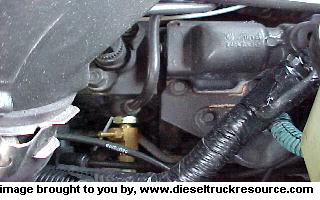
Needle Valve Mounted on Banjo Bolt
It may say water, air or even fuel on it and will be a high quality made in USA Autometer Industrial gauge. Mount it down low at the bottom center of your dash. On a 12 valve you really don't need to watch your FP as much as a 24, down low mounting is no big deal.
Here's my instructions, save yourself a search.
To check fuel pressure on 12 valve:
I drill and tap the top of the injection pump banjo bolt to 1/8'' pipe
thread, then install a male x female 1/8'' needle valve with 1/8'' tubing
compression fitting in it. Boost gauge or oil pressure tubing pushed
though some 1/4'' tubing to protect against cuts and kinks to the gauge.
For a gauge you can use a fuel, boost or water pressure gauge, for a 12
valve it must be at least 40 psi, 60 is best. They can have no
lighting since it's not a gauge you need to look at all the time. They can
be mounted low for the same reason. Use no Teflon tape, it doesn't work
with diesel. Instead use anti-seize or Permatex #2. Remember you are
working on the clean side of the filter, keep everything spotless.
Compression fittings with a ferrule that slips over the tubing will leak
if overtightened, finger tight with one turn of a wrench is plenty.
The ferrule should be replaced if the fitting is ever removed.
If you can tap your manifold for a pyro tapping the banjo bolt is a piece
of cake. Just drill from the inside to keep the hole straight and tap from
the outside. You can also connect to the bleed screw on top of your fuel
filter with the appropriate adapter to tubing if you don't want to tap.
The adaptor is available from TST for $25 they say it is only for temporary use though http://www.tstproducts.com/index.asp...PROD&ProdID=62 . After the install start your
engine with the needle valve closed then open it slowly till someone in
the cab signals you that it's just reading pressure. If you tighten down
the packing nut under the valve handle the setting can't move. The valve
will control pulsation and buzzing and can also be shut down in the
unlikely event that you have a leak. Without a valve to restrict the flow
the gauge will pulsate so badly that you won't be able to read it in the
short time before it self destructs.
Parts list; 1/8'' needle valve - $3.50 from the hardware store, plastic
oil pressure tubing kit that comes with the compression fittings - under $10
from any auto parts store. 1/4'' tubing for protective sleeve - less than $2.
Gauge is your choice and may come with tubing. The Surplus Center pressure gauges I use cost less than $10, bringing the total cost to less than $20 and a couple hours of your time.
From Grainger, needle valve http://www.grainger.com/Grainger/pro...835462&ccitem=
Needle Valve Mounted on Banjo Bolt

Thread
Thread Starter
Forum
Replies
Last Post
Flatty
Performance and Accessories 2nd gen only
16
Apr 21, 2005 09:56 PM
gaRam
Performance and Accessories 2nd gen only
6
Sep 18, 2004 03:41 PM