instant cab heat


Registered User
Joined: Jan 2003
Posts: 4,179
Likes: 142
From: The "real" Northern CA
Well I measured the input current at full load and it was 72 amps so that'd not a problem. I got 2 1000 amp batteries and i think the alternator puts out 150 amps so I'm covered there. he k the grid heater pulls 90-100 amps lol
I'm not sure about the tstat but it seems to work great in the summer. I also tried a cold front last year but it mighta only helped marginally? Maybe my truck is allergic to putting out heat
I looked into just putting in wiring and a heater that worx when u plug iy in but what I wanted was mobility. this way I got heat anywhere I go whether I got a plugin or not
I'm not sure about the tstat but it seems to work great in the summer. I also tried a cold front last year but it mighta only helped marginally? Maybe my truck is allergic to putting out heat
I looked into just putting in wiring and a heater that worx when u plug iy in but what I wanted was mobility. this way I got heat anywhere I go whether I got a plugin or not
So back to my point..... Again, I am not nearly as smart as other guys on this topic but I do know that just because your battery is a 1000 ca doesn't mean its capable of sustaining any draw of that capacity. If you did, you'd destroy it in no time.
Having an RV, I've talked to many people about inverters and battery capacity.....and potentially adding solar to offset battery charge from any usage. I know solar isnt part of our discussion in this thread but just know that it was something I was looking towards in order to keep batteries in good condition. I was asking about the ability to run a simple coffee maker off an inverter with multiple "deep cycle" batteries and this is what a few really intelligent guys told me in discussion:
For an inverter find the item that draws the greatest number of watts and multiply that by 125%. That will be the continuous duty value for the inverter. For example my microwave draws a whopping 1591 watts so an adequate inverter is 1989 watts continuous (which usually means about 4000 watts surge).
There is also a suggested limit by the size of the battery bank. Basically 100 amp-hours @ 12 volts for about every 500 watts of inverter. So for the above example to work well 400 amp-hours of battery bank @ 12 volts is a quite rough estimate.
Of course, if all you wish to do is warm a cup of coffee--or do some popcorn that battery size need not be followed. But for *serious* cooking of say 30 minutes--you are going to need a big bank.
And another short comment another guy made:
.....requires an Inverter that runs off the batteries to be able to run my 120VAC appliances and the inverters will draw some serious power. My 1500WATT PSW inverter will draw around 120AMPS of 12VDC from my battery if fully loaded down to 1500WATTS and that will run down a single GP27 battery in about 15-30 minutes time. So you can see real quick that the total wattage you need to run your 120VAC appliances is going to be small because of how much power the inverter takes to operate it.
So by all means, I'm not trying to put your idea down since I think you were thinking outside the box.....but I'm just trying to save you from draining your batteries and potentially harming the alternator over time. If you find that your setup is working fine then great.

Also..... I really think you need to look at your thermostat and a winter front. Yes -40 is really cold but with a working thermostat and the help of a cold front your truck should be able to maintain normal running temps. And normal engine temps during the summer are no indication of a working thermostat. Search thermostat threads and you'll find lots of guys dont find out that their thermostat isnt working until the cold weather comes.


Thread Starter
Registered User
Joined: Jan 2011
Posts: 395
Likes: 0
Good info katoom. I don't run the grid heater with the space heater that's for sure. and my inverters is rated 1000w continuous and 1500 peak inrush. with my heater on low it draws 850-900 watts, going by the digital readout on the inverters. so I'm sure that's fine. as far as batteries that's a good point. good thing I have a 5yr replacement plan on them  didn't really research the effect of a long extended draw and the charging characteristics of the alternator. maybe others should do that if they plan on doing this. the way I operate tho is run everything to the max then replace it with something better lol that way somewheres down the road the truck will eventually b bulletproof!
didn't really research the effect of a long extended draw and the charging characteristics of the alternator. maybe others should do that if they plan on doing this. the way I operate tho is run everything to the max then replace it with something better lol that way somewheres down the road the truck will eventually b bulletproof!

Registered User
Joined: Dec 2003
Posts: 14,672
Likes: 9
From: Montana
You know it's cold when you let off the throttle and the temp drops as fast as the pedal comes up.
I don't think you even need the radiator in the winter, the heater core is enough to cool the engine.
Grid heaters in action


Registered User
Joined: Jan 2012
Posts: 88
Likes: 0
From: Redding,Ca
Please excuse my iGnEranCe, is the block heater ineffective at extreme low temps? The coldest it gets here is maybe +20. My truck fires right up when plugged in overnight but still takes a bit to actually feel any cab heat. P.S. This is my 1st diesel.
Registered User
Joined: Jan 2003
Posts: 4,179
Likes: 142
From: The "real" Northern CA
The block heater is totally effective down until the fuel stops flowing. By then its a mute point. Its suggested to plug in below 40* but there's plenty of big chested fellows who will say thats way to hot to even bother. When it gets in the 30's, I'll plug it in just because its so much more friendly to the engine and I like a warm cab between home and work. In saying that, with strong batteries, the Cummins will start without plugging in down to -20*. I dont suggest it though since thats hard on everything.
Registered User
Joined: Jan 2012
Posts: 88
Likes: 0
From: Redding,Ca
The block heater is totally effective down until the fuel stops flowing. By then its a mute point. Its suggested to plug in below 40* but there's plenty of big chested fellows who will say thats way to hot to even bother. When it gets in the 30's, I'll plug it in just because its so much more friendly to the engine and I like a warm cab between home and work. In saying that, with strong batteries, the Cummins will start without plugging in down to -20*. I dont suggest it though since thats hard on everything.
Registered User
Joined: Jan 2003
Posts: 4,179
Likes: 142
From: The "real" Northern CA
I think that diesel starts to gel between around 10* and 0*. I also understand that winter blend diesel and bio diesel resists gelling in lower temps than normal diesel #2 but I'm not sure how much colder. And I agree, I dont think its ever going to get cold enough at Mt. Shasta to cause a gelling problem. Especially if you have the OEM fuel filter canister with the fuel heater.
Registered User
Joined: Jan 2012
Posts: 88
Likes: 0
From: Redding,Ca
I think that diesel starts to gel between around 10* and 0*. I also understand that winter blend diesel and bio diesel resists gelling in lower temps than normal diesel #2 but I'm not sure how much colder. And I agree, I dont think its ever going to get cold enough at Mt. Shasta to cause a gelling problem. Especially if you have the OEM fuel filter canister with the fuel heater.
Registered User
Joined: Jan 2003
Posts: 4,179
Likes: 142
From: The "real" Northern CA
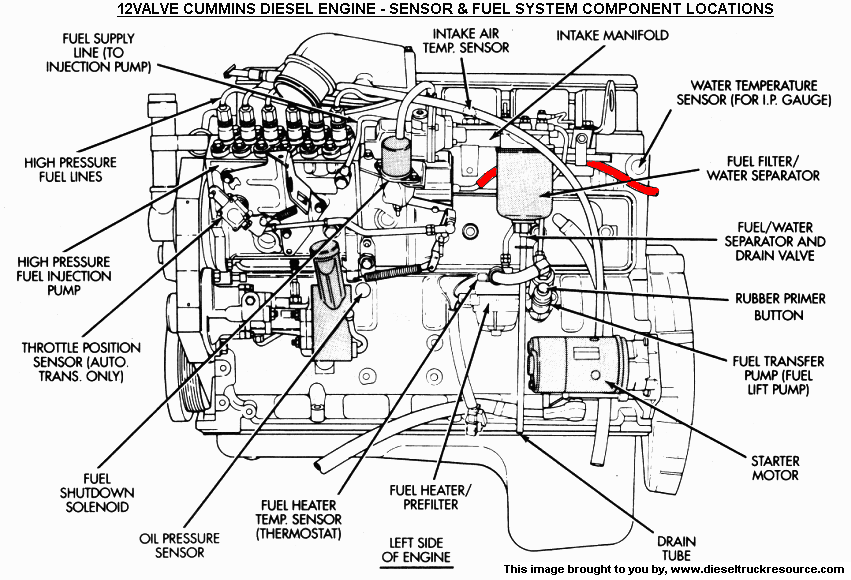
My fuel filter looks like an oil filter with a water sensor/drain on the bottom, the sensor as I'm sure you know illuminates a water warning light in the cab. I changed it soon after I bought the truck as it was leaking. I guess all my rig has is the block heater. I gotta say I love this truck, it's only just turned over to 150,000 miles, has no oil leaking on my driveway and everything works except the driver door electric lock....It makes like a spinning noise while the passenger door locks/unlocks immediately. Thanks again

Registered User
Joined: Jan 2012
Posts: 88
Likes: 0
From: Redding,Ca
1995.I bought it from my longtime bosses father Don and he gave me a huge reciept book with records of everything including even light bulb changes with the date and milage recorded on all reciepts. Don, my boss and I are aircraft techs but Don takes proper maintenance to another level He had the tranny overhauled and installed a ProLoc Multi Disc torque converter? 20 thou miles before I bought it. It has a larger fluid capacity tranny and differential, sway bars? on rear end, full gauges and a leather interior,the KDP and every Dodge service bulletin has been complied with.
The motor is still stock. Sorry but my knowledge of what I've tried to tell you is weak at best, I work on airplanes. What I do know is I paid a grand less for the truck than Don paid for the tranny work He gave me a great deal. P.S. I also got a full set of factory maintenance manuals with it!!! Sorry but you asked
He had the tranny overhauled and installed a ProLoc Multi Disc torque converter? 20 thou miles before I bought it. It has a larger fluid capacity tranny and differential, sway bars? on rear end, full gauges and a leather interior,the KDP and every Dodge service bulletin has been complied with.The motor is still stock. Sorry but my knowledge of what I've tried to tell you is weak at best, I work on airplanes. What I do know is I paid a grand less for the truck than Don paid for the tranny work
He gave me a great deal. P.S. I also got a full set of factory maintenance manuals with it!!! Sorry but you asked

Registered User
Joined: Jul 2006
Posts: 1,497
Likes: 23
From: SE Mass
My fuel filter looks like an oil filter with a water sensor/drain on the bottom, the sensor as I'm sure you know illuminates a water warning light in the cab. I changed it soon after I bought the truck as it was leaking. I guess all my rig has is the block heater. I gotta say I love this truck, it's only just turned over to 150,000 miles, has no oil leaking on my driveway and everything works except the driver door electric lock....It makes like a spinning noise while the passenger door locks/unlocks immediately. Thanks again
Thanks to infidel for the diagram!