


Replace Your Tired Engine Mounts


Thread Starter
1st Generation Admin
Joined: Jan 2005
Posts: 4,601
Likes: 118
From: Buies Creek, NC
 Replace Your Tired Engine Mounts
For the last month I've enjoyed being the only Dodge diesel running down at the local track whooping the ricers. Finally, a good fella showed up with a '91 that's stock other than W/M and some Ebay PODs that run quite hot.
He got me by a nose the first pass.
We lined up for the second pass and I launched hard. So much so that my heap jumped out of gear when it went to second. I've been on the bleeding edge of run-away all along. For a second or two, . . . . or three . . . . . . . .. . I thought this boy's gonna scatter! Then I though "Put it in gear dummy!"
  Whew!
Whew!
I took it straight home and sitting in the driveway, with the engine in gear, standing on the brakes, I built up 10 pounds of boost while watching the engine. Sure enough, I could see the engine lift up well to the passenger's side. Broke an engine mount.
Need to fix that.
As well as the FSM is written, I found it odd that when it comes to replacing the engine insulators (proper name), the book was a bit vague.
It starts with roughly: "Lift engine with special engine lift, then raise vehicle on lift so as to work from under the truck."
Yeah.
So this is what I did ~
As always ~ SAFETY FIRST!
- Chock the wheels very securely.
- Set emergency brake.
- Disconnect the Negative battery cable from the battery.
- Have a known good fire extinguisher within sight.
- Have a clean, uncluttered work area.
- Have good lighting.
- Considering you will be lifting/holding the engine with a jack be sure it's rated for the load with a good safety factor. Don't cut any corners here. When considering all this, don't forget to include a strong, level area to park the truck.
- With any work I do, I usually power wash everything the night before. If you don't have the means at home, the local car-wash works well. If you don't walk away soaking wet with gritty/grime on your face, you need to strike it again.
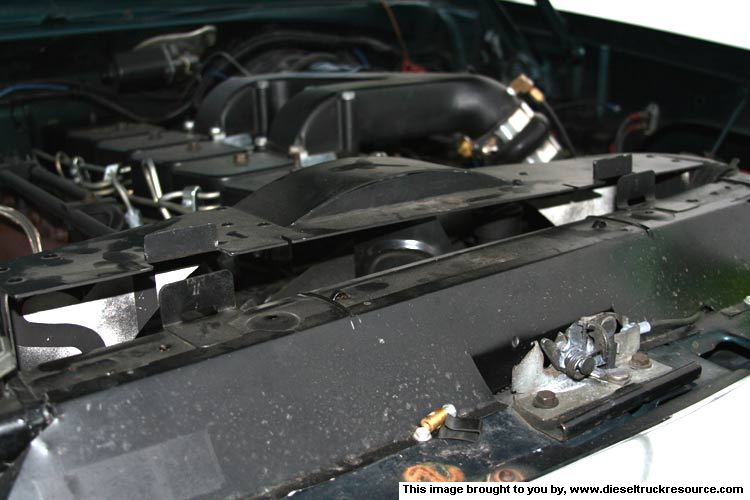
OK, I don't have a vehicle lift nor the special engine lift described in the FSM. According the the FSM, nothing really needs to be removed or disconnected to replace the insulators outside of unfastening the radiator's fan shroud so as to accommodate the engine as you lift it. OK, fine.
If this were a small-block Chevy, many would lift the engine by the oil pan using a floor-jack and a block of wood to spread the load. You will crush the CTD oil pan so don't think about that any further.
- Secure the truck so it can't roll any.
- Remove the fan shroud clips up top and lift the shroud out of the bottom clips and set it back on the fan.
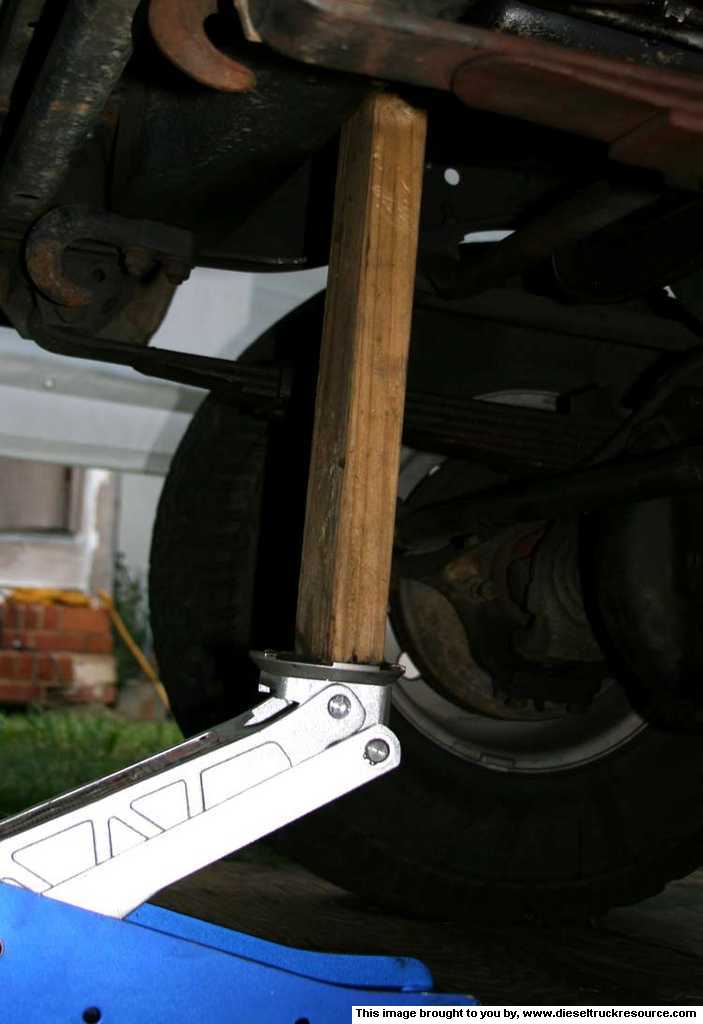
- Place a 16" or so length of sound 2x4 on the pad of a good floor-jack located directly under the crankshaft damper. ~
- Place the other end of the 2x4 on the flange of the oil pan just behind the damper. Lifting the engine here assures us that the load is taken by the timing cover which is much more substantial than the oil pan. ~
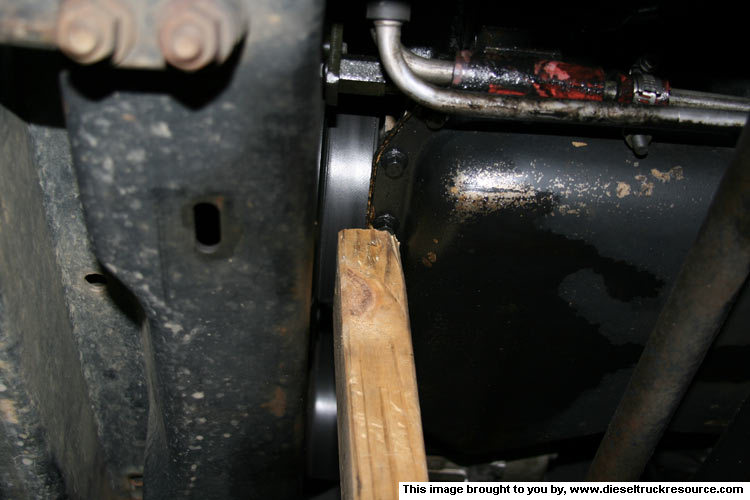
>> WARNING << Make sure the 2x4 is straight up and down when taking the load of the engine. We don't want the 2x4 slanted as it may very well shoot out from under the engine at any time. When positioning the jack, keep in mind that you may have to initially slant the 2x4 so that when you do lift the engine, the 2x4 will go straight up and down when the jack lifts.
Have some scrap 2x4's to place between the oil pan and frame cross-member to catch the engine should things go bad.
- Initially, raise the engine enough to remove it's weight from the mounts.
- Remove the nuts from the lower insulator studs.
The rubber insulator actually sits on the cross-member and has a bracket bolted to it's top. That bracket bolts to the engine block. Removing the bracket and insulator as a unit makes things much easier.
- With that, we need to remove the through-bolts. (Passenger side shown) ~

The FSM doesn't mention this but there's a slot in the frame cross-member directly under the engine mounts. ~
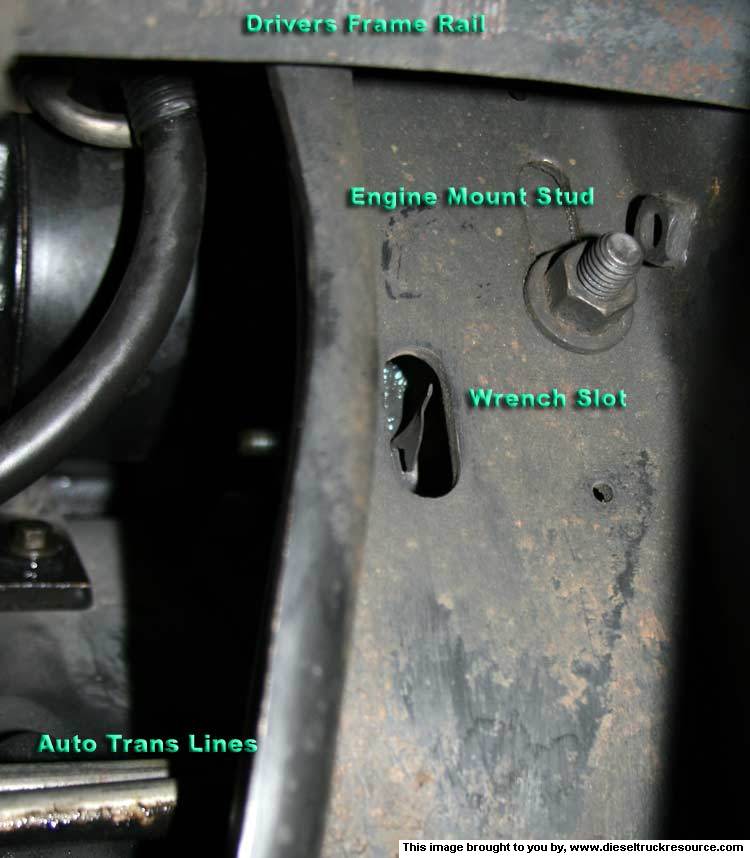
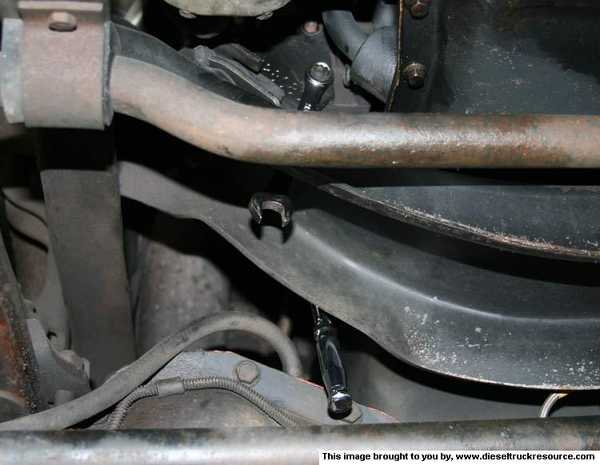
- A box-end wrench goes through the slot to hold the mount's through-bolt nuts. A socket with appropriate extensions turns the through-bolt. ~
He got me by a nose the first pass.
We lined up for the second pass and I launched hard. So much so that my heap jumped out of gear when it went to second. I've been on the bleeding edge of run-away all along. For a second or two, . . . . or three . . . . .
. . .. . I thought this boy's gonna scatter! Then I though "Put it in gear dummy!" Whew!I took it straight home and sitting in the driveway, with the engine in gear, standing on the brakes, I built up 10 pounds of boost while watching the engine. Sure enough, I could see the engine lift up well to the passenger's side. Broke an engine mount.
Need to fix that.
As well as the FSM is written, I found it odd that when it comes to replacing the engine insulators (proper name), the book was a bit vague.
It starts with roughly: "Lift engine with special engine lift, then raise vehicle on lift so as to work from under the truck."
Yeah.
So this is what I did ~
As always ~ SAFETY FIRST!
- Chock the wheels very securely.
- Set emergency brake.
- Disconnect the Negative battery cable from the battery.
- Have a known good fire extinguisher within sight.
- Have a clean, uncluttered work area.
- Have good lighting.
- Considering you will be lifting/holding the engine with a jack be sure it's rated for the load with a good safety factor. Don't cut any corners here. When considering all this, don't forget to include a strong, level area to park the truck.
- With any work I do, I usually power wash everything the night before. If you don't have the means at home, the local car-wash works well. If you don't walk away soaking wet with gritty/grime on your face, you need to strike it again.
OK, I don't have a vehicle lift nor the special engine lift described in the FSM. According the the FSM, nothing really needs to be removed or disconnected to replace the insulators outside of unfastening the radiator's fan shroud so as to accommodate the engine as you lift it. OK, fine.
If this were a small-block Chevy, many would lift the engine by the oil pan using a floor-jack and a block of wood to spread the load. You will crush the CTD oil pan so don't think about that any further.
- Secure the truck so it can't roll any.
- Remove the fan shroud clips up top and lift the shroud out of the bottom clips and set it back on the fan.
- Place a 16" or so length of sound 2x4 on the pad of a good floor-jack located directly under the crankshaft damper. ~
- Place the other end of the 2x4 on the flange of the oil pan just behind the damper. Lifting the engine here assures us that the load is taken by the timing cover which is much more substantial than the oil pan. ~
>> WARNING << Make sure the 2x4 is straight up and down when taking the load of the engine. We don't want the 2x4 slanted as it may very well shoot out from under the engine at any time. When positioning the jack, keep in mind that you may have to initially slant the 2x4 so that when you do lift the engine, the 2x4 will go straight up and down when the jack lifts.
Have some scrap 2x4's to place between the oil pan and frame cross-member to catch the engine should things go bad.
- Initially, raise the engine enough to remove it's weight from the mounts.
- Remove the nuts from the lower insulator studs.
The rubber insulator actually sits on the cross-member and has a bracket bolted to it's top. That bracket bolts to the engine block. Removing the bracket and insulator as a unit makes things much easier.
- With that, we need to remove the through-bolts. (Passenger side shown) ~
The FSM doesn't mention this but there's a slot in the frame cross-member directly under the engine mounts. ~
- A box-end wrench goes through the slot to hold the mount's through-bolt nuts. A socket with appropriate extensions turns the through-bolt. ~
Thread Starter
1st Generation Admin
Joined: Jan 2005
Posts: 4,601
Likes: 118
From: Buies Creek, NC
Make sure you keep the blocks of wood between the pan and cross-member while you're removing the mounts. You don't want to be jerking too hard on things and have the engine come down on you, so be careful.
Expect to have to mess with it some to get the blame things out. Know where your fingers are all the time!
I had to lift the engine almost four inches to make room! ~
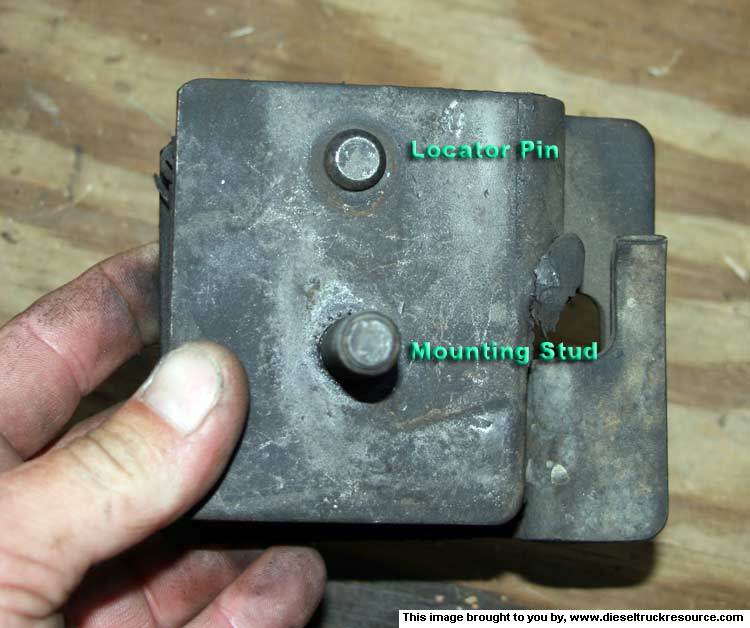
- Though I don't know that it's critical, keep up with which way the old insulators are oriented when removing so as to put things back like you found them. There's a locating pin to keep the insulators straight to the bracket and cross-member. ~
Oops! ~
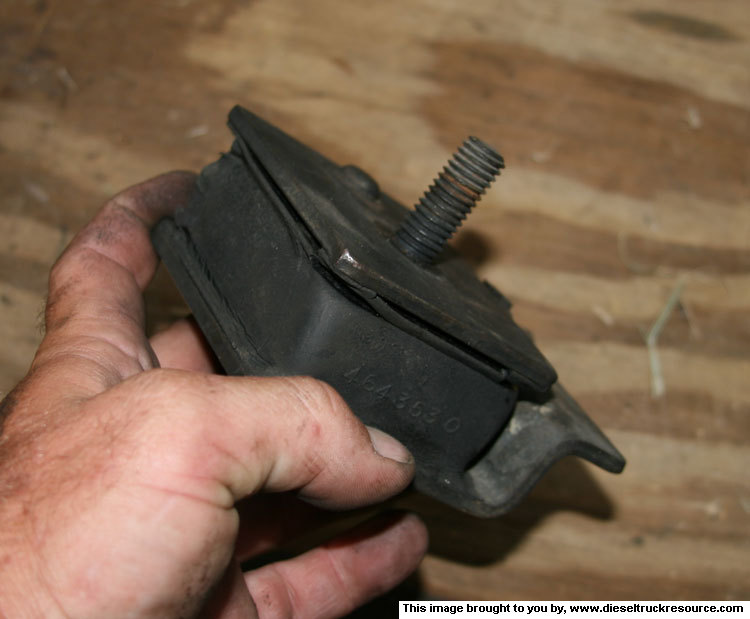
- Assembly is pretty-much the reverse of the above. Torque the through-bolts to 44ft/lbs and the insulator nuts to 80ft/lbs.
NOTE: Not all insulators are the same in quality (Click on the blue arrow next to mhuppertz's name to go to his thread for the part numbers) ~
I hope this helps those pondering this repair.
Expect to have to mess with it some to get the blame things out. Know where your fingers are all the time!
I had to lift the engine almost four inches to make room! ~
- Though I don't know that it's critical, keep up with which way the old insulators are oriented when removing so as to put things back like you found them. There's a locating pin to keep the insulators straight to the bracket and cross-member. ~
Oops! ~
- Assembly is pretty-much the reverse of the above. Torque the through-bolts to 44ft/lbs and the insulator nuts to 80ft/lbs.
NOTE: Not all insulators are the same in quality (Click on the blue arrow next to mhuppertz's name to go to his thread for the part numbers) ~

I hope this helps those pondering this repair.


Trending Topics


Adminstrator-ess

Joined: Mar 2003
Posts: 22,594
Likes: 19
From: New Holland, PA

Registered User
Joined: Sep 2011
Posts: 30
Likes: 0
I'm thinking my mopunts need a thorough check as I have been noticing under tough pull at low speed; ie. pulling my 5th wheeler up a steep grade in a campground caused it to jump out of gear as well; thinking the engine rolled and bumped the shift linkages into neutral positioning allowing the engine to rev and a louder bang as this occurred; it also happened lifting the trailer/truck from a stop light on a steep grade in a town about 2 weeks earlier; haven't had opportunity to check it out but cetainly will; thanks for the parts sourcing as well!
p.s. - the only issue and change I might consider is to use a metal plate or piece of 1/4" x 3" x 3" angle iron either clamped or bolted flat to the floor jack's plate and using its edge to contact the oil pan rail, only, which supports the wweight of the engine directly thru the engine block rather than the timing cover as Cummins are known to have front engine timing cover leakage problems without placing a lifting force on them; just something to consider, otherwise great writeup!
p.s. - the only issue and change I might consider is to use a metal plate or piece of 1/4" x 3" x 3" angle iron either clamped or bolted flat to the floor jack's plate and using its edge to contact the oil pan rail, only, which supports the wweight of the engine directly thru the engine block rather than the timing cover as Cummins are known to have front engine timing cover leakage problems without placing a lifting force on them; just something to consider, otherwise great writeup!

Registered User
Joined: May 2010
Posts: 531
Likes: 1
hey-Hey!!!,
Since when does the timing cover have the first main bearing in it? It looks like the lifting force applied to the damper will go to that first bearing in the block. It will try to bend the crank a bit, but it is a short lever and the crank is plenty stout( likely forged 4340 ).
Cheers,
Douglas
Since when does the timing cover have the first main bearing in it? It looks like the lifting force applied to the damper will go to that first bearing in the block. It will try to bend the crank a bit, but it is a short lever and the crank is plenty stout( likely forged 4340 ).
Cheers,
Douglas
Registered User
Joined: Sep 2011
Posts: 30
Likes: 0
Hey Man!! sorry for any confusion. I didn't state the timing cover has the first or any main bearings in it. I'm not certain where u R gettin' this from??, all intentions were to keep force off of the timing cover itself , as it is not all that stout, and Cummins has had some oil leakage difficuly @ the covers so why chance further problems with undue force being applied to it when you can concentrate the lifting force into the pan rail bolt(s) and thus directly into the cylinder block; also in your reply you mention the lifting force applied to the damper; this unit is very delecate and meant to take the twisting forces out of the crank; by its internal design you are chancing damage to the operation of this unit and then your "likely forged 4340" crankshaft will break in 2 at a main bearing contact area; only trying to be helpful.
I'm a seasoned diesel mechanic of 30+ years; licensed and worked in the automotive, heavy duty, and truck/coach fields. Just trying to promote proper procedure thereby avoiding anyone very costly repairs; so take this info as you will; cheers.............happy motoring
I'm a seasoned diesel mechanic of 30+ years; licensed and worked in the automotive, heavy duty, and truck/coach fields. Just trying to promote proper procedure thereby avoiding anyone very costly repairs; so take this info as you will; cheers.............happy motoring