


Help! Brakes are down!


Registered User
Joined: Mar 2010
Posts: 789
Likes: 0
Nobody mentioned the mysterious "no brakes at random"!
I've read it here and experienced it on my truck, mostly after a multiple point turn. The next braking attempt after said turning, leads to a pedal on the floor and NO brakes at all followed by a dire need to clean your underwear, at best.
I've yet to find a fix for this. My thought was the vacuum pump but it was showing like 27 or 29 inches of vacuum.
I've read it here and experienced it on my truck, mostly after a multiple point turn. The next braking attempt after said turning, leads to a pedal on the floor and NO brakes at all followed by a dire need to clean your underwear, at best.
I've yet to find a fix for this. My thought was the vacuum pump but it was showing like 27 or 29 inches of vacuum.

Registered User
Joined: Mar 2013
Posts: 320
Likes: 0
From: Tx
I had one of the ole rides back in 94, it was a 93 5sp. And I drove a few of them and was never impressed with the brakes. I just bought a 92 a few days back and the brakes need attention after I figure out why it had a miss. If mine becomes a money pit on the brakes it will get a hydrovac setup. I have a 73 dually 454 that my uncle bought new. Never had a brake problem other than stuff wearing out but the hyd. Part has never had anything done to it. Brakes are brakes but dodge has demons or gremlins built into them lol. It seems like they spent good money to make you work and think extra hard to get them to work correctly. Fantastic ole trucks, fun ole trucks, addictive ole trucks, but they will make you think rethink then cuss alot and ask yourself why you bought such a ride. But gotta love em they keep old men like me from going brain dead.

Thread Starter
Registered User
Joined: Feb 2012
Posts: 124
Likes: 2
From: Salem, Virginia
Well I started working at 8:15 and worked till 12:15, took a lunch/errand break and I am about to go back at it again. Bleeding the brakes is taking forever! I've been getting air out of it since I started bleeding them at 10:00. I should be finished with it in the next few hours. It takes quite a bit longer to do this by yourself.
Thread Starter
Registered User
Joined: Feb 2012
Posts: 124
Likes: 2
From: Salem, Virginia
I had to give up for the evening. I'm still getting air out of the system. This is turning out to be a terribly long process. Also, a friend of mine who was trying to help rounded off the d.s. bleed screw. Thars the last time I'm letting anyone try to bleed my brakes.

DTR's Night Watchman & Poet Laureate
Joined: Jun 2004
Posts: 2,156
Likes: 1
From: Lyndon KS
OK, without being there, I am hesitant to say your not doing it right, but it should NOT take 6-7 hours to bleed your brakes .... you could flush the whole system in that time, probably more than once!
Either you arent getting a good seal around the bleeder and are sucking air back in, or more likely, you have a major air leak in the system somewhere.
Id suggest closing everything up,clean any and all brake fluid off the bleeders and such, filling the reservoirs and pumping pressure into the system, then start very carefully looking for leaks. Dont forget to check the wheel cylinders and calipers as well
Something just aint right....
Either you arent getting a good seal around the bleeder and are sucking air back in, or more likely, you have a major air leak in the system somewhere.
Id suggest closing everything up,clean any and all brake fluid off the bleeders and such, filling the reservoirs and pumping pressure into the system, then start very carefully looking for leaks. Dont forget to check the wheel cylinders and calipers as well
Something just aint right....

Registered User
Joined: Nov 2011
Posts: 4,479
Likes: 211
From: Isanti, MN
OK, without being there, I am hesitant to say your not doing it right, but it should NOT take 6-7 hours to bleed your brakes .... you could flush the whole system in that time, probably more than once!
Either you arent getting a good seal around the bleeder and are sucking air back in, or more likely, you have a major air leak in the system somewhere.
Id suggest closing everything up,clean any and all brake fluid off the bleeders and such, filling the reservoirs and pumping pressure into the system, then start very carefully looking for leaks. Dont forget to check the wheel cylinders and calipers as well
Something just aint right....
Either you arent getting a good seal around the bleeder and are sucking air back in, or more likely, you have a major air leak in the system somewhere.
Id suggest closing everything up,clean any and all brake fluid off the bleeders and such, filling the reservoirs and pumping pressure into the system, then start very carefully looking for leaks. Dont forget to check the wheel cylinders and calipers as well
Something just aint right....

Registered User


Joined: Dec 2010
Posts: 6,838
Likes: 1,683
From: Land of the Toxic Avenger
I've mentioned this in other threads on this exact same problem. You have air entering the system through a connection, or at the bleeders. Retighten all of your connections and start over .
#1. You need someone to pump the brakes and hold them, while the truck is running. Don't waste your time otherwise.... although it sounds like you're already doing that. If the proportioning valve is in the wrong position, you can't get it to move back where it needs to be by bleeding the system by yourself. It takes someone pushing the pedal and pumping it to realign the prop valve in the right orientation to allow fluid to go to both front and rear of the truck's braking system. It's "self aligning" when manually bleeding the system with 2 persons, one in the truck pumping, and the other outside bleeding. Do NOT overpressure the pedal. Gentle pedal pressure is all you need. Excessive foot pressure on the pedal can tear the seals in the master if it goes to the floor too often.
#2. The front calipers are NOT the issue for air, unless you've changed the hoses and haven't tightened the banjo bolt down hard enough. If it's not tight enough, or the copper washer (new) hasn't enbedded itself correctly, you'll get air in the caliper at the junction. Been there, done that. I would check the tightness of the banjo bolts again to make sure no air is bypassing. You know you have it when your bleeding them, and the recovery tube has no bubbles being let into the fluid of the tube held vertical above the caliper. The fluid acts as a seal to prevent back sucking of air.
#3. When you crack the bleeders on the Calipers, wheel cylinders and the ABS Valve, DO NOT OPEN THEM UP MORE THAN A SMIDGE ....otherwise, air bypasses around the screw, and you let more air into the system. Some suggest using a heavy grease on the backside of the screw to prevent this, but I've never done it that way, nor will I start, as I'd get grease sucked into the system...
#4. Utilize the recovery can & tube to ensure that any back-sucking into the end of the bleeder is covered by clean new brake fluid in the tube, and not the atmosphere of an open bleeder.
#5. I'll repeat this one more time..... WHen cracking a bleeder, open it barely enough to let fluid out, then shut it fast. You don't need to open it more than barely enough for it to let fluid out.
#1. You need someone to pump the brakes and hold them, while the truck is running. Don't waste your time otherwise.... although it sounds like you're already doing that. If the proportioning valve is in the wrong position, you can't get it to move back where it needs to be by bleeding the system by yourself. It takes someone pushing the pedal and pumping it to realign the prop valve in the right orientation to allow fluid to go to both front and rear of the truck's braking system. It's "self aligning" when manually bleeding the system with 2 persons, one in the truck pumping, and the other outside bleeding. Do NOT overpressure the pedal. Gentle pedal pressure is all you need. Excessive foot pressure on the pedal can tear the seals in the master if it goes to the floor too often.
#2. The front calipers are NOT the issue for air, unless you've changed the hoses and haven't tightened the banjo bolt down hard enough. If it's not tight enough, or the copper washer (new) hasn't enbedded itself correctly, you'll get air in the caliper at the junction. Been there, done that. I would check the tightness of the banjo bolts again to make sure no air is bypassing. You know you have it when your bleeding them, and the recovery tube has no bubbles being let into the fluid of the tube held vertical above the caliper. The fluid acts as a seal to prevent back sucking of air.
#3. When you crack the bleeders on the Calipers, wheel cylinders and the ABS Valve, DO NOT OPEN THEM UP MORE THAN A SMIDGE ....otherwise, air bypasses around the screw, and you let more air into the system. Some suggest using a heavy grease on the backside of the screw to prevent this, but I've never done it that way, nor will I start, as I'd get grease sucked into the system...
#4. Utilize the recovery can & tube to ensure that any back-sucking into the end of the bleeder is covered by clean new brake fluid in the tube, and not the atmosphere of an open bleeder.
#5. I'll repeat this one more time..... WHen cracking a bleeder, open it barely enough to let fluid out, then shut it fast. You don't need to open it more than barely enough for it to let fluid out.

Registered User
Joined: Jul 2010
Posts: 131
Likes: 0
From: Napa, CA
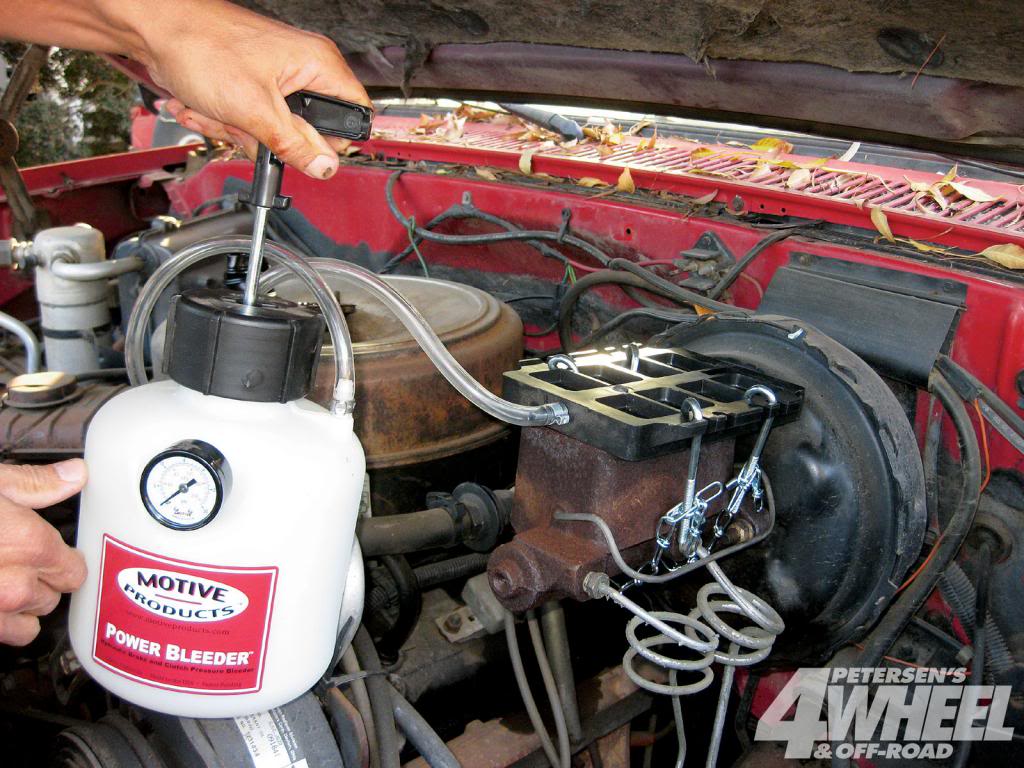
Sounds like the OP might have an issue (and a LOT of paitence!!), but if using a vacuum bleeder it will look like air is coming out but it's just air entering at the bleeder screw or hose. I recently purchased a power bleeder from Motive Products, it's the greatest addition to my tool collection in years. I love perfect brakes and now I have them thanks in part to this (and new shoes/drums in back). As stated before, a good firm pedal is 90% related to the condition/adjustment of the rear brakes. As far as adapting the power bleeder to my truck, I bought the adapter plate shown in the image (mine is anodized aluminum) and held it in place with a C clamp rather than the chains/blots shown. It's a beautiful way to bleed air out or exchange fluid.

Administrator
Joined: Jul 2009
Posts: 5,311
Likes: 566
From: Phoenix AZ
I've mentioned this in other threads on this exact same problem. You have air entering the system through a connection, or at the bleeders. Retighten all of your connections and start over .
#1. You need someone to pump the brakes and hold them, while the truck is running. Don't waste your time otherwise.... although it sounds like you're already doing that. If the proportioning valve is in the wrong position, you can't get it to move back where it needs to be by bleeding the system by yourself. It takes someone pushing the pedal and pumping it to realign the prop valve in the right orientation to allow fluid to go to both front and rear of the truck's braking system. It's "self aligning" when manually bleeding the system with 2 persons, one in the truck pumping, and the other outside bleeding. Do NOT overpressure the pedal. Gentle pedal pressure is all you need. Excessive foot pressure on the pedal can tear the seals in the master if it goes to the floor too often.
#2. The front calipers are NOT the issue for air, unless you've changed the hoses and haven't tightened the banjo bolt down hard enough. If it's not tight enough, or the copper washer (new) hasn't enbedded itself correctly, you'll get air in the caliper at the junction. Been there, done that. I would check the tightness of the banjo bolts again to make sure no air is bypassing. You know you have it when your bleeding them, and the recovery tube has no bubbles being let into the fluid of the tube held vertical above the caliper. The fluid acts as a seal to prevent back sucking of air.
#3. When you crack the bleeders on the Calipers, wheel cylinders and the ABS Valve, DO NOT OPEN THEM UP MORE THAN A SMIDGE ....otherwise, air bypasses around the screw, and you let more air into the system. Some suggest using a heavy grease on the backside of the screw to prevent this, but I've never done it that way, nor will I start, as I'd get grease sucked into the system...
#4. Utilize the recovery can & tube to ensure that any back-sucking into the end of the bleeder is covered by clean new brake fluid in the tube, and not the atmosphere of an open bleeder.
#5. I'll repeat this one more time..... WHen cracking a bleeder, open it barely enough to let fluid out, then shut it fast. You don't need to open it more than barely enough for it to let fluid out.
#1. You need someone to pump the brakes and hold them, while the truck is running. Don't waste your time otherwise.... although it sounds like you're already doing that. If the proportioning valve is in the wrong position, you can't get it to move back where it needs to be by bleeding the system by yourself. It takes someone pushing the pedal and pumping it to realign the prop valve in the right orientation to allow fluid to go to both front and rear of the truck's braking system. It's "self aligning" when manually bleeding the system with 2 persons, one in the truck pumping, and the other outside bleeding. Do NOT overpressure the pedal. Gentle pedal pressure is all you need. Excessive foot pressure on the pedal can tear the seals in the master if it goes to the floor too often.
#2. The front calipers are NOT the issue for air, unless you've changed the hoses and haven't tightened the banjo bolt down hard enough. If it's not tight enough, or the copper washer (new) hasn't enbedded itself correctly, you'll get air in the caliper at the junction. Been there, done that. I would check the tightness of the banjo bolts again to make sure no air is bypassing. You know you have it when your bleeding them, and the recovery tube has no bubbles being let into the fluid of the tube held vertical above the caliper. The fluid acts as a seal to prevent back sucking of air.
#3. When you crack the bleeders on the Calipers, wheel cylinders and the ABS Valve, DO NOT OPEN THEM UP MORE THAN A SMIDGE ....otherwise, air bypasses around the screw, and you let more air into the system. Some suggest using a heavy grease on the backside of the screw to prevent this, but I've never done it that way, nor will I start, as I'd get grease sucked into the system...
#4. Utilize the recovery can & tube to ensure that any back-sucking into the end of the bleeder is covered by clean new brake fluid in the tube, and not the atmosphere of an open bleeder.
#5. I'll repeat this one more time..... WHen cracking a bleeder, open it barely enough to let fluid out, then shut it fast. You don't need to open it more than barely enough for it to let fluid out.
 ...Mark
Thread Starter
Registered User
Joined: Feb 2012
Posts: 124
Likes: 2
From: Salem, Virginia
I'm about to reach the end of my knowledge and patience when it comes to these brakes. If I can't get this done today, then I'm taking it to a mechanic and I'm gonna let him mess with it. i really think part of my issue is not being able able to bleed the d.s. front with the bleeder screw thanks to a friend of mine rounding it off. What is the correct order with these trucks? Rwal, passenger side rear, d.s, rear, p.s. front and d.s. front? My rear brakes are adjusted tight, I've been using the recovery can and tube. Any advice would be appreciated.
Administrator
Joined: Jul 2009
Posts: 5,311
Likes: 566
From: Phoenix AZ
I'm about to reach the end of my knowledge and patience when it comes to these brakes. If I can't get this done today, then I'm taking it to a mechanic and I'm gonna let him mess with it. i really think part of my issue is not being able able to bleed the d.s. front with the bleeder screw thanks to a friend of mine rounding it off. What is the correct order with these trucks? Rwal, passenger side rear, d.s, rear, p.s. front and d.s. front? My rear brakes are adjusted tight, I've been using the recovery can and tube. Any advice would be appreciated.

Registered User
Joined: May 2003
Posts: 332
Likes: 0
From: Edmonton Alberta, Canada
To remove the rwal bleeder screw you can:
Repeatedly heat the bleeder to red hot and quench it with a water soaked rag. Just doing this a number of times gets some loose.
File opposite sides of the bleeder till you get two surfaces a newish pair of vice grips can get hold of and turn.
Gently tap the bleeder between heatings. Use a small hammer. Tap sideways. The Rwal bleeder is steel and will soften if not quenched after heating.
Repeat these things and it will eventually come loose. Keep a fire extinguisher handy just in case you start a little fire.
Good luck. If you are unsure check utube for bleeder removal techniques.
Repeatedly heat the bleeder to red hot and quench it with a water soaked rag. Just doing this a number of times gets some loose.
File opposite sides of the bleeder till you get two surfaces a newish pair of vice grips can get hold of and turn.
Gently tap the bleeder between heatings. Use a small hammer. Tap sideways. The Rwal bleeder is steel and will soften if not quenched after heating.
Repeat these things and it will eventually come loose. Keep a fire extinguisher handy just in case you start a little fire.
Good luck. If you are unsure check utube for bleeder removal techniques.
Registered User
Joined: Dec 2010
Posts: 6,838
Likes: 1,683
From: Land of the Toxic Avenger
I'm about to reach the end of my knowledge and patience when it comes to these brakes. If I can't get this done today, then I'm taking it to a mechanic and I'm gonna let him mess with it. i really think part of my issue is not being able able to bleed the d.s. front with the bleeder screw thanks to a friend of mine rounding it off. What is the correct order with these trucks? Rwal, passenger side rear, d.s, rear, p.s. front and d.s. front? My rear brakes are adjusted tight, I've been using the recovery can and tube. Any advice would be appreciated.
BTW. When you bleed the brakes, the truck has to be running.
If you lived closer, I'd come there and help you get it done........ but the 8 hour drive would be a real pita.
When you bleed with the recovery tube, are you orientating the tube upwards towards the sky so you can see the fluid fill the tube? The tube should be long enough so you can arc the tube northwards, and then back down to the ground into the container. The "upwards side" should stay filled with fluid, while the downward side drains off into the container. This assures you that you can "see " or not "see" bubbles in the tube.
IIRC, the bleeders are wrenched with a 10mm on the calipers and 8MM on the wheel cylinders.
Thread Starter
Registered User
Joined: Feb 2012
Posts: 124
Likes: 2
From: Salem, Virginia
Im going to take the bleeder out tomorrow . I had errands to run and what not so I couldn't do to much today. I'm going to try the file method first, if that doesn't work, ill pull out the torches. I tried a pipe wrench and then some vice grips earlier today, it's in there and it wasn't budging. I did bleed the brakes while it was running. T, I appreciate the offer! But I'm sure I can get it done! I've never had this many problem with brakes, and I've done several brake jobs. I appreciate everyone's advice! Y'all have been extremely helpful!