


Blowby tester - Lowes style...


Thread Starter
Registered User
Joined: Mar 2005
Posts: 2,615
Likes: 0
From: Nevada
Blowby tester - Lowes style...
I give full credit to Bill (Infidel) for the homemade u-tube manometer idea (open-ended). It's kinda hard to visualize what it really is through text only, so I thought I'd share how I made mine for anyone else who wants to make one.
Size of clear tubing doesn't matter, amount of water in the tube doesn't matter (as long as enough remains in both sides of the "U" under pressure). This one is about 5 feet tall, but you can make it 3 feet tall or so as well. Before starting you have to plug the crankcase breather hose on the bottom of the truck with a 1/2" nipple and cap with a 15/64" hold drilled in it.
Then fill the manometer with water about halfway and hook it up to your oil dipstick tube and run the engine at 2.2k, 2.5k, and 2.8k rpms. Measure how many inches the water moved up in the left column. You can also buy a manometer gauge but this homemade one is very accurate! With water in there it's accurate to 1/100th of a psi (not that you need it that accurate for testing blowby).
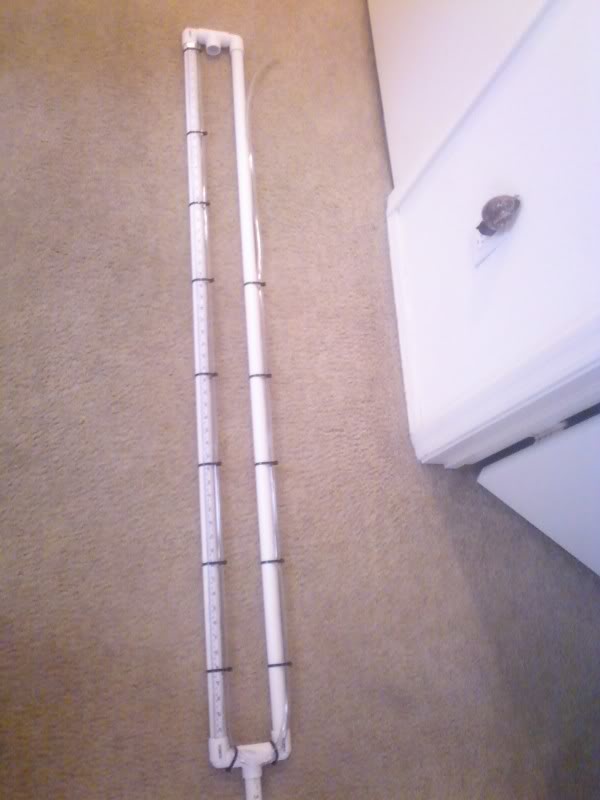

10' - 3/8" I.D. clear PVC hose
10' - 3/4" PVC pipe cut in half w/ bends, etc.
Flexible measuring tape for sewing/crafts
Glue
Zip ties
1/2" brass nipple
1/2" brass cap
Cost about $10 for the manometer, and about $7 for the brass nipple/cap. Total under $20 from Lowes.
Crankcase pressure is not very high (less than 1 psi) so water works well for this, but for higher pressure applications you can use a denser fluid like 2-stroke oil, vegetable oil, or mercury (not recommended).
Keep in mind that if you live at higher elevations, your numbers will be skewed, but it shouldn't matter. If you're engine is toast, you'll know... lol.
Physics behind it all...
(P - Po) = pgh
(P - Po) = Pressure difference (crankcase vs. atmosphere)
p = Rho (density) (water = 1 kg/L)
g = Gravity constant (9.81 m/s/s)
h = Height difference between water levels in tube
http://www.efunda.com/formulae/fluid...meter.cfm#calc
Enjoy!
The following has been copied from Infidel's previous posts on this board:
You need a blowby tool.
The Cummins blowby orifice tool is simply a tee with one .221" (15/64-in) outlet. Connect one end of the tee to the end of the blowby tube. Put a manometer on last tee outlet. That is your blowby tool. They sell them at the Cummins, but I have made my own plenty of times, less than $10. A simple manometer can be made by looping into a 'U' 6 feet of clear tubing with water in it half way. Measure how high the water level rises with a tape measure, multiply it by 2, convert it to LPMs.
Rough conversion is 1"= 27 lpm, add 3 lpm for each one inch (1/2'' of rise in the tube) of water
The reason for multiplying by 2 is that inches of water equals the water rise in the open end of the tube plus the inches the water is pushed down on the engine side of the water tube. For simplicity my numbers below are the measurement of rise only.
Cummins new 5.9 engine numbers are:
63 liters per minute(2.5" water rise) @ 2200rpm,
76 L/Min (3.5" rise) @ 2500rpm
85 L/Min (4.5" rise) @ 2800rpm.
Worn engine that needs rebuilding are roughly double i.e.
126 L/Min(10.5"rise) @ 2200rpm
152 L/Min(14.5"rise) @ 2500rpm
170 L/Min(17"rise) @ 2800 rpm
Beside indicating a compression problem the valves could also be out of adjustment.
Another way (mine), same idea, is to block the blowby tube with a 1/2'' pipe nipple with a cap that has a 15/64 hole drilled in it. Use 3/8'' id looped clear tubing with water in it slipped over the oil dipstick tube. Other tubing end remains open. Use a sharp tipped felt marker to mark the water level with the engine off, have a helper start an already warmed up engine and run the rpms up to 2.2, 2.5 & 2.8k rpms. Mark each water level with the pen, measure the distance from engine off mark then multiply each by 2.
Size of clear tubing doesn't matter, amount of water in the tube doesn't matter (as long as enough remains in both sides of the "U" under pressure). This one is about 5 feet tall, but you can make it 3 feet tall or so as well. Before starting you have to plug the crankcase breather hose on the bottom of the truck with a 1/2" nipple and cap with a 15/64" hold drilled in it.
Then fill the manometer with water about halfway and hook it up to your oil dipstick tube and run the engine at 2.2k, 2.5k, and 2.8k rpms. Measure how many inches the water moved up in the left column. You can also buy a manometer gauge but this homemade one is very accurate! With water in there it's accurate to 1/100th of a psi (not that you need it that accurate for testing blowby).
10' - 3/8" I.D. clear PVC hose
10' - 3/4" PVC pipe cut in half w/ bends, etc.
Flexible measuring tape for sewing/crafts
Glue
Zip ties
1/2" brass nipple
1/2" brass cap
Cost about $10 for the manometer, and about $7 for the brass nipple/cap. Total under $20 from Lowes.
Crankcase pressure is not very high (less than 1 psi) so water works well for this, but for higher pressure applications you can use a denser fluid like 2-stroke oil, vegetable oil, or mercury (not recommended).
Keep in mind that if you live at higher elevations, your numbers will be skewed, but it shouldn't matter. If you're engine is toast, you'll know... lol.
Physics behind it all...
(P - Po) = pgh
(P - Po) = Pressure difference (crankcase vs. atmosphere)
p = Rho (density) (water = 1 kg/L)
g = Gravity constant (9.81 m/s/s)
h = Height difference between water levels in tube
http://www.efunda.com/formulae/fluid...meter.cfm#calc
Enjoy!
The following has been copied from Infidel's previous posts on this board:
You need a blowby tool.
The Cummins blowby orifice tool is simply a tee with one .221" (15/64-in) outlet. Connect one end of the tee to the end of the blowby tube. Put a manometer on last tee outlet. That is your blowby tool. They sell them at the Cummins, but I have made my own plenty of times, less than $10. A simple manometer can be made by looping into a 'U' 6 feet of clear tubing with water in it half way. Measure how high the water level rises with a tape measure, multiply it by 2, convert it to LPMs.
Rough conversion is 1"= 27 lpm, add 3 lpm for each one inch (1/2'' of rise in the tube) of water
The reason for multiplying by 2 is that inches of water equals the water rise in the open end of the tube plus the inches the water is pushed down on the engine side of the water tube. For simplicity my numbers below are the measurement of rise only.
Cummins new 5.9 engine numbers are:
63 liters per minute(2.5" water rise) @ 2200rpm,
76 L/Min (3.5" rise) @ 2500rpm
85 L/Min (4.5" rise) @ 2800rpm.
Worn engine that needs rebuilding are roughly double i.e.
126 L/Min(10.5"rise) @ 2200rpm
152 L/Min(14.5"rise) @ 2500rpm
170 L/Min(17"rise) @ 2800 rpm
Beside indicating a compression problem the valves could also be out of adjustment.
Another way (mine), same idea, is to block the blowby tube with a 1/2'' pipe nipple with a cap that has a 15/64 hole drilled in it. Use 3/8'' id looped clear tubing with water in it slipped over the oil dipstick tube. Other tubing end remains open. Use a sharp tipped felt marker to mark the water level with the engine off, have a helper start an already warmed up engine and run the rpms up to 2.2, 2.5 & 2.8k rpms. Mark each water level with the pen, measure the distance from engine off mark then multiply each by 2.


Registered User
Joined: Dec 2003
Posts: 14,672
Likes: 9
From: Montana
Rather than PVC pipe for a frame my manometer has the clear tubing attached to a 1x4 with cable staples like you use for Romex wire.
Many people don't use a frame at all and just attach the open end of the clear tubing to the radiator overflow hose with a clothes pin.
Many people don't use a frame at all and just attach the open end of the clear tubing to the radiator overflow hose with a clothes pin.

Thread
Thread Starter
Forum
Replies
Last Post
04ctd
Other
2
Sep 26, 2013 11:05 PM