


To box or not to box frame??


Registered User
Joined: Nov 2011
Posts: 4,479
Likes: 211
From: Isanti, MN
You've lost me on the last part. Boxing isn't really doing anything to the horizontal sections. It adds a second vertical section. How would boxing affect the fastening? You would just move the fastening from any of the horizontal section to an angled bracket fastened to the vertical. Maybe I'm not following. Care to elaborate? Thanks.

Registered User


Joined: Sep 2004
Posts: 4,053
Likes: 135
From: Tijeras, New Mexico, 7,000ft up

Registered User
Joined: Jan 2013
Posts: 138
Likes: 10
Yeah, I wasn't trying to be rude there. I was simply curious about the fastening comment. I agree fishplating is the way to section any length of frame whether you are changing the length or including boxing plates. I know as far as anything attached to the top flange, our beds are, but the cab mounts, and suspension components are on the vertical surface. The only other flange mount items are crossmembers, which I plan to replace with either welded tubing of some sort, or make a removable x member that bolts to a threaded gusseted section that I box the frame with.

Registered User
Joined: Feb 2010
Posts: 1,635
Likes: 59
From: New York
I would leave it alone.. there are guys here that drive C chevy's and the old Dodge trucks. Thirty years later and there is hardly nothing wrong with them. I just did service on a 2010 ford, the frame is gone. Salt/calcium must have been inside the frame and accelerated the corrosion process. When the owner arrived he poked his finger through it. Called ford and they do not cover the frame under warranty.
That happen because there really was no way out for salt/calc to go.
That happen because there really was no way out for salt/calc to go.
Registered User
Joined: Feb 2010
Posts: 1,635
Likes: 59
From: New York
Indeed. The only way I know around it if you live in a salt belt. Buy a used honda and don't drive. The green internal frame sealer eastwood has is good stuff though... or fluid film the heck out of it.

Registered User
Joined: Dec 2008
Posts: 45
Likes: 0
Yes. It can be done. But do not box the entire frame. You need some flex.
On the W350 long box I did not want the tq from the compounds to twist my frame, nor did I want the weakest section (over the rear axle) to collapse so I did a sectional box. Example:
Your pre weld shot:


If you look closely on the inner top edge of the frame rail you will see the weld marks from the 6" wide plates that went in every 16" or so. Hard to see but I did not want them THAT visible.
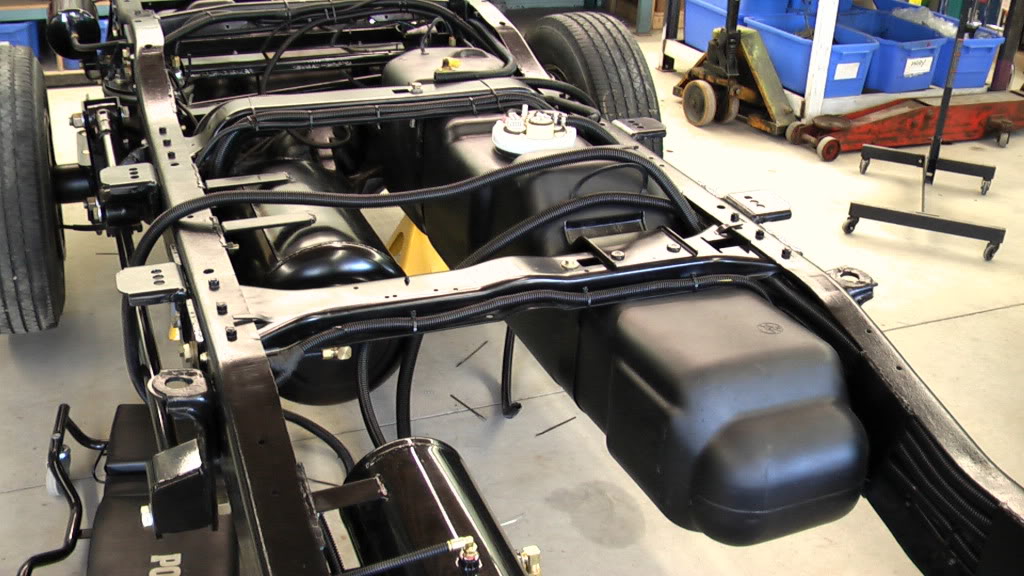
Also, do be mindful our frames are high carbon steel and do NOT like to be welded on. The carbon gets weaker after being exposed to a weld so do keep that in mind.
On the W350 long box I did not want the tq from the compounds to twist my frame, nor did I want the weakest section (over the rear axle) to collapse so I did a sectional box. Example:
Your pre weld shot:


If you look closely on the inner top edge of the frame rail you will see the weld marks from the 6" wide plates that went in every 16" or so. Hard to see but I did not want them THAT visible.

Also, do be mindful our frames are high carbon steel and do NOT like to be welded on. The carbon gets weaker after being exposed to a weld so do keep that in mind.

Registered User
Joined: Apr 2002
Posts: 1,602
Likes: 93
From: Richmond, VA
I apologize in advance for the terse nature of this post. However, there are a few ideas in this thread that are incorrect, so I would like to caution people before they take them as gospel.
First of all, imagine a "C" channel standing up between two supports, with a weight sitting on it in the middle. The weight that can be supported is most affected by the height of the channel, and the strength of the flanges. In this scenario, boxing the channel increases its strength very little, but increases its weight quite a lot. This is why the "wide flange" I - beam is widely used, the proportion of the flanges & web are optimized to support a vertical load.
Boxing the frame increases its resistance to twist, and its resistance to sideways deflection. Stiffening the frame this way, in general, improves handling. Resistance to twist, however, on uneven terrain, reduces traction and can cause damaging load concentrations unless other suspension components can compensate.
The frames on 1st gen trucks are made from mild, not high carbon steel. Welding, properly done, is an acceptable repair technique for first gen frame members.
In general, welding is not an acceptable way to attach brackets, etc. to the frame, or to attach frame components to each other. Regardless of how good the weld is or the welder's technique, welds create an area where there is a sudden change in the properties of the material. Unless the attachment point is carefully designed, the welds can lead to cracking and subsequent failure, as part of the assembly can flex at one rate, while the welded area flexes at a different rate.
The frames were originally assembled with riveted assemblies because they are much less likely to fail, and much safer if they do fail, than welded assemblies. If you look at more modern welded frame assemblies, you will see that the shapes of the welded assemblies at the connection points are quite different from the shapes of riveted or bolted assemblies.
That said, have fun & mod away!
First of all, imagine a "C" channel standing up between two supports, with a weight sitting on it in the middle. The weight that can be supported is most affected by the height of the channel, and the strength of the flanges. In this scenario, boxing the channel increases its strength very little, but increases its weight quite a lot. This is why the "wide flange" I - beam is widely used, the proportion of the flanges & web are optimized to support a vertical load.
Boxing the frame increases its resistance to twist, and its resistance to sideways deflection. Stiffening the frame this way, in general, improves handling. Resistance to twist, however, on uneven terrain, reduces traction and can cause damaging load concentrations unless other suspension components can compensate.
The frames on 1st gen trucks are made from mild, not high carbon steel. Welding, properly done, is an acceptable repair technique for first gen frame members.
In general, welding is not an acceptable way to attach brackets, etc. to the frame, or to attach frame components to each other. Regardless of how good the weld is or the welder's technique, welds create an area where there is a sudden change in the properties of the material. Unless the attachment point is carefully designed, the welds can lead to cracking and subsequent failure, as part of the assembly can flex at one rate, while the welded area flexes at a different rate.
The frames were originally assembled with riveted assemblies because they are much less likely to fail, and much safer if they do fail, than welded assemblies. If you look at more modern welded frame assemblies, you will see that the shapes of the welded assemblies at the connection points are quite different from the shapes of riveted or bolted assemblies.
That said, have fun & mod away!

Registered User
Joined: Jan 2013
Posts: 138
Likes: 10
I apologize in advance for the terse nature of this post. However, there are a few ideas in this thread that are incorrect, so I would like to caution people before they take them as gospel.
First of all, imagine a "C" channel standing up between two supports, with a weight sitting on it in the middle. The weight that can be supported is most affected by the height of the channel, and the strength of the flanges. In this scenario, boxing the channel increases its strength very little, but increases its weight quite a lot. This is why the "wide flange" I - beam is widely used, the proportion of the flanges & web are optimized to support a vertical load.
Boxing the frame increases its resistance to twist, and its resistance to sideways deflection. Stiffening the frame this way, in general, improves handling. Resistance to twist, however, on uneven terrain, reduces traction and can cause damaging load concentrations unless other suspension components can compensate.
The frames on 1st gen trucks are made from mild, not high carbon steel. Welding, properly done, is an acceptable repair technique for first gen frame members.
In general, welding is not an acceptable way to attach brackets, etc. to the frame, or to attach frame components to each other. Regardless of how good the weld is or the welder's technique, welds create an area where there is a sudden change in the properties of the material. Unless the attachment point is carefully designed, the welds can lead to cracking and subsequent failure, as part of the assembly can flex at one rate, while the welded area flexes at a different rate.
The frames were originally assembled with riveted assemblies because they are much less likely to fail, and much safer if they do fail, than welded assemblies. If you look at more modern welded frame assemblies, you will see that the shapes of the welded assemblies at the connection points are quite different from the shapes of riveted or bolted assemblies.
That said, have fun & mod away!
First of all, imagine a "C" channel standing up between two supports, with a weight sitting on it in the middle. The weight that can be supported is most affected by the height of the channel, and the strength of the flanges. In this scenario, boxing the channel increases its strength very little, but increases its weight quite a lot. This is why the "wide flange" I - beam is widely used, the proportion of the flanges & web are optimized to support a vertical load.
Boxing the frame increases its resistance to twist, and its resistance to sideways deflection. Stiffening the frame this way, in general, improves handling. Resistance to twist, however, on uneven terrain, reduces traction and can cause damaging load concentrations unless other suspension components can compensate.
The frames on 1st gen trucks are made from mild, not high carbon steel. Welding, properly done, is an acceptable repair technique for first gen frame members.
In general, welding is not an acceptable way to attach brackets, etc. to the frame, or to attach frame components to each other. Regardless of how good the weld is or the welder's technique, welds create an area where there is a sudden change in the properties of the material. Unless the attachment point is carefully designed, the welds can lead to cracking and subsequent failure, as part of the assembly can flex at one rate, while the welded area flexes at a different rate.
The frames were originally assembled with riveted assemblies because they are much less likely to fail, and much safer if they do fail, than welded assemblies. If you look at more modern welded frame assemblies, you will see that the shapes of the welded assemblies at the connection points are quite different from the shapes of riveted or bolted assemblies.
That said, have fun & mod away!
 So far, it seems like we have narrowed down some of the weak points of our frames as well as some weak points of boxing. This is a great thread!
Registered User
Joined: Dec 2008
Posts: 45
Likes: 0
I apologize for incorrect information. I was told they were high carbon by one of the retired Dodge gen 1 engineers during one of our technical sessions. As I am not a metallurgist, and due to his background, I went with what he said.
Sorry for incorrect information.


Registered User
Joined: Mar 2006
Posts: 35
Likes: 0
According the Factory Service Manuals the frames are made of carbon steel.
In looking at 3 different FSM's in the frame section (1988, 1990 and a 1992) they all state under Frame Side Rail Material: "Carbon steel with a minimum yield strength of 32,000 psi is used to fabricate the light and the medium duty truck frame side rails."
In looking at 3 different FSM's in the frame section (1988, 1990 and a 1992) they all state under Frame Side Rail Material: "Carbon steel with a minimum yield strength of 32,000 psi is used to fabricate the light and the medium duty truck frame side rails."
Registered User
Joined: Sep 2004
Posts: 4,053
Likes: 135
From: Tijeras, New Mexico, 7,000ft up
I got Barbecue'd for suggesting that boxing your frame on a working truck eliminates the flex you need to keep from shock breaking driveline parts, but I stand by that.
Where chassis flex is bad, drag racing! Got to meet Herb McCandless (Mr. 4-speed) and have dinner with him and his wife, and he said when they stiffened the frame on his Pro-Stock Hemi car (back when pro-stock was still stock) they picked up several 10th's, even with the added weight.
Box the frame on a Semi truck though and you will twist a driveshaft as soon as you take off loaded.
Where chassis flex is bad, drag racing! Got to meet Herb McCandless (Mr. 4-speed) and have dinner with him and his wife, and he said when they stiffened the frame on his Pro-Stock Hemi car (back when pro-stock was still stock) they picked up several 10th's, even with the added weight.
Box the frame on a Semi truck though and you will twist a driveshaft as soon as you take off loaded.
Registered User
Joined: Jan 2013
Posts: 138
Likes: 10
Sorry if you took it the wrong way. My reply wasn't meant to be harsh. I was just stating my observations of vehicle engineering advancements. I always have been under the impression that other components were used to cushion driveline shock. Mounts, u joints, slip joints, etc. And our trucks aren't exactly semis.  Those things twist like a pretzel anyways. I would think that has to do with the weight and the extremely low gearing required to move that weight multiplying the torque from the engine. Now, I'm curious to see about our frame make up. We know it is carbon steel, but need to find out the carbon content for sure
Those things twist like a pretzel anyways. I would think that has to do with the weight and the extremely low gearing required to move that weight multiplying the torque from the engine. Now, I'm curious to see about our frame make up. We know it is carbon steel, but need to find out the carbon content for sure

Registered User
Joined: Apr 2008
Posts: 857
Likes: 6
From: Palmyra, Nebraska
Then how come the newer diesel Cummins reside in fully boxed frame? They have way more torque from the factory than ours did. Still not selling me on the 'frame is supposed to flex' idea. The driveline has u joints. The axles have springs. Isn't flexing and movement their job? Wouldn't a drag truck run more risk of twisting something out of shape than an everyday diesel? Look up the chevy frame vs ford frame on youtube. There's also a Dodge owner that has posted a vid of his truck. If flex was a good thing, why are auto companies eliminating it? Not everyone needs a boxed frame. A 2wheel drive that does light hauling is probably never gonna see much fame flex. It really depends on what you're gonna haul and your preferences.
One critical place that is NOT boxed is in the area near the transmission and that is EXACTLY where I have seen many, many of them cracked out and rusted through.
Speaking of rust, that's what the "miracle" of boxing a frame can do, it traps dirt and moisture, because even where it's not boxed on a 2nd/3rd gen, there is still a slight lip that traps dirt.
So now, not only is there a point that creates high stress due to boxing, you also have lip with a debris trap that won't "self clean", which makes the frames rot out in short order in the salt belt.
Mark.

Thread
Thread Starter
Forum
Replies
Last Post
roxxx
1st Gen. Ram - All Topics
41
Nov 19, 2021 03:07 PM
gts95
3rd Generation Ram - Non Drivetrain - All Years
1
Aug 27, 2007 10:13 AM
95black2615
2nd Gen. Dodge Ram - No Drivetrain
10
Dec 20, 2006 06:37 PM
ptgarcia
3rd Generation Ram - Non Drivetrain - All Years
2
Sep 12, 2006 06:04 PM