


hazards bad/ turn signals good


Thread Starter
Registered User


Joined: Nov 2010
Posts: 691
Likes: 102
From: Winterset, IA
hazards bad/ turn signals good
Like the title says, I have turn signals but no hazards since I have owned this truck. However, when I have a turnsignal on and turn my hazards on the turn signal will turn off. I am out of ideas. I have replaced the mufti-function switch (ts/ wipers, etc switch), checked the fuses, switched both relays around, and now I am down the the wiring diagram in the FSM (AD56).
I have tested continuity start to finish from fuse9 to L6 to switch, fuse13 to L19 to switch, L50 to RWAL module(ABS), L50 to the male connector of brake switch (not sure how to test switch), and L60 to guage cluster harness. Testing to the lights doesnt make sense to me since the turn signals work.
My only ideas are that I have one goofed up relay or my brake switch is faulty. Any ideas? Me and wires dont get along.
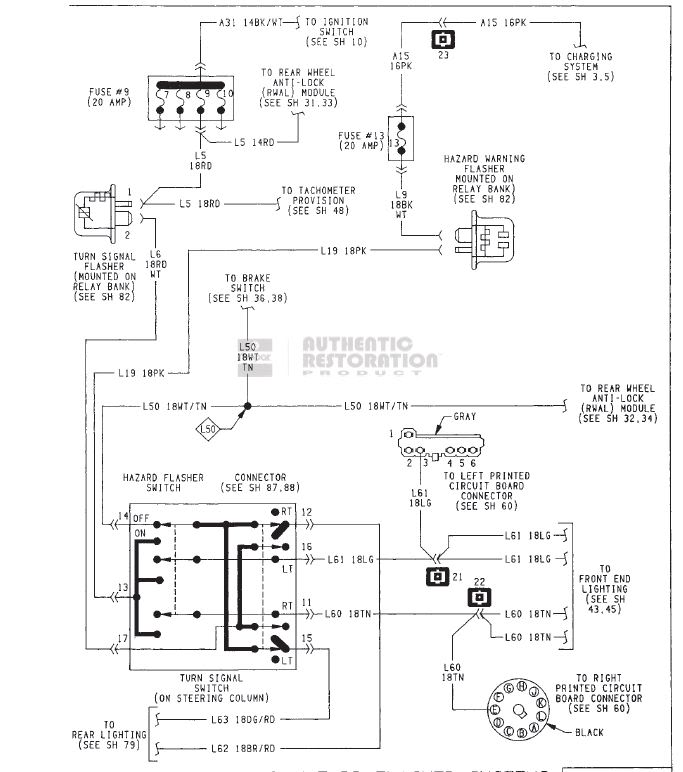
I have tested continuity start to finish from fuse9 to L6 to switch, fuse13 to L19 to switch, L50 to RWAL module(ABS), L50 to the male connector of brake switch (not sure how to test switch), and L60 to guage cluster harness. Testing to the lights doesnt make sense to me since the turn signals work.
My only ideas are that I have one goofed up relay or my brake switch is faulty. Any ideas? Me and wires dont get along.


Trending Topics

Administrator

Joined: Nov 2004
Posts: 4,084
Likes: 235
From: Southern California
2 Blade Relays?
I think you are refering to your flashers.
A note about flashers, cheaper flashers are thermal and resistance makes them heat up to flash, (more trailer lights the faster they flash) better flashers use either a L/C or R/C circuit or integrated circuit to give a constant speed regardless of load, this is the one you want to use unless you are running LED's then you need another flasher.
BTW
L/C = Inductor / Capacitor
R/C = Resistor / Capacitor
Aah electronic therory again...
Good flashers can cost from $10.00 to $100.00
I have an electromechanical unit jumpered to my fuse block, the kind used in class-8 tractor trailers.
Swap out a good known flasher in your hazards and see what happens.
Also Interesting that the schematic shows the Turn Signal and Hazard flasher as two diffrent schemes, one series and the other parallel.
Jim
I think you are refering to your flashers.
A note about flashers, cheaper flashers are thermal and resistance makes them heat up to flash, (more trailer lights the faster they flash) better flashers use either a L/C or R/C circuit or integrated circuit to give a constant speed regardless of load, this is the one you want to use unless you are running LED's then you need another flasher.
BTW
L/C = Inductor / Capacitor
R/C = Resistor / Capacitor
Aah electronic therory again...
Good flashers can cost from $10.00 to $100.00
I have an electromechanical unit jumpered to my fuse block, the kind used in class-8 tractor trailers.
Swap out a good known flasher in your hazards and see what happens.
Also Interesting that the schematic shows the Turn Signal and Hazard flasher as two diffrent schemes, one series and the other parallel.
Jim
Administrator
Joined: Nov 2004
Posts: 4,084
Likes: 235
From: Southern California

I use my hazards almost everyday to flash all of my LED's when I have to park in parking complexes at work, I also leave my parking lights on when I leave my truck, makes it easier to notice.
Jim
Thread Starter
Registered User
Joined: Nov 2010
Posts: 691
Likes: 102
From: Winterset, IA
This was the very first thing I had tried actually, an no go. Based on Reapertura experience I wonder if one is faulty and looking at each relay one is original to the truck and one is a replacement. Additionally, I am wondering if the relays work as a pair, unless someone can confirm this...
To reiterate... each one works as a turn signal relay but neither work as a haz. It does not matter if a relay is in each socket simultaneously or if only one relay is in the panel.
This is why I have been stumped for a year.
Thread Starter
Registered User
Joined: Nov 2010
Posts: 691
Likes: 102
From: Winterset, IA
This is what I have found
http://www.oreillyauto.com/site/c/de...1546&ppt=C0117
The EL12 from Tridon is an electromechanical turn signal flasher that operates at 12V and features 2 terminals. This type of turn signal flasher uses electromagnetism to operate. It was developed to directly replace corresponding 2 terminal thermal turn signal flashers (536, 552, 577). This flasher has a design life up to 400 hours.
Product Features:
Designed To Outlast Thermal Flashers
Trailering Capable
Capable Of Handling Up To 10 Lamps
Product Application(s):
1993 Dodge W250
Hazard Warning; Electro-Mechanical Flasher
Turn Signal; Electro-Mechanical Flasher
http://www.oreillyauto.com/site/c/de...1546&ppt=C0117
The EL12 from Tridon is an electromechanical turn signal flasher that operates at 12V and features 2 terminals. This type of turn signal flasher uses electromagnetism to operate. It was developed to directly replace corresponding 2 terminal thermal turn signal flashers (536, 552, 577). This flasher has a design life up to 400 hours.
Product Features:
Designed To Outlast Thermal Flashers
Trailering Capable
Capable Of Handling Up To 10 Lamps
Product Application(s):
1993 Dodge W250
Hazard Warning; Electro-Mechanical Flasher
Turn Signal; Electro-Mechanical Flasher

Registered User
Joined: Nov 2011
Posts: 4,479
Likes: 211
From: Isanti, MN
Crimps fail
Connectors back out of the housing
Wires break when flexed
Mice have their way
Somewhere, something's broken.
Wire a couple of faston male blade connectors to a lamp socket (168 for instance) and plug them in where the hazard flasher goes. Turn on the hazard switch, then probe by grounding the expected circuit path through the wires, switches, and lamp wiring. When you ground a point the light should turn on. You can't hurt anything.
Connectors back out of the housing
Wires break when flexed
Mice have their way
Somewhere, something's broken.
Wire a couple of faston male blade connectors to a lamp socket (168 for instance) and plug them in where the hazard flasher goes. Turn on the hazard switch, then probe by grounding the expected circuit path through the wires, switches, and lamp wiring. When you ground a point the light should turn on. You can't hurt anything.
Thread Starter
Registered User
Joined: Nov 2010
Posts: 691
Likes: 102
From: Winterset, IA
Crimps fail
Connectors back out of the housing
Wires break when flexed
Mice have their way
Somewhere, something's broken.
Wire a couple of faston male blade connectors to a lamp socket (168 for instance) and plug them in where the hazard flasher goes. Turn on the hazard switch, then probe by grounding the expected circuit path through the wires, switches, and lamp wiring. When you ground a point the light should turn on. You can't hurt anything.
Connectors back out of the housing
Wires break when flexed
Mice have their way
Somewhere, something's broken.
Wire a couple of faston male blade connectors to a lamp socket (168 for instance) and plug them in where the hazard flasher goes. Turn on the hazard switch, then probe by grounding the expected circuit path through the wires, switches, and lamp wiring. When you ground a point the light should turn on. You can't hurt anything.
Interesting idea, I am in town so I will stop at orilleys and try 2 new relays in the parking lot. If they fix the problem i will buy new ones. If they dont I will try your test.